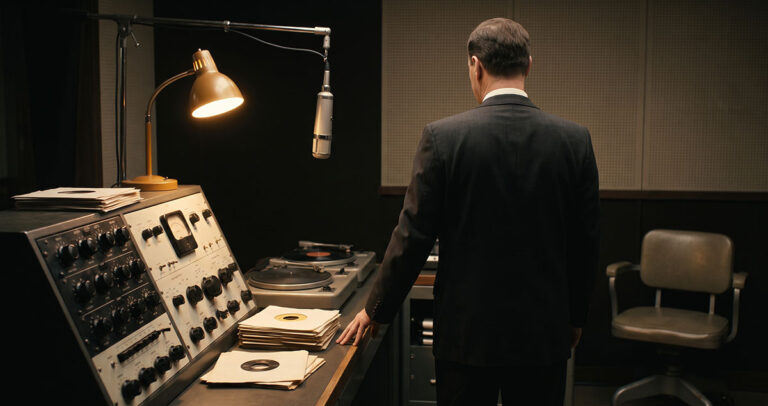
Episode 3: The Workshop and the Cartel (1948–1958)
This is Episode 3 of Vin Amorando’s History of Rock documentary series, The Workshop and the Cartel (1948–1958), examining how independent labels gained enough technological and commercial freedom to build an early rock and roll market outside the major-label system. Leo Fender’s practical solid-body instruments, magnetic tape brought into American broadcasting through Jack Mullin, Bing Crosby, and Ampex, and Les Paul’s recording experiments lowered barriers to performing and recording. Regional distribution, jukeboxes, and local radio gave smaller companies a route to listeners. The freedom was real, but national distribution, capital, and broadcast access remained concentrated. RCA Victor’s acquisition of Elvis Presley’s Sun contract exposed that weakness, and the payola investigations that followed further altered the infrastructure through which independent music reached a national audience. The technology kept advancing. The decisive change was the movement of leverage toward institutions capable of acquiring successful artists and controlling scale.
The collision at Sun Studio in July 1954 had been years in the making. Elvis Presley and Scotty Moore may have supplied the moment that Episode 2 left behind, but the conditions that allowed such a record to exist had been assembled elsewhere: in California workshops, radio control rooms, small recording studios, jukebox routes, neighborhood shops, and the offices of independent record companies that operated far below the scale of Columbia, RCA Victor, or Decca. Rock and roll needed musical ingredients, but it also needed a cheaper physical system for turning those ingredients into something people could hear and buy.
During the decade surrounding that Sun session, several barriers fell almost at once. Working musicians gained louder and more practical instruments. Magnetic tape made sound editable. Independent labels found regional methods of distribution that allowed them to reach audiences the major companies had neglected. The resulting system gave outsiders an extraordinary amount of creative room, but its freedom had a boundary that wouldn’t become obvious until the records became too successful to remain regional.
The Workshop in California
Leo Fender approached the problems of working musicians as a repairman rather than a romantic. In postwar Southern California, durability, volume, maintenance, and portability mattered more to him than preserving the traditions of instrument making. The Broadcaster, commercially introduced in 1950 and later renamed the Telecaster, embodied that logic. A solid body resisted the feedback problems associated with amplified hollow instruments, while a removable maple neck made major repairs unusually practical.
That practicality mattered because the economics of live music were changing. A large dance orchestra could fill a room acoustically, but fifteen or twenty musicians also meant fifteen or twenty wages, transportation requirements, scheduling problems, and a substantial operating cost. Smaller groups cost less to maintain, yet they had traditionally surrendered something important in return: physical volume.
The Precision Bass, introduced commercially in 1951, attacked that problem from the rhythm section. An upright bass was large and comparatively difficult to amplify beside drums and electric guitar. Fender’s electric bass was portable, amplified, and fretted, giving guitarists a familiar way to approach bass intonation while allowing the instrument to function comfortably inside a louder small ensemble. Fender’s own history places the first commercial Precision Bass in October 1951. (Fender)
The consequence wasn’t simply a new guitar and a new bass. Four musicians could now operate with a physical force that had previously demanded a much larger organization. Fewer musicians meant fewer wages and a smaller touring operation. Fender’s contribution therefore reached beneath style and into economics.
Fender didn’t democratize music. He democratized the economics of volume.
Rock culture would eventually turn the electric guitar into a symbol of individual rebellion, but one of the instrument’s foundational victories was almost stubbornly practical. The small amplified band had become cheaper to maintain, easier to move, easier to repair, and loud enough to compete for the same rooms once dominated by much larger ensembles. The revolution began on the workbench.
Sound Becomes Editable

Jack Mullin returned from postwar Europe with German magnetic recording equipment and demonstrated what tape could do in the United States. The implications reached beyond improved fidelity. Disc recording had bound performers to a largely irreversible process, while tape turned recorded sound into something that could be cut, copied, rearranged, and replayed. A performance no longer had to remain identical to the moment in which it occurred.
Bing Crosby encountered the technology through a more immediate problem. Radio demanded performances organized around broadcast schedules and time zones, and high-quality prerecorded programming offered him a way out. His support of Ampex helped accelerate the commercial adoption of magnetic tape in American broadcasting. What solved a scheduling problem for a major entertainer also helped establish an entirely new recording infrastructure.
Les Paul pushed that infrastructure toward composition. His experiments with layering preceded tape, but in 1949 he developed a tape-based sound-on-sound method that allowed new material to be recorded against an existing performance. A guitarist could accompany himself. Voices could accumulate. The record heard by the listener no longer had to represent a group of musicians performing together at one moment.
The studio was beginning to behave like an instrument.
That shift altered more than aesthetics. Editing and overdubbing reduced the tyranny of the single perfect take and allowed a smaller number of people to construct increasingly complex recordings. The studio was moving away from its older role as a room that documented performances and toward a place where performances could be built.
The consequences would eventually transform popular music. In the early 1950s, the crucial fact was simpler: another expensive barrier had weakened. A small operation could accomplish more with less.
The Independent Window

Columbia, RCA Victor, and Decca possessed the machinery of national scale. Their businesses depended on established artists, manufacturing capacity, distribution relationships, promotion, and access to the organized infrastructure of American entertainment. That strength also encouraged a particular kind of blindness. Regional rhythm and blues, Southern gospel, country music, and records serving Black audiences or culturally specific local markets could look too fragmented for a national corporation organized around scale.
Independent labels moved into the space that remained. Chess Records in Chicago, King Records in Cincinnati, Atlantic in New York, and Sun in Memphis didn’t need every American listener to want the same record at the same time. They could work locally, pressing smaller quantities and relying on relationships that national companies considered marginal.
Records moved through wholesalers and independent retailers, but also through grocery stores, barbershops, automobile trunks, and jukebox routes. The improvised quality of that system can make it seem quaint in retrospect. It wasn’t. Those channels were infrastructure.
The neighborhood jukebox was especially useful because it placed a record directly inside the social world of its likely audience. Repeated plays created familiarity. Familiarity created demand. A local label could build a commercially meaningful record without obtaining national approval first.
That was the independent window: a period in which practical instruments, increasingly flexible recording technology, small-scale manufacturing, regional distribution, and local relationships overlapped just enough to let companies operate beyond the traditional major-label system.
The freedom still belonged to commerce. Chess, King, Atlantic, and Sun needed records to sell. Their advantage came from scale and proximity. They could hear markets forming because they were close enough to the people forming them.
Payola and the Rented Airwave

Radio exposed the limit of that independence. A label could record an artist, press a single, distribute copies through local shops, and place the record into jukeboxes. None of those achievements created a national broadcasting network.
A radio station had a finite number of records it could play. Major labels entered that competition with national advertising budgets and long commercial relationships. Smaller companies faced a more immediate question: how could an unknown label persuade a disc jockey to spend scarce airtime on an unknown performer?
Payola became one answer. Smaller operators paid disc jockeys for airplay because the disc jockey controlled access they couldn’t manufacture themselves. The arrangement was ethically compromised and commercially useful at the same time. It placed undisclosed money inside programming decisions, but it also gave undercapitalized labels a direct route into a system where better-financed companies possessed other ways of purchasing influence.
That ambiguity matters. Treating payola merely as corruption makes the existing commercial structure of broadcasting disappear. Radio was already a business. The independents used a direct and highly visible form of influence because they lacked many of the institutional forms available to their competitors.
Their problem had become clear. They had widened the creation of music without building an equivalent system for distributing attention. Every record that required radio exposure still depended on somebody else’s infrastructure.
They were renting access to the ear they were trying to reach.
Technology had decentralized production faster than business had decentralized access. Regional success could conceal the difference. A national hit could not.
Sun Studio and the Limits of Independence
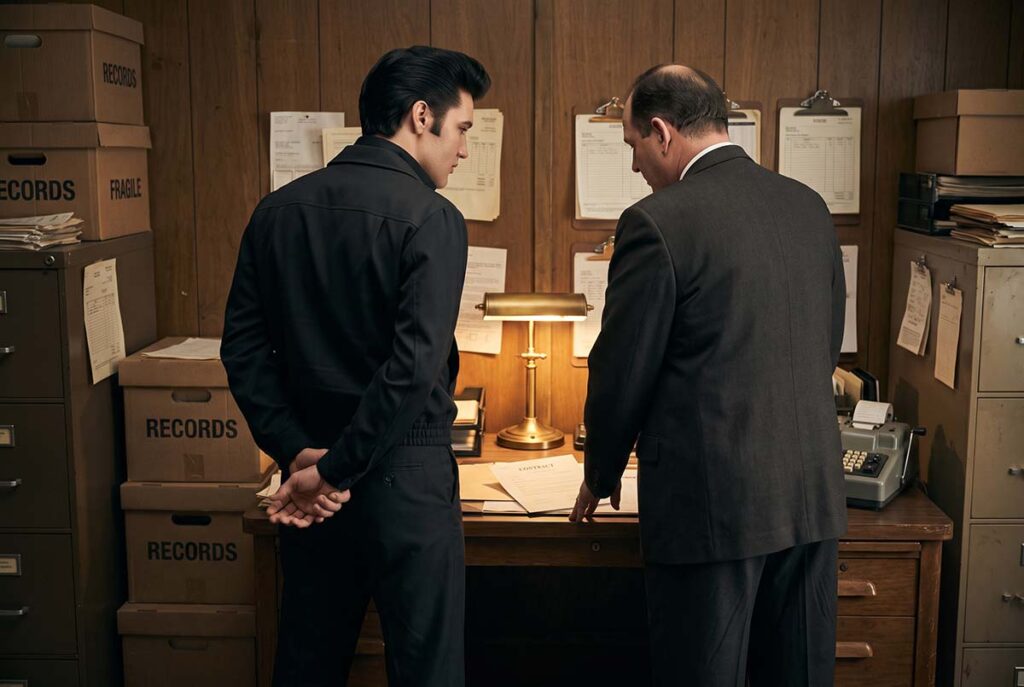
Sam Phillips built Sun inside the independent opening. He recorded music that larger companies had routinely undervalued and developed a studio culture in which regional traditions could collide without first being filtered through national categories. When Elvis Presley entered that environment in July 1954, the musical result became the climax of Episode 2. The commercial consequences belong here.
Success created costs before it created cash. Records had to be manufactured in anticipation of sales. Distribution could involve long delays before payments returned to the label. Promotion required new spending. A company experiencing rapid demand could therefore find itself owing money faster than revenue arrived.
A hit could endanger the company that made it.
Presley’s rising success forced Sun into that contradiction. The label could discover him, record him, establish a regional audience, and prove commercial demand. Sustaining the next stage required a different order of capital, along with national manufacturing, promotion, television exposure, and distribution.
Colonel Tom Parker understood that scale. In 1955, RCA Victor purchased Presley’s Sun contract, moving the emerging star from the independent company that had demonstrated his value into one of the largest entertainment systems in the country. The transaction gave Sun badly needed capital while exposing a structural difference that romantic histories of independence tend to blur.
Sun Records hadn’t lacked imagination. It lacked the infrastructure required to finance what its imagination had discovered.
The important part of the transaction isn’t that a major label outsmarted a small one. RCA didn’t need to discover Presley first. Sun had already accepted that uncertainty. Once the market had been demonstrated, a larger institution could purchase the successful asset with far less cultural risk.
Presley’s discovery validated the independent system. His transfer revealed where that system’s leverage ended.
The Payola Hearings as Weapon

By the end of the 1950s, independent labels couldn’t be dismissed as eccentric regional businesses. They had proved that neglected audiences could become major markets and that music developed outside the old national system could reorder youth culture.
The payola investigations that followed addressed a genuine problem. Undisclosed payments were influencing programming decisions, and critics had legitimate reasons to object. Turning the entire federal response into a coordinated plot by the major labels would go beyond what the documentary record can firmly support. The more defensible finding concerns the result: radio gatekeeping changed.
Independent labels had benefited from a decentralized relationship with individual disc jockeys. Restricting those arrangements and moving programming authority upward inside station organizations altered the geography of access. A small operator could negotiate with a local personality. An institutional programming structure was harder to approach through the same improvised relationships.
The distinction matters because regulation can be justified and still redistribute power. The reform impulse surrounding payola didn’t need to be invented for the new system to favor organizations already comfortable with formalized institutional channels.
What disappeared wasn’t the electric guitar or the tape machine. Nobody needed to reverse the technical revolution. The pressure could be applied farther downstream, where recordings competed for national attention.
Creation remained loose enough for outsiders to participate. Access was becoming easier to supervise.
The Studio Keeps Moving

Ampex delivered Les Paul a custom eight-track recorder in 1957 using selective synchronization, commonly shortened to Sel-Sync. The system allowed previously recorded tracks to be monitored accurately while new material was added, reducing the timing problems that complicated earlier overdubbing methods. The machine remained exceptional rather than an instant industry standard, but it demonstrated what multitrack recording could become. The Les Paul Foundation likewise identifies Sel-Sync with his development of the eight-track system. (Les Paul –)
A single performer could now construct an apparent ensemble over time. Parts could be recorded separately, aligned, reconsidered, replaced, and combined into a performance that had never existed simultaneously in one room.
The studio’s expanding power complicates any simple story of institutional victory. No corporation succeeded in putting magnetic tape back into the box. Nobody could restore the requirement that records document uninterrupted live performances. The technological opening survived the commercial one.
That survival matters because technology and power weren’t moving in the same direction. Recording continued to become more flexible and accessible. The organizations capable of taking a successful recording to a national market still possessed advantages that the machine itself couldn’t erase.
The studio had become an instrument in its own right. The question was who could reliably turn what came out of it into scale.
Verdict
Between 1948 and the end of the 1950s, working musicians and small operators gained tools that permanently expanded what they could make. Fender helped make the loud small group economically practical. Tape made recorded sound editable. Les Paul’s experiments showed that a record could be constructed layer by layer. Independent labels developed markets around audiences and music the national companies had failed to value.
Those achievements don’t become less important because the surrounding business remained unequal. The distinction lies elsewhere.
Making music and getting music heard are separate economic activities. A musician can acquire better tools. A small label can record an artist and prove local demand. National success introduces manufacturing, capital, distribution, promotion, broadcasting access, and the ability to spend money long before all of it comes back.
Sun met that distinction when Elvis Presley became too large for the system that had discovered him. Independent labels met it every time they needed radio. The payola confrontation exposed it again when access moved toward more formal institutional control.
The guitar remained. The tape remained. The studio kept getting more powerful.
What changed was the location of leverage.
Once independent operators proved the market, larger institutions didn’t need to invent the culture. They could acquire successful artists, distribute them nationally, and operate through infrastructure built for scale. The technologies widened participation permanently, but cheaper creative tools hadn’t produced a cheaper national distribution system.
Tools can change who makes the music. Infrastructure decides who profits from it.
Episode 4, The Empire Strikes Back, follows the next stage of that process, when the institutional reaction moves to the center of the story and rock and roll’s first opening begins to narrow. The revolution had demonstrated what could escape the old system. The next question was what the old system would do after it learned the value of what had escaped.
Frequently Asked Questions
What did this era actually establish about how early rock and roll became commercially viable?
Between 1948 and the end of the 1950s, instrument design, magnetic tape, independent distribution, jukeboxes, and local radio reduced the amount of institutional permission needed to make and sell records. The achievement was real, but the system remained vulnerable because national distribution, capital, and broadcast access were still concentrated.
Why were Leo Fender’s Broadcaster and Precision Bass important to early rock and roll?
Leo Fender approached instruments as practical engineering. The Broadcaster made a durable, repairable solid-body guitar commercially available, while the 1951 Precision Bass gave small groups a portable amplified bass with familiar fretted intonation. Together, they helped make loud, economically viable small-band instrumentation far more practical for working musicians.
What did Jack Mullin, Bing Crosby, and Ampex contribute to magnetic tape recording?
Jack Mullin brought German magnetic recording technology into postwar American broadcasting. Bing Crosby recognized its practical value and backed Ampex, helping accelerate commercial adoption. Tape allowed sound to be edited, copied, and rearranged rather than permanently fixed in one live performance, providing the technical foundation for a different kind of studio.
What did Les Paul mean by sound-on-sound recording, and what was Sel-Sync?
Les Paul’s 1949 tape-based sound-on-sound method let him layer a new part against material already recorded. In 1957, Ampex delivered him an eight-track machine using Sel-Sync, or selective synchronization, which allowed existing tracks to be monitored accurately while new ones were recorded. Multitrack construction became increasingly precise and flexible.
Why did independent labels use payola?
Independent labels such as Chess, King, Atlantic, and Sun could record and distribute music through regional networks, but national radio remained a bottleneck. Paying disc jockeys for airplay gave smaller companies direct access to listeners they couldn’t reach through major-label advertising systems. The practice also exposed how decentralized creation still depended on scarce media access.
Why did Sun Records sell Elvis Presley’s contract to RCA Victor?
Presley’s rapid regional success created manufacturing, promotion, and distribution demands that were difficult for a small label to finance. Colonel Tom Parker recognized the scale problem, and RCA Victor purchased Presley’s contract in 1955. The transaction gave Sun essential capital while demonstrating that independent discovery and national control required very different financial capabilities.
What is the episode’s verdict about technology, independent labels, and corporate control?
The verdict is deliberately complex. Fender instruments, tape recording, and independent commercial networks genuinely widened participation and remained transformative. As the market grew, however, institutions with deeper capital, national distribution, and stronger control over broadcast access gained increasing power to acquire successful artists and determine which recordings achieved national scale.
What happens next in Episode 4, The Empire Strikes Back?
Episode 4 follows the institutional reaction into 1959 through 1961, including the payola confrontation, the weakening of independent disc-jockey authority, sanitized teen idols, and other pressures that narrowed rock and roll’s first commercial opening.