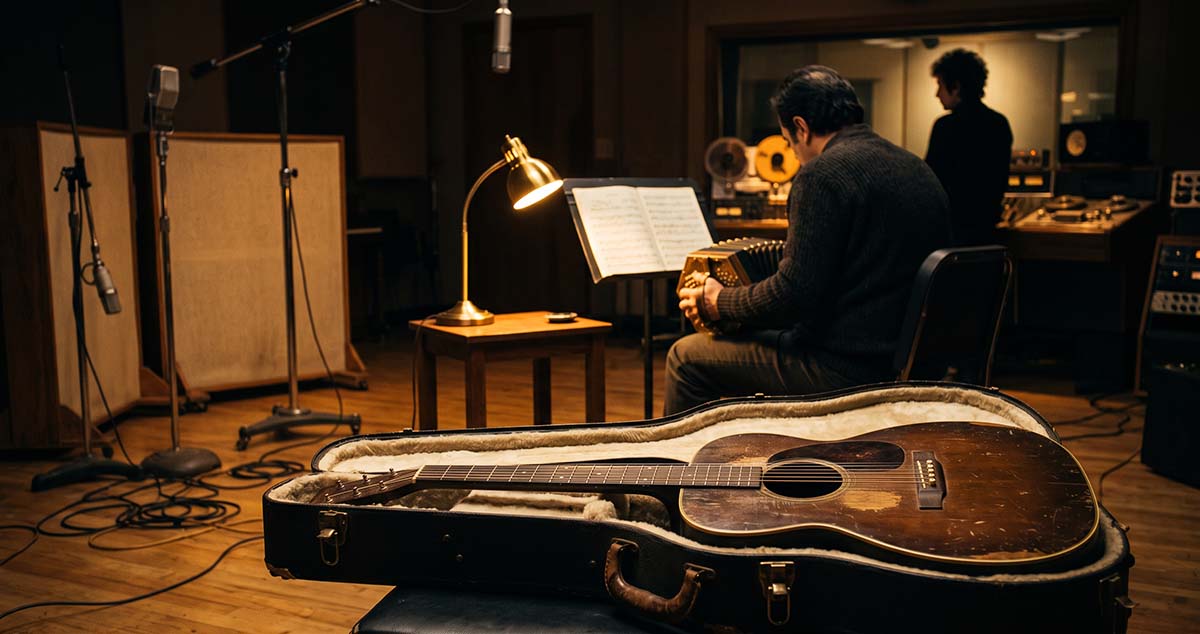
Simon & Garfunkel’s “The Boxer” Hid Fred Carter Jr’s Guitar in Plain Sight
Fred Carter Jr. created the defining guitar figure in “The Boxer” by answering Paul Simon’s foundational rhythm with a cascading backward roll on a short-scale Martin 000-18 during the November 16, 1968 Nashville session. Simon later spent a full day testing whether an Italian concertina player could reproduce Carter’s figure, rejected the substitute, and restored Carter’s original performance. Carter was paid and credited on the 1970 album, so the evidence does not support legal theft or deliberate concealment. The narrower verdict is cultural: formal attribution survived, but Carter’s authorship of the recording’s acoustic identity was absorbed into Paul Simon’s legend.
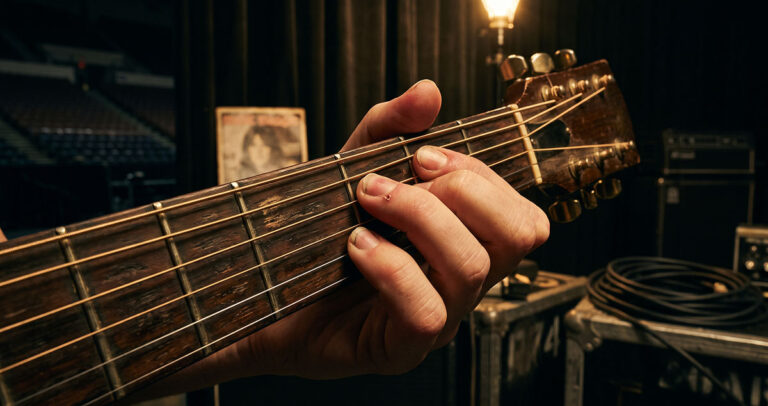
The strings were already near their physical limit when Fred Carter Jr. began to play. On November 16, 1968, Paul Simon sat inside Columbia’s Music Row Studios in Nashville with a Martin D-18 tuned to open C, fingerpicking the foundational rhythm of a new song. Across the room, Carter listened with a smaller Martin 000-18 resting against him, waiting for the space that Simon’s guitar had left open.
Carter had not been hired to duplicate the songwriter. Nashville session musicians operated in the territory between the written composition and the finished record, where register, texture, voicing, and physical touch could alter the identity of a song without changing a word of it. The best of them heard what a recording lacked before anyone had found the language to request it.
The 000-18 gave Carter a different range from Simon’s full-sized dreadnought. He raised the tuning into a bright, tense register that approached the character of a mandolin, placing unusual resistance beneath his fingers. Simon supplied the structure. Carter found the answer, and that answer became one of the most recognizable acoustic figures in American popular music.
Most listeners never learned the name of the man who found it.
The Solitary Myth
“The Boxer” entered public memory as an intimate expression of Paul Simon’s private endurance. Simon wrote the lyric during a period when he felt surrounded by criticism, and the wounded figure at the center of the song naturally became associated with him. The recording seemed to confirm that interpretation. Its opening sounded close, solitary, and self-contained, as though one man had sat with an acoustic guitar and transformed personal injury into an anthem.
Simon was the songwriter and the directing intelligence behind the sessions. Those facts remain intact. The mythology formed when authorship of the lyric expanded into an assumption about the entire physical recording, allowing the guitar texture, arrangement, and production to seem like natural extensions of the visible artist.
The record itself tells a more crowded story. Two guitarists occupied different registers in the Nashville tracking room. Carter answered Simon’s foundational rhythm with a higher counterpoint, while producer-engineer Roy Halee built an elaborate microphone system around the performance. Additional musicians, architectural spaces, overdubs, and unstable tape machines eventually contributed to an artifact that felt effortless because the labor behind it had been concealed so completely.
Celebrity provided the recording with a single face. The tape preserved an entire room.
The Acoustic Architecture
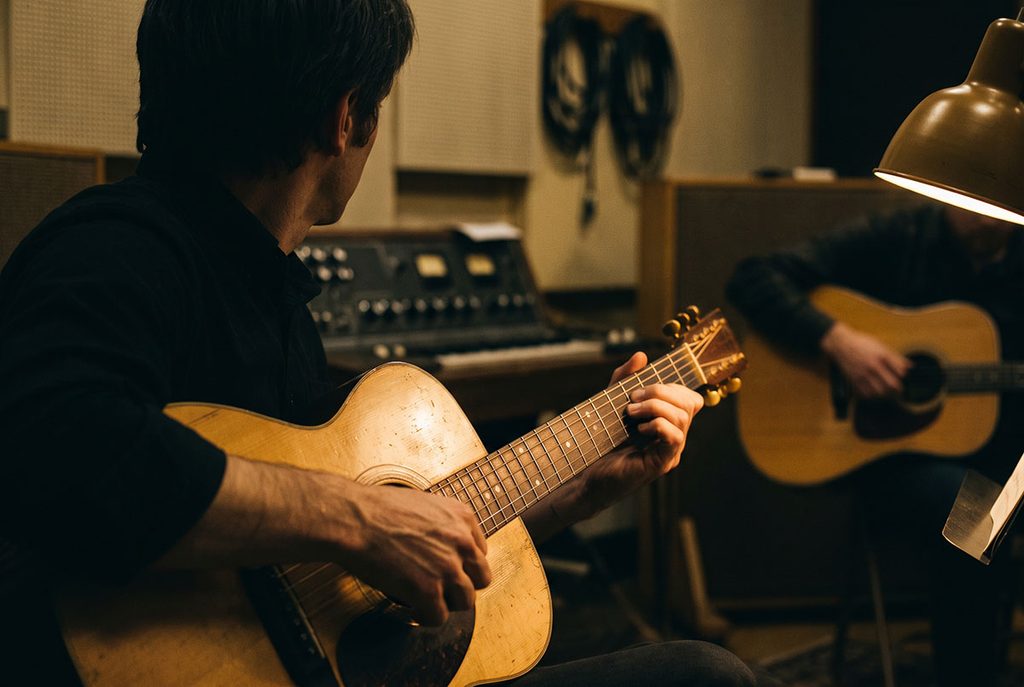
Carter listened to Simon’s chord progression and improvised a backward roll, a quick cascading figure that moved against the established rhythm instead of reinforcing it. The phrase emerged inside the session rather than arriving as a fully written part. Its shape depended on Carter’s touch, the raised tuning, the compact dimensions of the 000-18, and the musical space created by Simon’s dreadnought.
The figure became the sound through which the recording introduced itself. Its high register seemed to hover over the foundational guitar, creating the impression of one unusually complete acoustic performance. The illusion worked because the two parts interlocked so naturally that the listener had little reason to imagine separate players.
The acoustic identity of “The Boxer” was engineered in the room by a hired musician working on a specialized instrument under extreme string tension. That finding does not reduce Simon’s contribution. It reveals the collaborative mechanism through which his song acquired its recorded form.
Carter’s work continued beyond the introduction. According to his account, he contributed at least five guitar parts, including acoustic counterpoint, 12-string guitar, Fender Telecaster, and a fretted Dobro. The Dobro supplied the mournful metallic figure heard before the final verse, another defining texture that entered the song without announcing the person who produced it.
Session labor was designed to disappear into the result. Carter became something close to a one-man guitar section, yet the record never called attention to the accumulation of parts. The listener heard an inevitable arrangement rather than a room of specialists solving one problem after another.
The Breathing Microphone
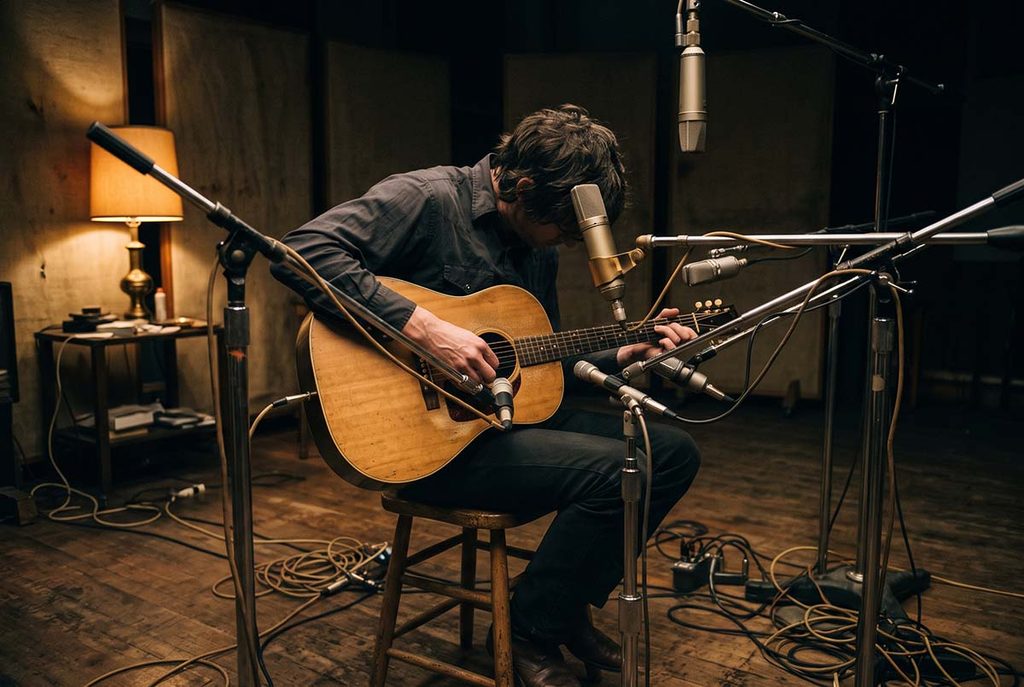
Roy Halee recorded Carter with the same obsessive attention that Carter brought to the guitar. Seven or eight microphones surrounded the player and the 000-18, capturing the finger attack, neck, soundhole, rear body, room ambience, and air above the instrument. One microphone was positioned at vocal level toward Carter’s face, even though he was not singing.
Halee was recording the body responsible for the performance.
The raised tuning made the strings harder to control, while the syncopated fingerpicking pattern demanded sustained precision at recording tempo. Carter’s breathing entered the microphone array and settled into the pulse of the guitar. The sound was an involuntary record of physical exertion, preserved alongside the notes his hands were producing.
An attempt was made to remove or mute the breathing. The recording lost part of its momentum when the sound disappeared, so Halee restored it and allowed it to remain as a faint organic layer within the rhythm. One of the most polished records of its era carries the respiration of a session musician inside its underlying pulse.
Carter’s name was absent from the standalone single released in March 1969 because the single did not contain the album’s personnel information. His body was already present. Every copy carried the sound of his lungs and hands into the world before most listeners had access to a printed credit explaining whose effort they were hearing.
A Hundred Hours of Tape
The Nashville session supplied the acoustic foundation, but “The Boxer” eventually consumed more than 100 hours of production across Nashville and New York. Its apparent intimacy emerged from a complicated industrial process involving specialized rooms, layered overdubs, architectural reverberation, mechanical synchronization, and repeated acts of technical judgment.
For the soaring vocal chorus, the production moved into St. Paul’s Chapel at Columbia University. Halee used the chapel’s physical dimensions as part of the signal chain, allowing the room to create the reverberation surrounding Simon and Art Garfunkel’s voices. Stone, air, and distance became active components of the recording.
At Columbia’s East 52nd Street studios, Hal Blaine was positioned in a hallway near an open elevator shaft. He struck a snare drum into the empty vertical space, allowing the architecture to enlarge the sound into the explosive report heard on the finished record. The building briefly became an instrument.
The arrangement eventually exceeded the practical capacity of a conventional eight-track setup. Halee ran two Ampex machines together to approximate a 16-track system, but the machines lacked digital synchronization. Their motors heated at different rates, and the recordings began to drift apart within seconds.
Halee assembled the mix in short sections. He stopped the machines, allowed the motors to cool, restarted them together, and mixed the next passage before the mechanical drift returned. The procedure repeated through the recording, sometimes across increments of only several bars.
The finished performance feels continuous because Halee managed its underlying instability with extraordinary patience. Tape tension, motor heat, room dimensions, human breath, guitar strings, and architectural reverberation all had to agree long enough to preserve the illusion of a unified event.
The Lick That Came Back
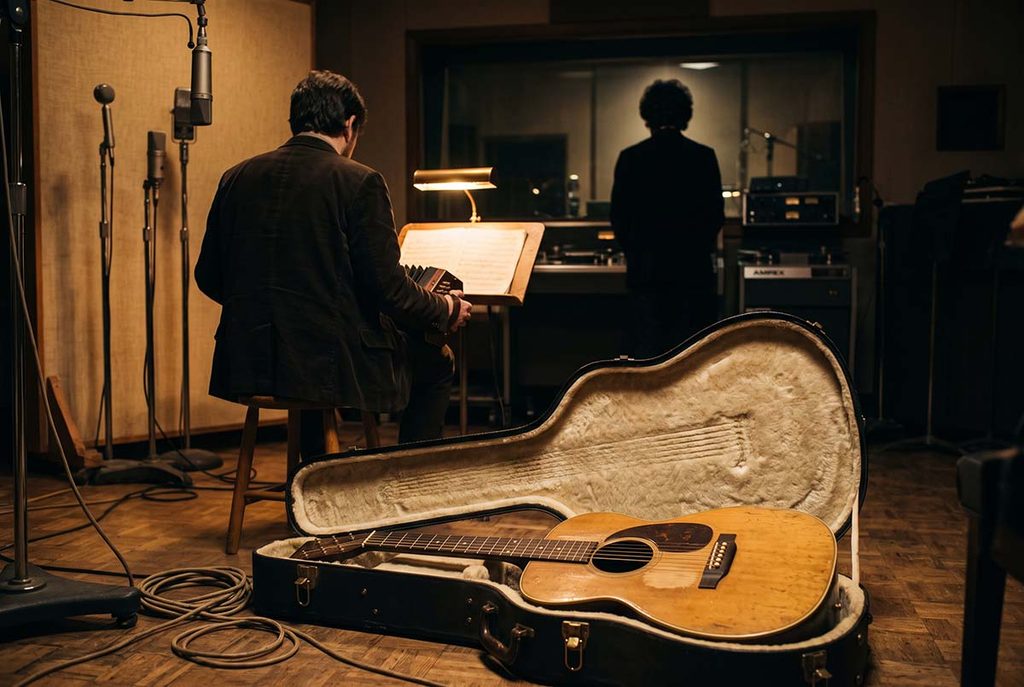
Paul Simon shaped the recording by testing the possibilities created around him. He brought the song, set its direction, and evaluated the musicians’ contributions with unusual persistence. Carter’s backward roll became one of the ideas Simon subjected to that process.
Simon liked the notes but questioned whether acoustic guitar was the right instrument to carry them. The production located an Italian concertina virtuoso who was touring the United States and brought him into the studio. Carter’s figure was transcribed onto sheet music, and the musician spent an entire day attempting to reproduce it on concertina.
The experiment required time, personnel, transcription, and studio resources. It tested whether the phrase could be separated from Carter’s instrument and transferred to another performer without losing its identity. At the end of the day, Simon rejected the substitute and returned to Carter’s original guitar track.
Simon knew precisely what Carter had made. He spent a full day trying to replace it and discovered that he could not. That knowledge never entered the popular story the record became.
The incident establishes Carter’s importance without speculation. Simon did more than accept the part as one useful contribution among many. He tested an alternative, heard the difference, and restored the original. The written notes could be transferred to another instrument, but the result could not reproduce the interaction between Carter’s hands, the raised tuning, the small-bodied guitar, and Simon’s foundational rhythm.
The sound depended on a particular body inside a particular exchange. Carter’s performance could remain essential even after his identity became unnecessary to the public understanding of the record.
Credit in Small Print
Columbia Records released “The Boxer” as a standalone single in March 1969. The song reached radio and circulated internationally without the personnel information that would later appear on Bridge Over Troubled Water. Listeners encountered the recording under the names Simon & Garfunkel, with no immediate documentation explaining how its acoustic architecture had been assembled.
The album appeared roughly ten months later and credited Carter and the other musicians. That acknowledgment was meaningful in an industry where session players often remained unnamed. Carter received standard union compensation, and his participation survived in the formal record.
The available evidence does not support a claim that Simon stole Carter’s songwriting ownership. Simon wrote “The Boxer.” The evidence also does not show that Columbia Records secretly removed Carter’s name, denied his wages, or concealed the session. The legal and financial record lacks the crime that a more sensational version of the story might require.
Compensation and cultural authorship occupy separate ledgers.
During the months before the album appeared, the single had already taught the public how to understand itself. Simon’s autobiographical lyric dominated the interpretation, while the acoustic introduction arrived beneath the authority of his name. The record sounded intimate enough to suggest that a single visible artist had played, sung, and endured his way through the entire artifact.
Popular culture absorbs an anthem more readily than a personnel list. By the time Carter’s credit appeared, the emotional ownership of the recording had settled elsewhere. His name was printed correctly, but the sound he created was remembered as part of another man’s solitary expression.
The formal credit arrived. The cultural narrative had already closed.
The Verdict
Paul Simon’s authorship of the lyric remains secure, and Carter’s story does not invalidate the autobiographical interpretation surrounding it. The solitary boxer at the center of the song can still reflect Simon’s experience of criticism and endurance. The mistake begins when the lyric and the recording are treated as the same object.
The lyric belongs to Simon. The recording contains more than 100 hours of labor across Nashville and New York. It contains Simon’s foundational guitar and Carter’s answering figure, a short-scale instrument under extreme tension, a backward roll improvised in the tracking room, and a musician breathing hard enough for the microphones to preserve his pulse.
The recording also contains St. Paul’s Chapel functioning as a reverberation chamber, an elevator shaft enlarging Hal Blaine’s snare, and two Ampex machines repeatedly drifting apart while Halee assembled the mix in short sections. It contains a guitar phrase transferred to concertina, tested for an entire day, rejected, and returned to the player who first created it.
The album credited the people who made those sounds. The culture remembered the person whose name occupied the front of the story.
Carter’s case qualifies as erasure only in the cultural sense. His credit survived, his compensation survived, and the documentation required to reconstruct his work remained in the archive. The missing element was the connection between Carter and the acoustic identity that listeners continued to recognize.
Correct paperwork does not guarantee historical recognition. A musician can remain present on a record sleeve while disappearing from the meaning assigned to the music. Documentation preserves participation, but narrative determines who the culture remembers as an author.
“The Boxer” sounds like one man enduring the world because an entire room of invisible people made the illusion perfect.
Fred Carter Jr. was one of those people. His hands remain in the opening. His breath remains inside the rhythm. His guitar remains the part Paul Simon attempted to replace and ultimately restored.
His name was in the credits. His hands were in the music. Neither one made the story.
Frequently Asked Questions
What did Fred Carter Jr. contribute to “The Boxer”?
Fred Carter Jr. supplied the counter-fingerpicked part that answered Paul Simon’s foundational rhythm and improvised the cascading backward roll heard in the opening. According to Carter’s account, he also added several overdubs, including 12-string guitar, Fender Telecaster, and the fretted Dobro figure heard before the final verse.
Who played the opening guitar part on “The Boxer”?
The recording’s opening acoustic identity came from two interlocking performances. Paul Simon played the foundational rhythm on a Martin D-18, while Fred Carter Jr. devised and performed the higher cascading figure on a smaller Martin 000-18. The familiar introduction cannot be accurately understood as Simon’s guitar alone.
Why did Fred Carter Jr. use a Martin 000-18 on the session?
Carter’s short-scale Martin 000-18 occupied a higher register than Simon’s full-sized dreadnought, allowing the two guitars to remain distinct. Carter tuned the smaller instrument into an unusually bright and tense register. That combination of size, tuning, string tension, and touch helped produce the introduction’s clear, almost mandolin-like character.
What was the breathing microphone on “The Boxer”?
Roy Halee’s elaborate microphone array captured Carter breathing in time while he performed the demanding fingerpicked part. The production attempted to remove or mute the sound, but the recording lost part of its rhythmic life. Halee deliberately retained the breathing, leaving Carter’s physical exertion embedded inside the finished record.
Did Paul Simon try to replace Fred Carter Jr.’s guitar part?
Yes. The production brought in an unidentified Italian concertina virtuoso and spent a full day attempting to transfer Carter’s improvised figure to the concertina. Simon ultimately rejected the experiment and returned to Carter’s original guitar track, establishing that Carter’s specific performance was essential and could not be transferred successfully.
Was Fred Carter Jr. denied credit or royalties for “The Boxer”?
The available evidence does not show denied session wages, stolen songwriting ownership, or removal from the album credits. Carter was a paid session musician and appeared in the personnel information for Bridge Over Troubled Water. The case concerns cultural authorship rather than a documented legal or financial injustice.
Why is Fred Carter Jr.’s story classified as erasure?
Carter’s name survived in print, but his role in creating the recording’s recognizable acoustic identity largely vanished from popular memory. No musician’s name formally replaced his. The sound he devised became absorbed into the larger image of Paul Simon as the solitary creator behind the record.
What does this case reveal about guitar history and album credits?
Album credits document participation, but they do not determine what the public remembers. A musician can be correctly named on a record sleeve while losing cultural ownership of the sound that made the recording recognizable. Guitar history often follows celebrity narratives rather than the hidden collaboration preserved in the archive.