Episode 5: The Privatization of Sound (1949–1963)
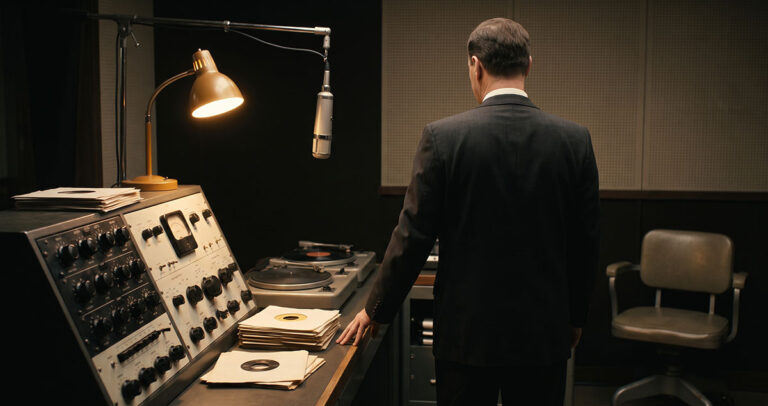
This is Episode 5 of Vin Amorando’s History of Rock documentary series, examining how the 45 rpm single, transistor radio, and earphone gave teenagers increasing control over where and how they heard music while the commercial system learned what that privacy was worth. Don Kirshner and Al Nevins built Aldon Music at 1650 Broadway into a professional songwriting operation, while the Shirelles’ “Will You Love Me Tomorrow” reached No. 1 in early 1961 and put a young woman’s uncertainty at the center of American popular culture. Girl-group records expanded the public territory available to female emotional experience as Phil Spector’s Wall of Sound demonstrated how much creative authority could accumulate behind the studio glass. Teenagers gained private cultural territory first. Publishers, producers, labels, and contracts then learned how to supply it, distribute it, and control much of the machinery surrounding it.
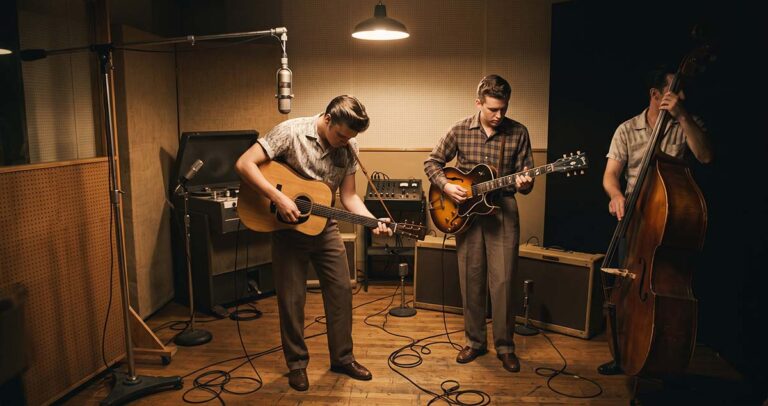
The institutions had spent the end of the 1950s trying to regain control. The Payola hearings had wounded independent disc jockeys, Alan Freed was finished, Elvis Presley was in the Army, and Buddy Holly was dead. The rawer edges of early rock were giving way to young male singers whose songs, clothes, and public behavior could be managed with considerably less risk.
The establishment had won the field. What it hadn’t controlled was the bedroom.
That failure began with objects small enough to underestimate: a seven-inch record, a pocket radio, a wire running from the radio to one ear. None looked revolutionary. Together, they changed where popular music lived. Once the location changed, the relationship between the listener and the industry began changing with it.
The Record Leaves the Living Room
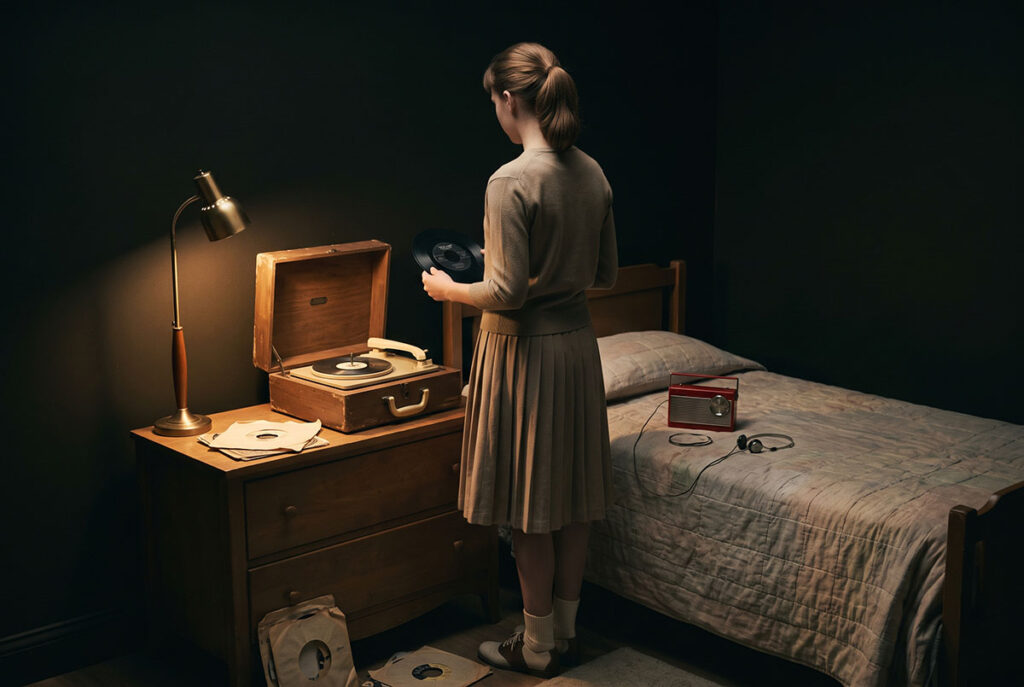
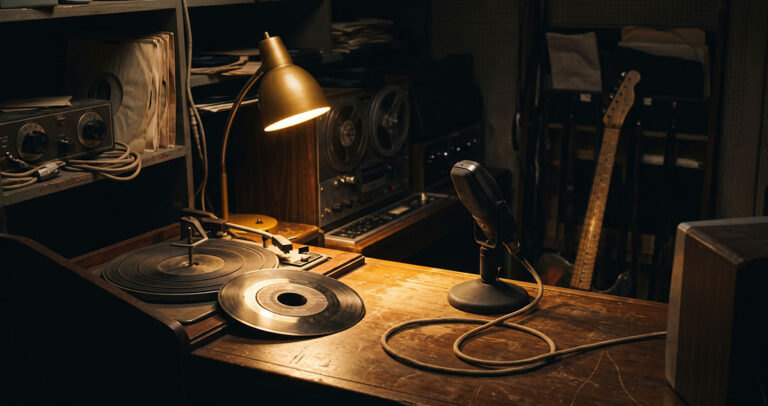
RCA Victor introduced the 45 rpm microgroove disc in 1949 during the postwar battle over recorded-music formats. The technical argument concerned speed, size, fidelity, and competing systems, but the physical character of the object eventually mattered beyond any engineering dispute. A seven-inch single could be held in one hand, carried easily, bought one song at a time, and accumulated without requiring the financial commitment of an album collection.
That made the 45 unusually well suited to the emerging teenage market. The LP fit naturally into an adult household organized around expensive equipment and shared rooms. A 45 could migrate into a teenager’s bedroom, joining other singles one purchase at a time until the collection itself became personal territory.
The record player didn’t have to leave the house for that change to matter. A teenager with a stack of singles and a small machine already possessed a musical environment that answered less completely to the family around her. The gap between formats was becoming territorial.
The commercial transistor radio expanded that territory further. The Regency TR-1 reached American stores late in 1954, although its initial price meant teenage adoption wasn’t instantaneous. As prices fell, manufacturers multiplied, and Top 40 programming concentrated popular songs into easily accessible radio formats, the small receiver became increasingly useful to young listeners.
Portability changed where music could travel. The earphone changed who had to hear it.
A transistor radio carried from the kitchen to a bedroom remained audible to everyone nearby. Connect one wire to one ear and the social arrangement changed. A teenager could occupy the same physical room as parents or siblings while listening to something they couldn’t hear. Music could travel down a sidewalk, sit beside a homework assignment, or disappear behind a bedroom door while remaining an individual experience.
The earphone created a private room inside public and domestic space. The music industry was still thinking in terms of the family living room.
The Song Factory Across Broadway
The professional songwriting world that emerged around Midtown Manhattan has been compressed in popular memory into the Brill Building at 1619 Broadway. The name remains useful as shorthand for the era, but it obscures the geography. Don Kirshner and Al Nevins opened Aldon Music across the street at 1650 Broadway in 1958.
The correction matters because the real subject is larger than one building. Publishers, managers, writers, record companies, performers, rehearsal rooms, and other parts of the commercial music business operated within a concentrated Midtown ecosystem. Songs could move quickly from an assignment to a piano room, from a demo to a publisher, and from a publisher toward a singer or label.
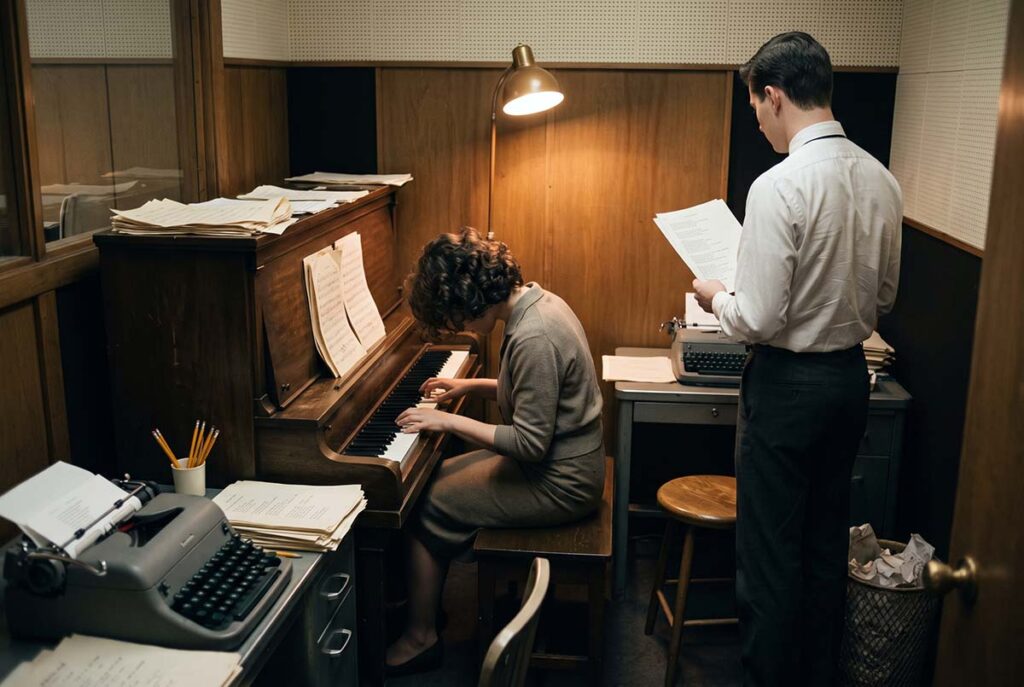
Kirshner treated professional songwriting as organized production. Young writers worked in cramped rooms with upright pianos, paper, pencils, and deadlines. Record companies and performers needed songs for particular markets and particular emotional situations, which meant the writers weren’t simply waiting for inspiration. They were expected to understand an audience and produce material for it.
Carole King was eighteen when she joined Aldon in 1960 with Gerry Goffin. Barry Mann and Cynthia Weil worked in the same professional world, as did Neil Sedaka. The environment resembled a crowded editorial office more than the later romantic image of the solitary singer-songwriter discovering a song in isolation.
Commercial pressure didn’t eliminate genuine feeling. In some cases, it demanded closer observation. A professional writer trying to reach young listeners had to understand what those listeners recognized as emotionally true, even when the song itself was being created inside an unapologetically commercial system.
The Brill Building is the wrong address. Kirshner ran his operation from across the street, and the geographic correction points toward a larger historical mistake: the machinery of early-1960s pop was an ecosystem, not a single legendary room.
Efficiency could get a song written, demonstrated, assigned, and recorded. It couldn’t guarantee that the audience would recognize itself inside the result. The teenagers building private musical territory around the 45 and transistor radio were developing an emotional world of their own. The commercial system could serve that world only after somebody discovered what was happening inside it.
Four schoolmates from Passaic, New Jersey supplied the clearest answer.
The Girls Take the Center
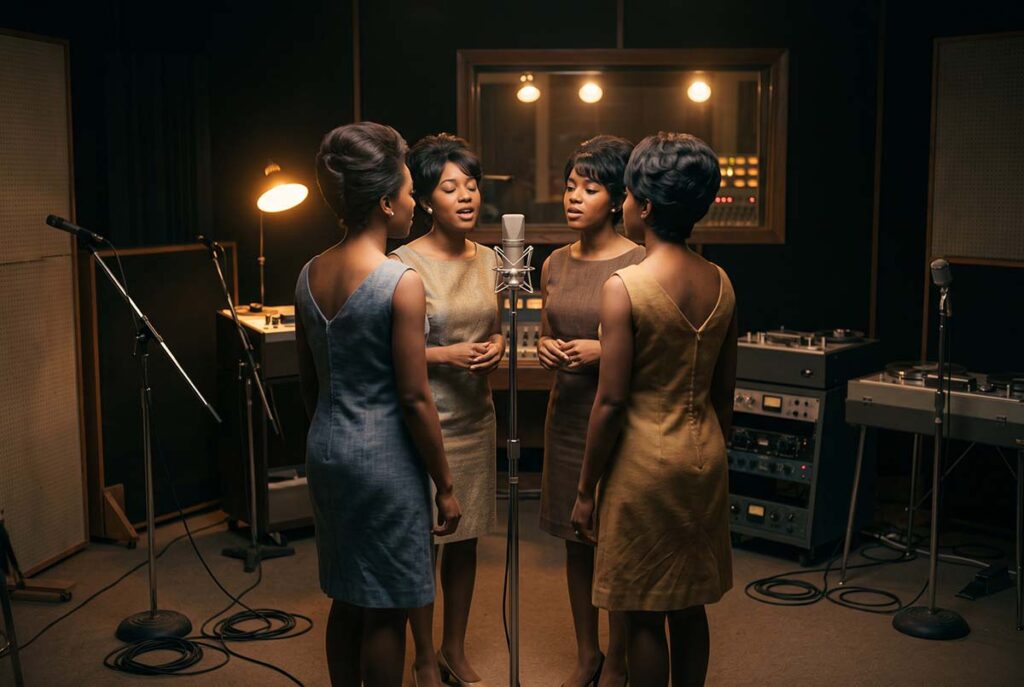
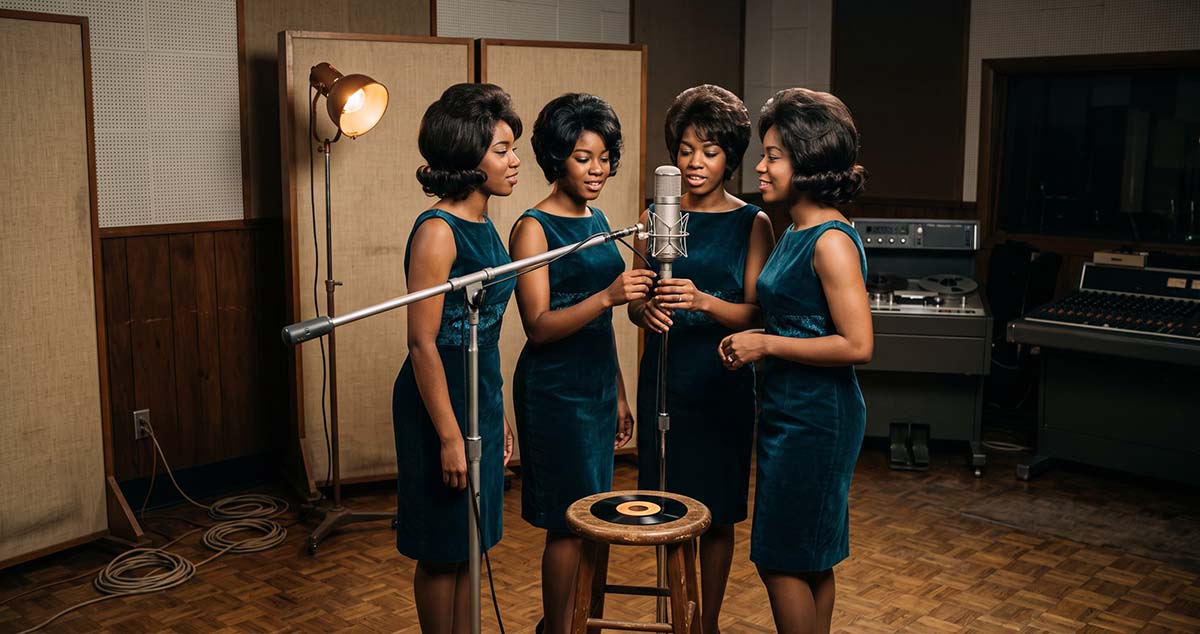
Shirley Owens, Addie Harris, Beverly Lee, and Doris Coley formed the Shirelles before the professional record business discovered a commercial use for them. They weren’t assembled as interchangeable voices around somebody else’s concept. Their history as a group already existed when the industry arrived.
That distinction complicates the familiar picture of girl-group pop as a system in which male writers, producers, and executives simply manufactured young women for a teenage audience. The machinery was real, but so was the agency of the singers moving through it. The Shirelles entered that machinery with an identity of their own.
Late in 1960, they recorded Gerry Goffin and Carole King’s “Will You Love Me Tomorrow.” The song centers on a young woman’s uncertainty about intimacy and what remains after the immediate emotional moment has passed. Its subject is recognizably adolescent without requiring an adult narrator to explain adolescence from the outside.
That point of view gave the record unusual force. The singer isn’t merely being desired. She is assessing what desire means, asking what happens next, and wondering whether affection survives beyond the present encounter. The emotional stakes belong to her.
In early 1961, the record reached No. 1 on the Billboard Hot 100, making the Shirelles the first girl group to reach the top of the chart. The achievement turned an argument about cultural change into something measurable. A young woman’s uncertainty had become the most popular song in America.
The transistor radio had created increasingly private listeners. Aldon and the wider Midtown publishing system had created a professional supply network. “Will You Love Me Tomorrow” was where those developments met in public. Private feeling had acquired national scale.
The music industry spent the late 1950s manufacturing teen idols, young men delivering sanitized product to audiences someone else had decided were manageable. Four women from Passaic, New Jersey walked into a recording studio, and the premise dissolved.
Other girl groups widened the territory. The Crystals, the Ronettes, the Chiffons, the Marvelettes, and their contemporaries brought longing, jealousy, anticipation, romantic uncertainty, fear of abandonment, and the exhilaration of being wanted into the daily vocabulary of national pop. These weren’t marginal subjects once millions of listeners were buying the records.
Female interior experience was becoming commercially undeniable. Young women were affecting what popular music could talk about because the audience had demonstrated that these subjects mattered. Yet cultural visibility and institutional authority weren’t moving together.
Teenage girls could transform what the records said without necessarily controlling the publishing, contracts, studios, masters, or revenue surrounding those records. The contradiction would become much harder to ignore once the producer himself became one of the record’s defining creative signatures.
The Producer Owns the Room

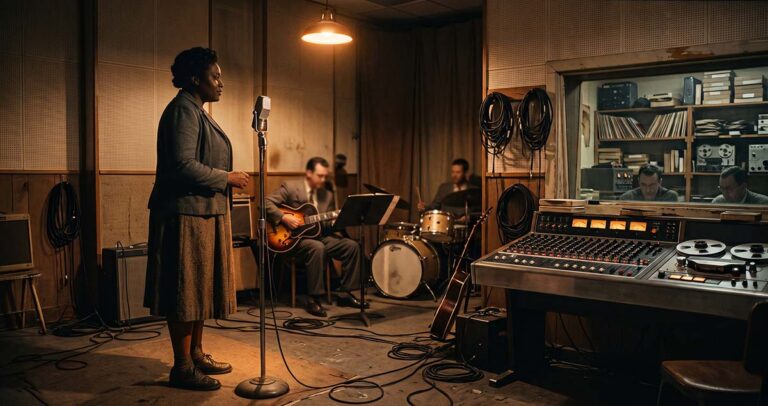
Phil Spector developed the Wall of Sound at Gold Star Studios in Los Angeles by treating recording as architecture. Dense instrumental layering, echo, orchestration, doubled parts, and mono presentation combined until individual performances became difficult to separate from the total sonic structure. The room itself became part of the composition.
That changed the location of authorship. A producer who determined the arrangement of sound, the density of the room, the balance of instruments, and the final recorded architecture could become inseparable from the identity of the record. Production was no longer merely the process by which a performance was captured. It could become one of the reasons the performance sounded important in the first place.
Spector understood the scale of the teenage market well enough to call himself a “tycoon of teen.” The phrase joined commercial ambition and cultural power with unusual efficiency. He wasn’t simply making records for teenagers. He was building an institutional position around what teenagers wanted to hear.
If the producer’s architecture couldn’t be separated from the finished record, ownership and authorship were already beginning to overlap before the singer reached the microphone.
The Ronettes make the argument harder, which is precisely why they matter. Ronnie and Estelle Bennett and their cousin Nedra Talley had sung together as teenagers in New York and recorded before working with Spector. Their appearance, attitude, vocal identity, and group history weren’t inventions of the producer who would later become associated with their greatest records.
“Be My Baby,” recorded in 1963, makes both kinds of authorship audible. Ronnie Spector’s vocal presence is unmistakable, and so is the production surrounding it. Remove either force and the record ceases to be the record people remember.
The later ownership history gives that artistic contradiction a material consequence. The Ronettes fought Spector for years over royalties and the exploitation of recordings whose commercial lives continued long after their original release. Those disputes need to remain distinct from Ronnie Spector’s separate testimony about coercion and abuse within their marriage. Personal abuse, contractual authority, production control, and rights to recordings belong to different historical categories even when the same people appear in each story.
Kept separate, the facts reveal how power can accumulate without requiring one single mechanism. Producer authority, label ownership, publishing arrangements, and recording contracts can reinforce one another until the voice at the center of a record controls surprisingly little of the commercial machinery surrounding it.
That is why “manufactured pop” is too small a description for the period. The Shirelles and Ronettes had agency. Professional songwriters produced genuine emotional insight inside a commercial system. Spector’s innovations were real. The records became important because human expression survived inside the machinery and sometimes became more powerful than the machinery expected.
By 1963, those records were crossing the Atlantic. American R&B, girl-group singing, professional songwriting, and increasingly ambitious studio production were reaching young British musicians who had grown up looking toward the United States for sounds that their own immediate culture hadn’t supplied. Episode 6 begins when those listeners start sending the inheritance back.
America had already crossed a different threshold. The 45 gave teenagers an object they could own. The transistor radio let music leave the shared console. The earphone made solitude possible. The Shirelles revealed what could happen when the emotional life occupying that solitude became visible on a national scale.
The industry followed.
Once teenagers could take music where adults could not follow, the industry learned that private feeling could be manufactured, distributed, and owned.
Frequently Asked Questions
What did the privatization of sound actually establish?
Private listening and commercial capture developed together. The 45 rpm single, transistor radio, and earphone gave teenagers greater control over where music lived, while Aldon Music and the surrounding pop industry learned how to supply that audience. The Shirelles demonstrated that teenage female interior experience could become national mass culture.
Why was the 45 rpm record important to teenage music culture?
RCA Victor introduced the seven-inch 45 rpm microgroove format in 1949. Its importance was physical as well as technical. A teenager could buy one song, carry it easily, build a personal collection, and play it away from the expensive shared-console culture that had organized household listening.
What was the Brill Building songwriting system?
The Brill Building became shorthand for a professional songwriting ecosystem concentrated around Midtown Manhattan. Don Kirshner and Al Nevins actually operated Aldon Music at 1650 Broadway, across from the Brill Building at 1619 Broadway, where young writers including Carole King and Gerry Goffin worked inside a competitive commercial system.
Why were the Shirelles and “Will You Love Me Tomorrow” historically important?
The Shirelles were four young Black women from Passaic, New Jersey who had formed their group before the professional music industry reached them. In early 1961, their recording of “Will You Love Me Tomorrow” became the first girl-group single to top the Billboard Hot 100, making a young woman’s uncertainty nationally visible and commercially undeniable.
What was Phil Spector’s Wall of Sound?
Phil Spector’s Wall of Sound used dense instrumental layering, orchestration, echo, Gold Star Studios’ recording environment, and mono presentation to create a distinctive sonic architecture. The method made production inseparable from the finished record and expanded the producer’s claim to creative authorship.
What is the episode’s verdict about teenage music and the industry?
Teenagers established private cultural territory before the industry fully understood its value. Once that emotional territory became commercially visible, publishers, producers, labels, and contracts developed increasingly effective ways to write for it, distribute it, and control the economic machinery surrounding it.
Why does girl-group pop complicate the idea of manufactured music?
Early-1960s girl-group pop contained genuine performer agency, genuine songwriting insight, and genuine production innovation inside a highly organized commercial system. Female emotional visibility could expand dramatically while publishing, recording, contractual, and financial authority remained concentrated elsewhere.
How did this American pop system lead toward the British Invasion?
By 1963, American R&B, girl-group records, professional songwriting, and ambitious studio production were already crossing the Atlantic. The next stage of the story follows British musicians absorbing those sounds and eventually returning America’s musical inheritance in transformed form.