Episode 4: The Empire Strikes Back (1959–1961)
This is Episode 4 of Vin Amorando’s History of Rock documentary series, examining how the upheavals of 1959 through 1961 changed who controlled rock and roll’s route to a mass audience. Buddy Holly’s death, Elvis Presley’s Army absence, Chuck Berry’s Mann Act prosecution, and the payola crackdown fractured the music’s first revolutionary generation while institutions gained more control over radio, television, promotion, and youth marketing. The decisive moment came in the radically different outcomes of Alan Freed and Dick Clark: Freed became expendable, while Clark reorganized his financial relationships and remained inside the system. Rock survived. Its distribution had been disciplined, and the machinery built to manage it was simultaneously creating a teenage audience that would eventually outrun that control.
On February 3, 1959, the Winter Dance Party tour was already in trouble before an airplane ever left the ground. Buddy Holly had been crossing the Midwest on a bus whose heater had failed during one of the coldest stretches of the tour. The next performance was roughly three hundred miles away, so Holly chartered a small Beechcraft Bonanza from Mason City, Iowa. Ritchie Valens and J.P. Richardson took the remaining passenger seats.
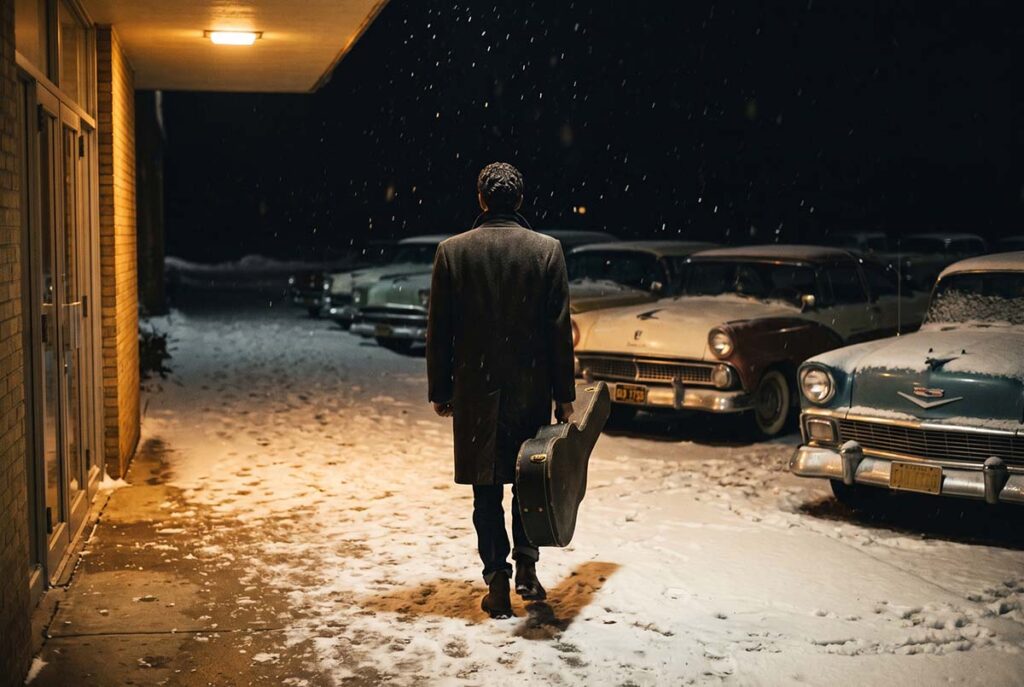
The aircraft departed shortly after midnight with twenty-one-year-old pilot Roger Peterson at the controls. Its wreckage was found hours later in a frozen cornfield only a few miles from the airport. Valens was seventeen. Holly was twenty-two. Richardson was twenty-eight.
The deaths soon acquired the weight of mythology, eventually becoming part of the larger cultural memory of “the day the music died.” The physical circumstances tell a harder story. Rock’s first touring economy depended on ballrooms separated by hundreds of miles, overnight drives, unreliable transportation, thin margins, and young musicians expected to reach the next town regardless of weather or exhaustion. A charter flight in the middle of an Iowa winter could look less like extravagance than a practical solution to a broken bus.
That’s the infrastructure beneath the legend. The Surf Ballroom in Clear Lake became the final stage Holly, Valens, and Richardson would ever play, but their deaths didn’t remove the audience that had gathered around rock and roll. Records were still selling, teenagers were still listening, and the culture was still expanding. The fragile part was the machinery carrying the performers through it.
What failed on February 3 was the infrastructure the music had been running on.
The Army and the Indictment
Elvis Presley entered 1959 already removed from American performance. He had been inducted into the U.S. Army on March 24, 1958, and transferred to West Germany later that year. Rock’s most commercially successful figure was physically absent just as the music was becoming too large for the broader culture to ignore.
His business operation hardly stopped. RCA continued releasing recordings prepared before his induction, and Presley remained commercially present even while the performer himself was overseas. His management had prepared for the interruption well enough that one of rock’s original symbols of disruption had already become something more durable: a commercial system capable of operating without the person at its center.
Chuck Berry entered a different institution altogether. In December 1959, Berry was indicted under the Mann Act, a federal law governing interstate transportation for what the statute defined as immoral purposes. The case involved a fourteen-year-old girl from El Paso whom Berry had hired to work at his St. Louis nightclub.
Berry’s first trial ended in conviction, but the Eighth Circuit Court of Appeals later vacated that judgment because the trial judge’s prejudicial conduct had denied him a fair proceeding. The government tried him again. A second jury convicted him, his appeal failed in 1961, and Berry ultimately served twenty months in federal prison.
The racial context of the case belongs in the history without turning interpretation into evidence. Berry’s prosecution occurred inside a legal culture with a long record of unequal enforcement against Black men, and the unfairness of his first trial became serious enough for a federal appellate court to overturn the conviction. The surviving record doesn’t establish that prosecutors fabricated the case simply to remove a Black rock musician from public life. Berry acknowledged the interstate transportation at the center of the case while disputing criminal intent.
The narrower conclusion carries more weight. One of the central Black architects of rock and roll entered a legal system whose racial history mattered, endured a first proceeding judged unfair on appeal, faced the government again, and went to prison. By the beginning of the new decade, another member of rock’s first revolutionary cohort had been removed from active circulation.
The Mann Act’s enforcement history followed the color line for decades. Berry encountered that history at the precise moment his music was helping redraw American popular culture.
Who the Hearings Were Really For
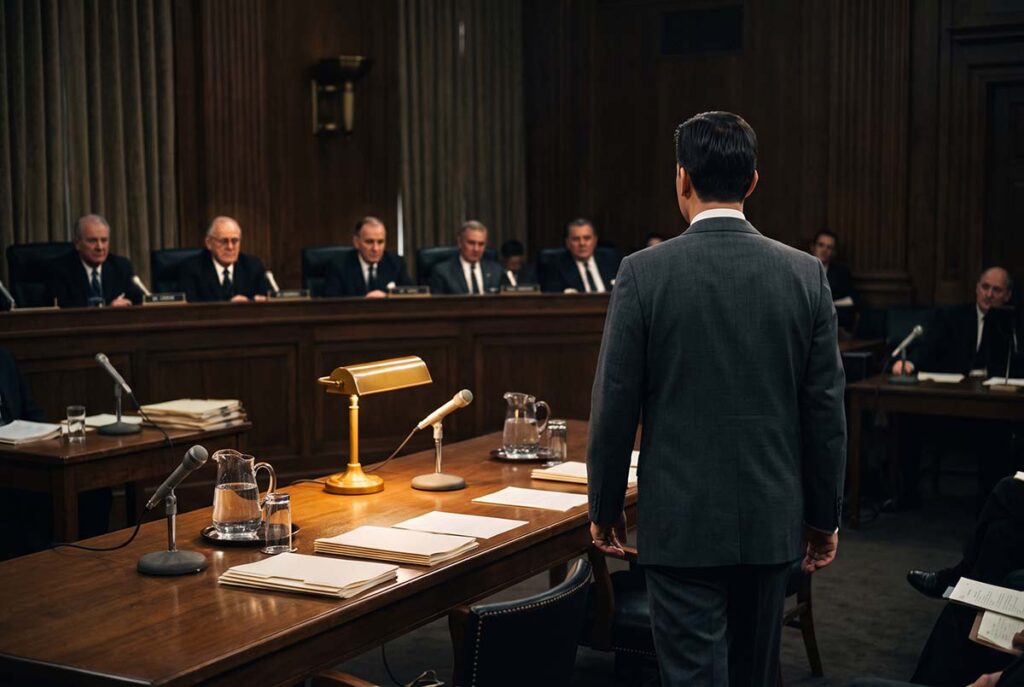
The payola scandal rested on genuine corruption. Disc jockeys had accepted money, gifts, ownership interests, and other undisclosed benefits connected to record promotion and airplay. Independent labels competing for access to radio helped normalize a system in which programming judgment and financial influence could become difficult to separate.
That loose structure had also helped build rock and roll. A disc jockey with enough personal authority could hear a record, decide it mattered, and place it before an audience without waiting for a centralized programming department. The arrangement created obvious opportunities for abuse, but it also provided a path for records that established institutions might otherwise have ignored.
Alan Freed had built his career inside that opening. He championed Black-origin music, embraced the term rock and roll, and carried the music to audiences broader and more integrated than much of American broadcasting was prepared to serve. When ABC asked him to sign an affidavit denying financial relationships tied to airplay, Freed refused. He lost his WABC position, testified before investigators, and watched the national broadcasting career he had built collapse.
Dick Clark presented investigators with a different problem. Under pressure from ABC, Clark disclosed financial interests running through numerous music-related businesses, including labels, publishing concerns, manufacturing, distribution, and promotion. The host of one of the most powerful teenage music programs in the country stood inside an extensive commercial network connected to the very music his program could help turn into hits.
Clark divested the interests ABC required him to surrender. He cooperated with investigators, denied accepting payola in the specific sense under examination, and survived with his broadcasting career intact.
The difference between the two outcomes matters more than any theory of secret coordination. Institutions had demonstrated that they could distinguish between financial entanglements they knew how to regularize and cultural intermediaries they could afford to discard. Freed’s independence, his association with Black-origin rock, and his relationship with integrated audiences placed him differently inside the broadcasting establishment from Clark, whose commercial relationships could be reorganized without removing him from the center of youth culture.
The hearings didn’t need to be a conspiracy to change the balance of power. Their consequences were enough. Rock still had listeners, performers, records, and demand, but the people allowed to control the channel between the record and the audience were becoming easier for institutions to supervise.
That is the turning point. The question had moved beyond whether teenagers wanted rock and roll. The question was who would be permitted to stand between them and it.
The Machine That Remained

American radio after the payola crackdown didn’t fall silent. It became more organized.
The autonomous disc jockey had possessed an unusual amount of personal power. A broadcaster could discover a record and create an audience for it through taste, personality, and repetition. That independence could conceal financial corruption, but it could also open a route around established commercial gatekeepers. Black-origin rock had benefited enormously from precisely that kind of opening.
As the system tightened, programming became more formally managed and financial relationships moved deeper inside institutional structures. The margin in which one personality could make an unexpected record matter began to narrow. The intermediaries who remained increasingly worked inside organizations capable of supervising both their commercial relationships and their public presentation.
At almost the same moment, another model of teenage entertainment became increasingly attractive. Frankie Avalon reached the top of the market with “Venus” in 1959. Fabian Forte was signed, groomed, recorded, and transformed into a teen idol in Philadelphia despite arriving without the musical background associated with many of rock’s first stars. Bobby Rydell emerged from the same broad commercial environment.
The process offered predictability. A young performer could be selected, given a coordinated image, matched with suitable material, recorded under controlled conditions, and moved through increasingly powerful promotional channels. The performers themselves could possess real talent. The commercial system surrounding them was designed to reduce uncertainty.
The teen idol revealed what the industry had learned from rock’s first explosion: the excitement of youth culture could be marketed without granting youth culture the same degree of autonomy that had made the original eruption threatening. Raw rock remained on the charts, and no central authority ordered the substitution of Frankie Avalon for Chuck Berry. The transformation was more ordinary. Manageability had acquired commercial value.
An artist whose image, contracts, songs, and public position could be coordinated through established institutions offered advantages that an autonomous disc jockey or an unpredictable first-generation rock figure did not. The industry had followed the rebellion long enough to understand the market it had created. Now it was learning how to own the route to that market.
What the Audience Became
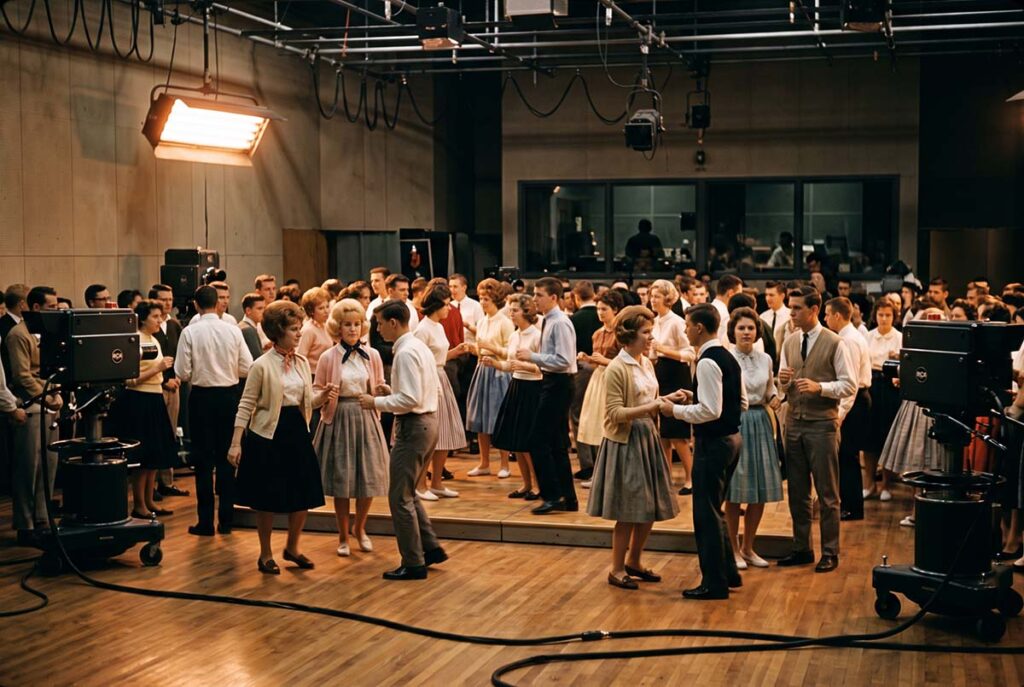
American Bandstand made the new arrangement visible on national television. The program had moved onto ABC’s national network in August 1957, and by the end of the payola period Dick Clark stood at the center of one of the most powerful promotional systems in American popular music. A record could pass through a Philadelphia television studio and emerge before a national teenage audience.
Black artists appeared on the program, and Black-origin records entered homes across the country through it. Chubby Checker’s recording of “The Twist” became a national phenomenon with enormous help from the promotional system surrounding Clark, while Hank Ballard and the Midnighters had written and recorded the song first. Ballard’s version had already charted, yet Checker became the figure television carried into the national market at overwhelming scale.
The music crossed the channel. The channel helped decide which face carried it.
The studio audience exposed a deeper boundary. Historical scholarship on American Bandstand’s Philadelphia years describes a predominantly white dance floor that remained racially segregated even as Black performers appeared onstage and Black records played through the studio. American institutions could embrace the commercial value of Black musical culture while restricting Black teenagers’ equal participation in the visible social world built around that culture.
That contradiction sits near the center of early rock history. Distribution can broaden while control remains narrow. A culture can enter millions of homes while institutions continue determining who appears, who participates, and which version of the culture receives the largest platform.
Yet American Bandstand was creating something its machinery couldn’t finally contain. It assembled an enormous national audience of teenagers accustomed to treating popular music as part of daily life. Radio had become more manageable. Television presentation could be controlled. Performers could be cultivated, images coordinated, and records promoted through systems far more predictable than the improvised networks that had carried first-generation rock.
Appetite was harder to manage.
The previous episode followed the instruments, recording technologies, independent labels, and autonomous disc jockeys that gave rock its first functioning distribution system. By 1961, institutional attention had begun reorganizing those channels. Holly, Valens, and Richardson were dead. Presley had spent much of the period overseas. Berry was headed toward prison. Freed had been pushed from national radio. The commercial center increasingly favored systems able to control the relationship between performer, promoter, broadcaster, and audience.
The audience never retreated. Within a few years, millions of those same teenagers would watch four musicians from Liverpool perform American-derived rock and roll on national television. The culture American institutions had spent years filtering would return across the Atlantic with enough commercial force to overwhelm the boundaries built around it.
They didn’t kill the music. They built the machine that delivered it, and the audience that machine assembled would eventually become too large for any machine to control.
The next stage moves inside the private world of that audience. Cheap 45 RPM singles and portable transistor radios will move listening beyond the supervised living room. The Brill Building will industrialize songwriting, while Phil Spector will demonstrate how extraordinary musical ambition can coexist with extraordinary personal and contractual control.
Containment had worked well enough to create an industry. It had also created the audience for the next rebellion.
Frequently Asked Questions
What did the payola scandal actually change in rock and roll?
The scandal exposed genuine corruption in radio promotion while accelerating a larger structural change. Disc jockey autonomy weakened, programming became more institutionally supervised, and greater power moved toward organizations able to regulate financial relationships and access to the teenage audience. Rock’s demand remained intact.
Who was Alan Freed and why did he matter to early rock and roll?
Alan Freed was a major radio disc jockey who championed Black-origin music and helped popularize the term rock and roll before much of mainstream broadcasting embraced it. During the payola scandal, he refused an ABC affidavit concerning financial relationships tied to airplay, lost his WABC position, and saw his national broadcasting career collapse.
Who was Dick Clark, and how did his payola outcome differ from Alan Freed’s?
Dick Clark hosted American Bandstand while holding extensive financial interests across music-related businesses. Under pressure from ABC, he divested interests the network required him to relinquish, cooperated with investigators, denied accepting payola in the specific sense being examined, and survived with his broadcasting career intact. The contrast with Freed became the episode’s central turning point.
What was Chuck Berry’s Mann Act case?
Chuck Berry was indicted under the Mann Act in December 1959 over interstate transportation connected to a fourteen-year-old girl he had hired to work at his St. Louis nightclub. His first conviction was overturned because prejudicial judicial conduct denied him a fair trial. The government tried him again, a second jury convicted him, his 1961 appeal failed, and he ultimately served twenty months in federal prison.
Did teen idols like Frankie Avalon and Fabian replace rock and roll?
No. Frankie Avalon, Fabian Forte, Bobby Rydell, and other polished teen idols became increasingly prominent while raw rock remained commercially active. Their rise showed the advantage of performers whose image, material, contracts, and promotion could be coordinated predictably through established systems.
Was American Bandstand racially integrated during this period?
Historical scholarship on American Bandstand’s Philadelphia period describes a predominantly white studio dance floor that remained racially segregated even while Black performers appeared and Black-origin records reached a national audience. That arrangement showed how institutions could broadcast Black musical culture while still controlling participation in the social world surrounding it.
Do the payola hearings prove there was a conspiracy to suppress rock and roll?
No. The record supports genuine corruption, unequal outcomes, and a crackdown that shifted control over radio, but it doesn’t establish a coordinated major-label conspiracy or a singular racial purge. The stronger conclusion is structural: autonomous intermediaries became more vulnerable as institutions gained greater control over distribution and promotion.
How did this period lead into the next stage of rock history?
Episode 5 moves from public distribution toward private listening and increasingly industrialized production. The 45 RPM single, portable transistor radio, Brill Building songwriting system, Phil Spector’s production model, and the Girl Groups all belong to a teenage market growing more powerful even as producers and institutions tightened control around it.