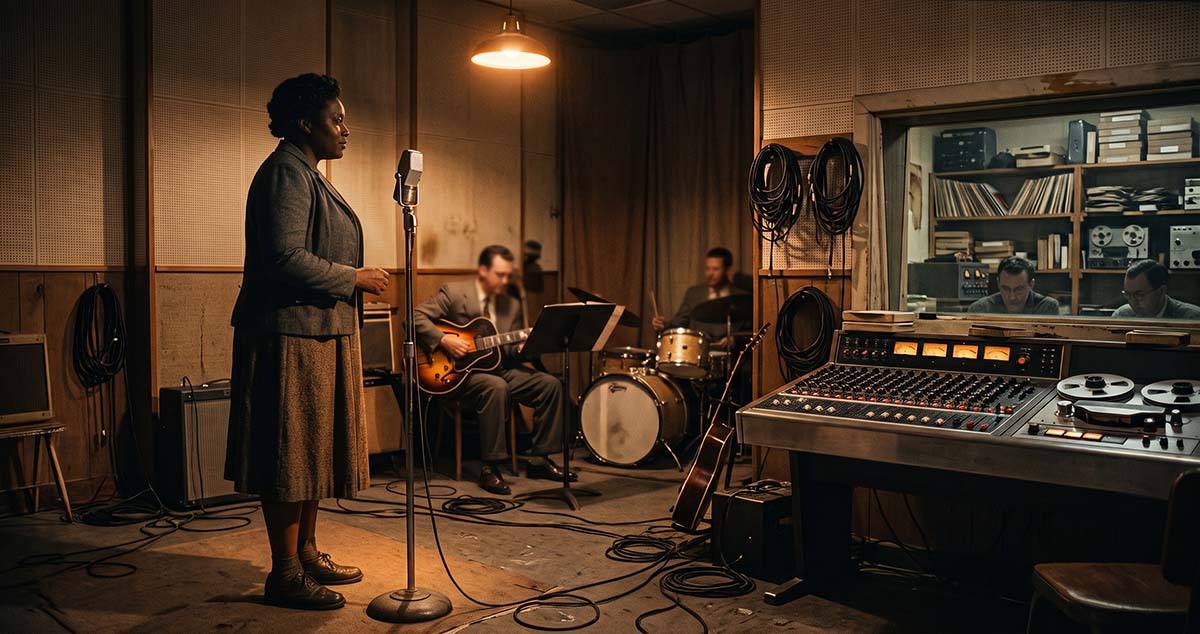
Episode 1: The Church, the Jukebox, and the Black Music That Became Rock (1920s–1954)
Rock and roll before Elvis wasn’t waiting to be invented in Memphis in 1954. Its rhythmic drive, amplified guitar vocabulary, call and response, compact-band propulsion, commercial audiences, and distribution networks had already developed across Black Pentecostal worship, jump blues, and rhythm and blues through performers including Sister Rosetta Tharpe, Louis Jordan, Ruth Brown, and Big Mama Thornton. “Hound Dog” makes the distinction especially clear: Thornton recorded a successful R&B version in 1952, Freddie Bell and the Bellboys later reworked the song, and Elvis Presley’s 1956 recording reached a vastly larger mainstream audience. Musical creation, commercial breakthrough, and historical ownership were different processes, and institutions helped determine which breakthrough later became remembered as the beginning.
The Accepted Story
Elvis Presley entered Sun Studio in Memphis during the summer of 1954, and popular memory eventually gave the moment the clean geometry of an origin story. A young white singer from Mississippi stood inside a small independent studio and produced a sound that seemed to announce a new cultural order. The story had everything historical mythology likes: a recognizable face, a location, and a date that could be repeated until it felt definitive.
The music refuses that simplicity. By the time Sam Phillips recorded Presley, much of the rhythmic and performative vocabulary later gathered under the name rock and roll had been developing across Black American sacred and secular culture for years. Churches had heard it. Jukebox customers had paid for it. Rhythm and blues charts had measured it, while record companies had already made money from the people creating it.
Presley’s breakthrough remains part of the history. Reducing the entire transition to an act of theft would merely trade one convenient origin myth for another. The more difficult question concerns the relationship between visibility and creation. A culture can exist, circulate, sell records, and influence musicians long before the mainstream decides that it has witnessed a beginning.
Rock and roll’s famous birth date tells us something important. It tells us when recognition reached another scale.
What the Church Already Had
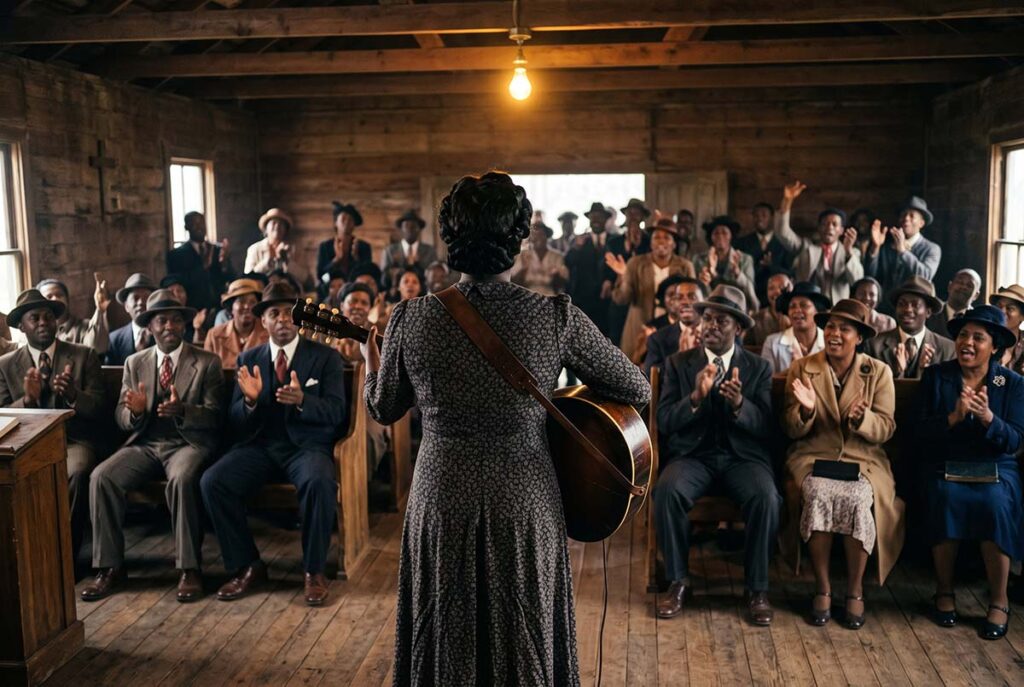
Black Pentecostal worship had developed a musical environment in which rhythm and physical participation were inseparable long before the commercial record business settled on a stable category called rock and roll. Congregations clapped their hands, struck wooden floors with their feet, answered singers and preachers, and treated instruments as part of worship itself. Music operated through the body as much as through melody.
Sister Rosetta Tharpe emerged from that world. Her importance begins with chronology rather than mythology. By 1938 she was recording professionally and carrying the expressive force of Black gospel into commercial performance, where guitar authority, rhythmic propulsion, call and response, amplification, and an unusually commanding stage presence could all be heard years before rock became a mainstream category.
Tharpe doesn’t need to be crowned the sole inventor of anything for the historical point to hold. A search for another solitary inventor would reproduce the problem this history is trying to correct. Her career matters because the musical evidence is concrete. She recorded, toured, reached audiences, and demonstrated possibilities that later histories often place downstream of the supposed rock revolution.
The record was already speaking. Later history simply learned to listen selectively.
The Constraint That Built the Sound
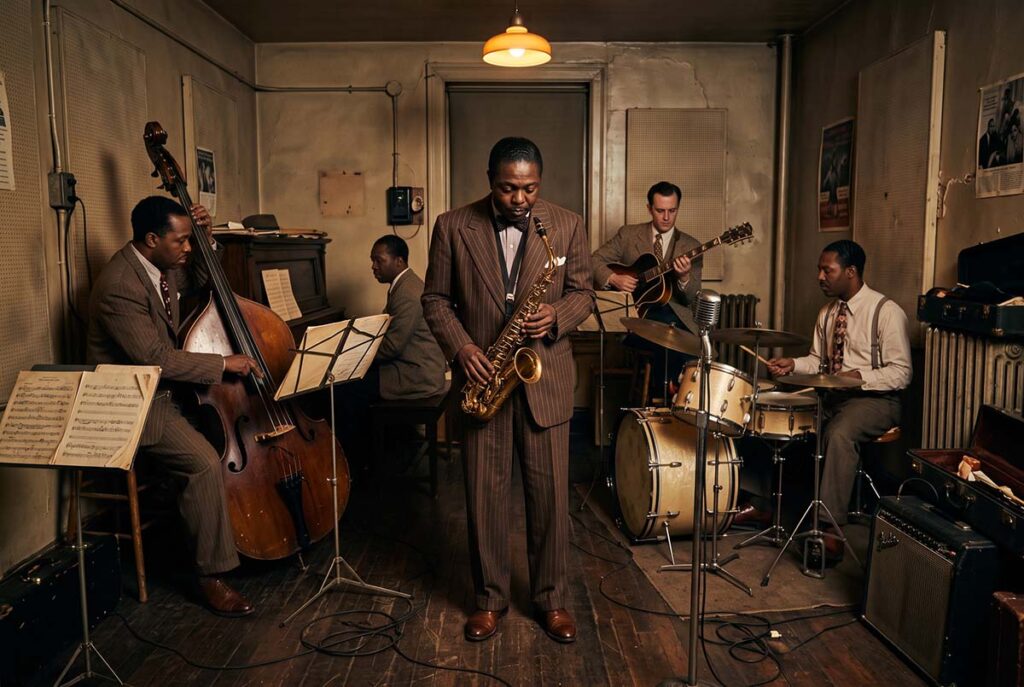
Louis Jordan carried another piece of rock’s future into the commercial marketplace through the compact force of the Tympany Five. Large swing orchestras had represented one of American popular music’s dominant formats, but keeping a large touring ensemble alive required transportation, payroll, instruments, suitable venues, and enough revenue to support the machinery. A smaller band could move differently and survive under different conditions.
Jordan had formed the Tympany Five before wartime and postwar pressures made musical economy even more valuable. Their jump-blues sound showed how much rhythmic weight a compact ensemble could generate. A smaller rhythm section exposed every beat, while individual players had more room to define the front edge of the music. The format was cheaper than a full orchestra, but its historical importance wasn’t merely financial. It also changed the physical architecture of the sound.
Musical innovation rarely arrives through inspiration alone. Musicians work inside rooms, budgets, transportation limits, labor conditions, available technologies, and the economics of keeping a group employed. Those constraints don’t dictate art, but they alter the set of possibilities that can survive.
Jordan’s success made one of those possibilities undeniable. The lean, hard-driving ensemble was commercially viable before rock adopted a similar physical form as its own.
The Market the Majors Ignored

Black rhythm and blues already had a working commercial infrastructure before the largest record companies treated it as the center of American popular culture. Independent labels, regional distributors, neighborhood businesses, jukeboxes, touring circuits, and local operators connected records to audiences without waiting for national institutions to decide those audiences mattered.
The jukebox was part of that infrastructure. A coin-operated machine in a restaurant, bar, or neighborhood business could place a record directly in front of paying listeners even when national radio programmers gave it little attention. Regional records could acquire measurable commercial life through repeated plays and local sales before executives elsewhere recognized a national opportunity.
That proximity mattered. Independent operators often understood what people were buying because they worked near the places where those records circulated. The major labels possessed scale, but scale didn’t guarantee perfect cultural vision. A decentralized market could identify demand from below while national institutions continued looking elsewhere.
By the early 1950s, Black rhythm and blues wasn’t a speculative future waiting for somebody to prove its appeal. Records were being recorded, distributed, purchased, played, and charted. The commercial evidence already existed. When larger institutions moved toward that music, they were entering a market whose proof of concept had been built outside their preferred center.
The House That Ruth Built

Ruth Brown makes the economics of that system difficult to separate from the music. Beginning around 1950, she became one of Atlantic Records’ defining early rhythm and blues artists, producing a sustained run of hits that helped establish the young label. The enduring phrase “the house that Ruth built” recognized just how structural her contribution had been.
Commercial importance didn’t guarantee economic ownership. Recording contracts placed performers and labels in very different positions. Recording costs and other expenses could be recouped before royalties reached the artist, leaving a commercially successful performer generating substantial revenue while an accounting statement continued to show little or nothing due.
Brown’s later financial struggles give the arrangement a human scale. The industry didn’t need to collapse for an artist to lose. Contracts, ownership of masters, distribution power, access to accounting, and control of capital already determined how value moved through the system.
“The house that Ruth built” therefore carries two histories inside one sentence. One celebrates the performer whose records helped build an institution. The other asks who held the deed.
The music escaped. The accounting stayed behind.
The Session That Proves Everything
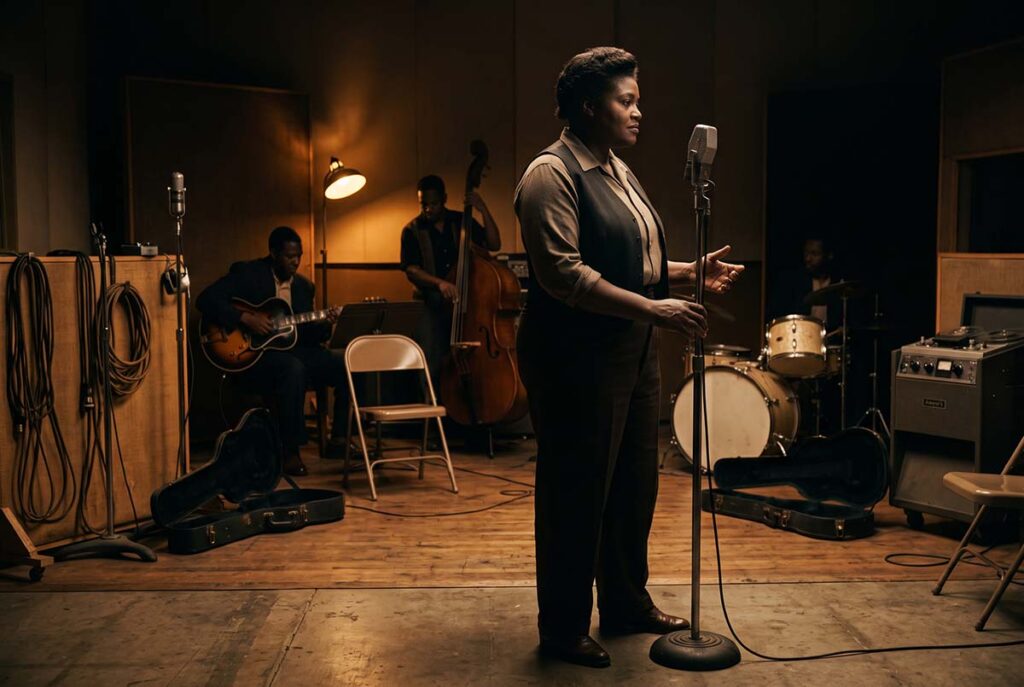
Willie Mae “Big Mama” Thornton entered a Los Angeles recording session on August 13, 1952, to perform “Hound Dog,” written for her by Jerry Leiber and Mike Stoller. The resulting record became a major rhythm and blues hit after its 1953 release, spending weeks at the top of the R&B chart. Thornton’s version was commercially validated years before Elvis Presley recorded the song.
That chronology matters because retrospective memory can quietly demote an earlier Black hit into the status of preliminary material for a later white blockbuster. Thornton’s record wasn’t an obscure sketch waiting for completion. It had already found an audience and succeeded inside an established market.
The path to Presley was also more complicated than a direct transfer from one recording to another. Freddie Bell and the Bellboys later altered the song, Presley encountered their version in Las Vegas, and that reworking became an important part of the route toward his own recording. The transmission chain moved through Thornton, Leiber and Stoller, Bell and the Bellboys, nightclub performance, different arrangements, segregated markets, and finally a much larger machinery of mass distribution.
That complexity strengthens the history. Thornton doesn’t need to become another solitary origin figure, and Presley doesn’t need to disappear from the story. “Hound Dog” instead shows how one composition can inhabit radically different commercial worlds depending on the performer, arrangement, distribution channel, audience, and historical moment surrounding it.
By 1956, the song already had a history. Mass success would determine how much of that history remained visible.
What the Filter Actually Did

Mid-century American popular music operated inside a segregated society, and the business of music reflected that structure. Rhythm and blues charts, mainstream pop charts, touring circuits, radio access, retail distribution, publicity, and performance opportunities didn’t operate across racial boundaries on equal terms.
Cover recordings became one route through those boundaries. Material could move more easily than the performer associated with an earlier version. A song could cross. A rhythmic idea could cross. An arrangement could cross. Access to the larger market didn’t necessarily travel with the person who had already proved the material’s value.
Legibility describes the resulting distinction more precisely than simple invisibility. Thornton’s record had charted. Jordan had sold extensively. Brown’s records helped build Atlantic. Tharpe had been recording and performing for years. None of this music was hidden in any literal sense.
Institutional recognition followed another logic. A culture could be audible without being treated as central to the national story. It could generate money without controlling the narrative attached to that success. It could leave a documentary record while later memory organized itself around somebody else’s breakthrough.
That changes what 1954 can legitimately mean. Elvis Presley remains important, and the Sun sessions remain important. Commercial breakthrough and musical birth simply aren’t the same historical event.
Once those two events are separated, the canonical origin story becomes evidence of something beyond chronology. It shows whose breakthrough American culture was prepared to remember as a beginning.
Verdict
Rock and roll becomes harder to compress once the documented record is allowed back into the room. Black Pentecostal worship supplies rhythmic and performative language. Sister Rosetta Tharpe demonstrates amplified guitar authority before rock stabilizes as a commercial category. Louis Jordan and the Tympany Five prove the force and commercial viability of the compact, aggressive ensemble. Independent labels and jukebox networks create functioning channels around music the majors haven’t placed at the center. Ruth Brown shows how enormous artistic value can coexist with weak economic ownership. Big Mama Thornton’s “Hound Dog” exposes the distance between a successful Black recording and the later version that mass culture would remember more easily.
Elvis Presley mattered enormously. His breakthrough altered the scale of the market, the visibility of the music, and the cultural consequences that followed. The distortion begins when that later scale is projected backward and used as proof that the musical culture itself began at the same moment.
The mainstream recording industry encountered no empty territory in the middle of the 1950s. Technique, rhythm, performance conventions, audiences, records, markets, and distribution systems were already operating. Institutions gained the power to stabilize those elements, carry them to another scale, and attach a durable origin story to the resulting breakthrough.
Searching for the “real inventor of rock and roll” would give us another convenient face for a process that had been dispersed across churches, clubs, neighborhoods, recording rooms, markets, technologies, and working musicians. The historical record asks something harder of us.
They didn’t discover the music. They discovered a version of it a certain kind of audience could accept, and then called that discovery an origin.
The next stage of the story follows these forces into the postwar American city. The Great Migration is still moving. Independent record companies are multiplying. Chess Records and Sun Studio are taking shape, while Muddy Waters, Sam Phillips, Elvis Presley, and Scotty Moore move toward the collision that will make 1954 impossible to ignore.
The beginning of rock history isn’t a room in Memphis. It’s the long record of what had to exist before that room could matter.
Frequently Asked Questions
What does the historical record show about rock and roll before Elvis?
Much of rock and roll’s musical language existed before Elvis Presley’s breakthrough. Black Pentecostal worship, jump blues, rhythm and blues, jukebox distribution, independent labels, and performers including Sister Rosetta Tharpe, Louis Jordan, Ruth Brown, and Big Mama Thornton had already established essential sounds, markets, and performance conventions.
Who was Sister Rosetta Tharpe, and why does she matter to rock history?
Sister Rosetta Tharpe was a Black American gospel singer and guitarist whose career connected Pentecostal musical culture with commercial recording and amplified guitar performance. By 1938 she was recording professionally, providing documented evidence that rhythmic drive, guitar authority, call and response, and commanding physical performance existed well before rock became a stable commercial category.
Who were Louis Jordan and the Tympany Five?
Louis Jordan was a saxophonist, singer, and bandleader whose Tympany Five became one of the most commercially important jump-blues groups of the 1940s. Their compact ensemble demonstrated how a small band could generate enormous rhythmic force and helped establish a practical musical configuration later inherited by rhythm and blues and rock groups.
Why was Atlantic Records called the house that Ruth built?
Ruth Brown became one of Atlantic Records’ defining early rhythm and blues stars, producing a sustained run of hits that helped establish the young label. The phrase captures the contradiction at the center of her story: an artist could create enormous institutional value without receiving equivalent economic ownership or long-term security.
What happened with Big Mama Thornton’s “Hound Dog” before Elvis recorded it?
Big Mama Thornton recorded “Hound Dog” in August 1952, and the 1953 release became a major R&B hit. Elvis Presley didn’t simply duplicate Thornton’s performance. Freddie Bell and the Bellboys later reworked the song, Presley encountered their arrangement in Las Vegas, and that transmission chain became part of the route toward his far larger 1956 mass-market recording.
What does institutional legibility mean in this episode?
Institutional legibility describes the difference between a culture being visible and institutions treating it as historically central. These records weren’t hidden. They charted, sold, circulated, and generated revenue. Institutions nevertheless possessed greater power to determine which performers and breakthroughs reached the mainstream at scale and which events later became remembered as historical beginnings.
Is the episode arguing that Elvis simply stole rock and roll from Black musicians?
No. That would replace one simplified origin myth with another. Elvis Presley’s significance remains substantial, but his commercial breakthrough shouldn’t be confused with musical birth. The episode follows documented chains of creation, adaptation, distribution, race, compensation, and memory to show how musical development and historical ownership became separated.
What happens after this pre-Elvis history of rock and roll?
Episode 2 follows these forces into the postwar Great Migration as Black music moves through cities including Chicago and Memphis, independent labels expand, Chess Records signs Muddy Waters, and Sam Phillips develops Sun Studio. Those changes carry Black blues and white Southern music toward the 1954 collision that popular history eventually treats as rock’s beginning.