Nancy Wilson Carried the Truth in Her Broken Nails
Nancy Wilson guitar erasure occurred because the public narrative surrounding Heart assigned greater historical weight to glamour and gender than to her documented technical mastery. In the December 1979 issue of Guitar Player, Wilson described her damaged worker hand, her deliberate retraining from acoustic to electric touch, and an arena system built around a stereo-output Ovation Adamas, a phase-switched 1957 Fender Stratocaster, and a Music Man HD-130. That evidence was already established when she reported being told, “You do not play too bad, for a girl.” The remark converted professional command into a gendered exception, allowing Wilson to remain highly visible while the substance of her work received less recognition.
By 1979, Heart had entered the machinery of arena rock. Tens of thousands of seats waited beyond the curtain while amplifiers forced dense layers of sound through concrete rooms built for spectacle rather than acoustic restraint. Nancy Wilson stood inside that scale with a guitar in her hands, one half of a sisterly image that had become instantly recognizable across American rock culture.
The consumer press understood the commercial value of that image. Nancy and Ann Wilson could be photographed as a pair and framed through beauty, clothing, charisma, and the novelty of women commanding the center of a successful rock band. Nancy’s guitar remained visible, but the physical and technical work required to operate it rarely became the subject.
Visibility and recognition are different historical conditions. A musician can appear everywhere while the substance of her decisions remains outside the frame. Nancy Wilson’s case begins in that gap.
The Image on the Cover
The polished photographs suggested ease. Wilson appeared beneath stage lights holding an acoustic guitar, an instrument often associated with intimacy and delicacy. The physical reality of playing one for hours inside an arena belonged to a harsher world, concealed behind the finished image.
A steel-string acoustic guitar demands sustained mechanical pressure. Each clear note requires the player to force metal against wood with enough accuracy to stop the string cleanly without pulling the pitch out of shape. Chords, arpeggios, transitions, and repeated performances turn that pressure into an occupational record carried in the fingertips.
Calluses thicken. Nails split against strings and fingerboards. The hand becomes stronger and increasingly specialized as the work accumulates. The graceful stage image may survive intact, but the body records what the photograph excludes.
The contradiction was already present whenever Wilson stepped in front of a camera. Her instrument helped complete the visual identity being sold, while the hand operating it carried evidence of labor that received far less attention.
The Work Beneath It
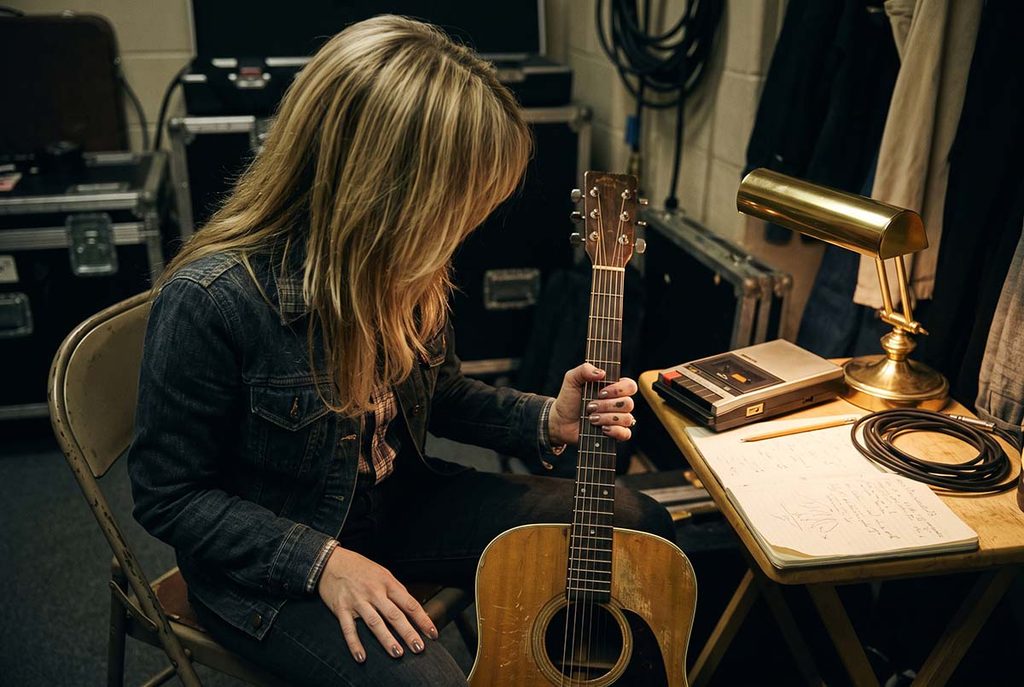
The December 1979 issue of Guitar Player preserved a different record. The magazine asked Wilson about instruments, physical technique, amplification, and the practical machinery required to function inside Heart’s sound. Those questions produced testimony that the broader image had failed to absorb.
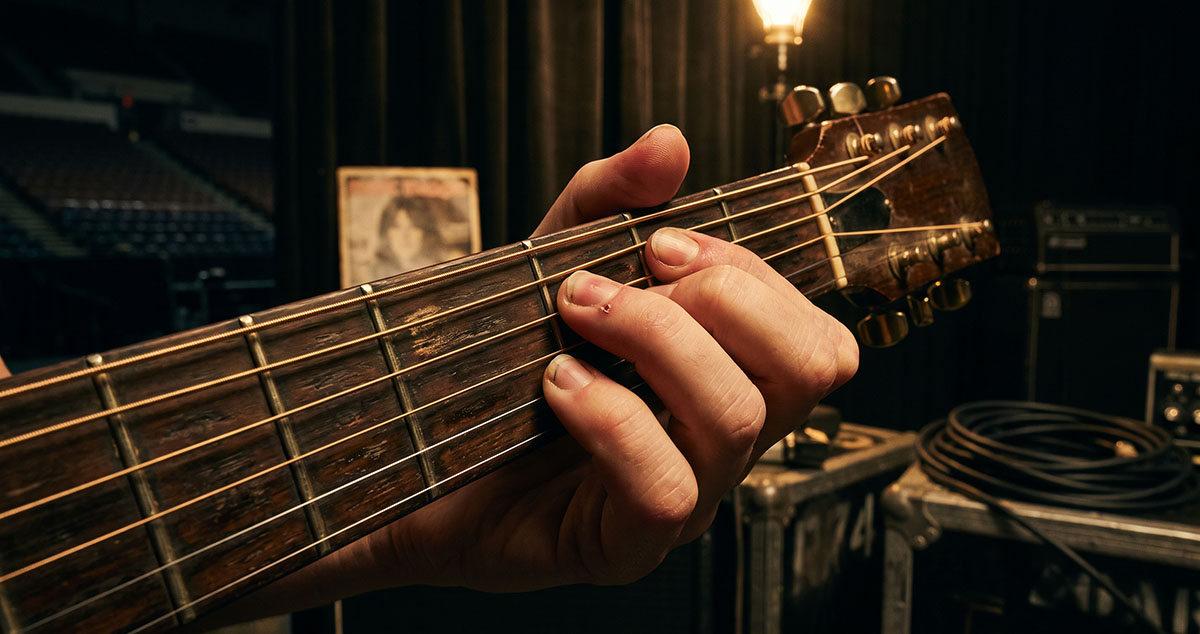
Wilson compressed the entire discrepancy into a description of her own hands. “My hands are the true story of my personality,” she said. “One hand looks kind of glamorous and the other is a real worker hand with the broken nails.”
The two hands are the case. One belonged to the public image, carefully photographed and easily circulated. The other carried the marks of steel strings, damaged nails, and repeated professional work. Wilson carried the disagreement between image and reality on her own body, where anyone willing to look closely could have read it.
Her testimony went beyond physical damage. Wilson identified a mechanical problem created by moving between acoustic and electric guitar. Acoustic strings generally require more pressure, and the player develops grip strength and muscle memory suited to that resistance. When the same hand moves to lighter electric strings, the established pressure can push the notes sharp and make the attack sound strained.
Wilson recognized that strength developed on one instrument could become a liability on another. She diagnosed the problem in her own playing and deliberately retrained her touch. That process revealed more than experience. It showed a musician capable of identifying the physical source of a sonic flaw and rebuilding an ingrained movement to correct it.
A player can hear that something sounds wrong without understanding why. Wilson connected muscular pressure to string behavior, pitch, and amplification, then altered her technique accordingly. Her worker hand had been damaged by the job, but it was also being examined and recalibrated by the musician who depended on it.
The Machinery She Built
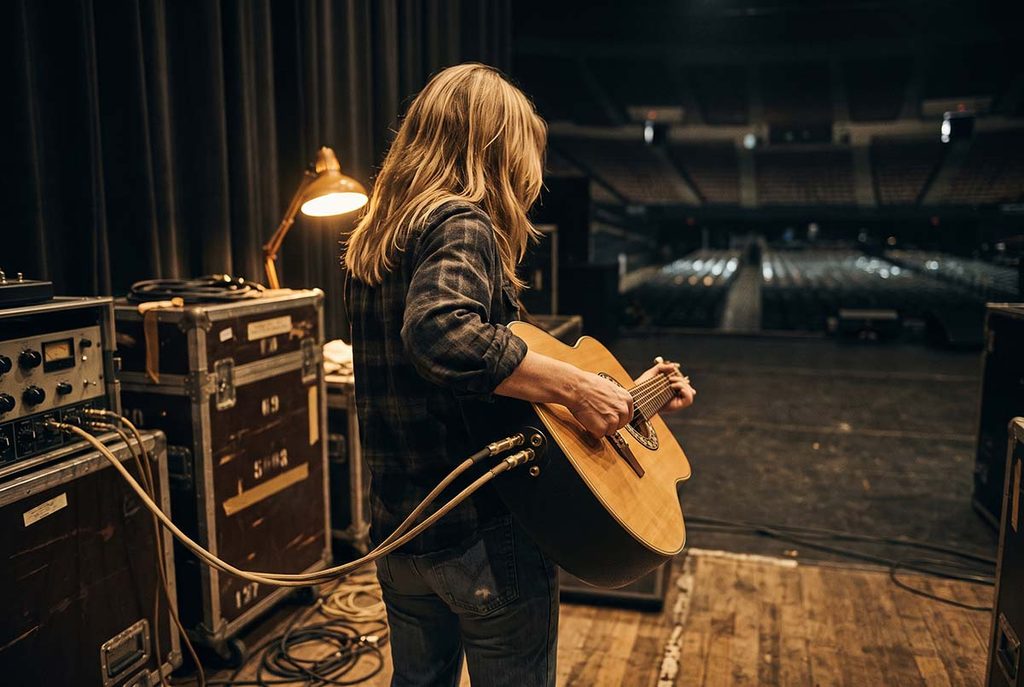
Wilson extended the same discipline into the equipment system she used at arena scale. Her instruments and amplification were not passive accessories surrounding the performance. They addressed concrete problems involving feedback, projection, clarity, and the limited amount of frequency space available inside Heart’s arrangements.
Her principal acoustic instrument during this period was a custom 1978 Ovation Adamas. Its composite construction placed it within a developing generation of acoustic-electric guitars designed for large amplified stages, where a conventional wooden instrument could struggle against the energy of the room.
An arena changes the behavior of an acoustic guitar. Low frequencies move through the floor, monitors, amplifier systems, and the body of the instrument. A resonant top can receive that energy and feed it back into the sound system until the useful signal disappears beneath an uncontrolled howl. The player is placing a resonant physical object inside a room saturated with amplified force.
The Adamas gave Wilson a more stable platform in that environment. Its construction helped address the feedback and projection problems created by large venues, while a custom stereo-output configuration allowed the twelve-string courses to be divided across separate signal paths.
That division carried a practical benefit. Heart’s arrangements contained electric guitars, bass, drums, keyboards, vocals, and the accumulated reflections of an enormous room. A conventional acoustic signal could disappear within that density. Spreading the twelve-string information across the sound field gave the instrument greater width and definition.
Wilson was engineering frequency space inside an arena.
Her electric system addressed the crowded arrangement from another direction. Wilson acquired a 1957 Fender Stratocaster from Heart bandmate Howard Leese and used it with out-of-phase pickup switching. She did not invent the electrical principle, but she incorporated its sound into a deliberate rhythm-guitar system.
An out-of-phase pickup combination can produce a leaner and more cutting character than a conventional full-bodied blend. Some shared frequencies cancel, leaving a narrower signal that occupies a different position in the arrangement. That character may sound less impressive in isolation, but rhythm guitar does not exist in isolation inside a band such as Heart.
Additional volume would have intensified the competition among instruments. A narrower sound could remain audible without occupying the same space as the bass, keyboards, and other guitars. Wilson paired the Stratocaster with a Music Man HD-130, whose substantial clean headroom suited a processed rhythm signal that needed definition before compression or distortion altered it.
She was carving rather than merely turning up.
The complete arrangement operated as a system. The Adamas supplied acoustic stability and stereo width. The Stratocaster switching created a more defined electric rhythm voice, while the HD-130 preserved clarity at professional volume. Wilson’s physical touch governed the entire structure, since excessive pressure could compromise the pitch before any signal reached the amplifier.
Each decision responded to the same environment: a late-1970s arena filled with competing frequencies and large amounts of acoustic energy. The simplified public image showed a woman holding a guitar. The trade record preserved a musician deciding how that guitar would occupy the room.
The Compliment That Reclassified the Work
Wilson had already described her damaged hand, her biomechanical retraining, and the equipment system behind her arena sound when the interview reached its most revealing remark. The evidence of professional command was established before the judgment entered the record.
“You do not play too bad, for a girl.”
Wilson reported the remark in the 1979 interview. Its historical force comes from the sequence. The words arrived after the evidence, when the speaker had already encountered competence and still refused to let that competence stand as an ordinary professional fact.
The phrase acknowledged the accomplishment while changing the category in which it would be stored. Wilson became a woman who played surprisingly well rather than a guitarist exercising technical command. Her mastery was treated as an exception to an expectation attached to her sex.
The remark therefore performed a subtler kind of erasure than outright denial. It did not remove Wilson from the photograph or claim that she could not play. It preserved the visible achievement while reducing its historical meaning.
That mechanism helps explain the divergence between the two surviving records. Consumer coverage could describe Wilson as glamorous, talented, and successful while leaving the deeper structure of her musicianship largely unexamined. Praise did not guarantee serious recognition because the praise itself could preserve the classification that made her skill seem unusual.
The trade press asked about her hands, modifications, signal paths, amplifiers, and technique. Those questions produced answers that survived in the archive. One record sold records. The other recorded the work.
No coordinated campaign was necessary. A repeated preference for image over labor was enough. Each article or photograph could seem harmless in isolation while the accumulated pattern pushed technical substance into the background. Over time, repetition hardened that hierarchy into the accepted story.
The glamorous Wilson sister remained familiar. The musician who retrained her grip, divided a twelve-string signal across an arena, and carved rhythm space with phase-altered pickups became less central. The erasure occurred through emphasis.
What the Hands Recorded
The physical laws governing Wilson’s work remained indifferent to publicity. Steel strings still required pressure. Excessive grip still pulled electric notes sharp. Low-frequency energy still threatened an amplified acoustic guitar with feedback, and dense arrangements still demanded clarity and controlled amplification.
The strings did not become easier because the photographs appeared effortless. The arena did not reduce its acoustic demands because audiences had been sold a glamorous image. Wilson’s worker hand kept the more reliable record.
Its damaged nails showed the physical toll of professional playing. Her lighter electric touch showed the discipline required to correct an ingrained habit. The stereo Adamas revealed an effort to preserve acoustic information across a large sound field, while the Stratocaster switching and HD-130 placed rhythm guitar through control and definition rather than spectacle.
The cumulative evidence requires no exaggeration. Wilson was not a hidden guitarist standing outside the photograph. She appeared onstage, in magazines, and inside one of the most successful rock bands of the era. That visibility makes the case more disturbing because the work remained available for examination.
The evidence was not buried in an abandoned studio or sealed inside a forgotten tape box. It appeared in a major guitar publication in 1979, spoken by Wilson herself. The archive preserved her testimony while the broader story learned to look past it.
The industry did not fail to see Nancy Wilson holding a guitar. It failed to count the work her hands had already proved.
Frequently Asked Questions
What does the archive show about Nancy Wilson’s guitar playing?
The archive shows that Nancy Wilson’s technical mastery was documented in the December 1979 issue of Guitar Player, even as her public image emphasized glamour. Her testimony covered physical technique, stereo routing, phase-altered pickup sounds, feedback control, and amplification. The erasure occurred through emphasis while the underlying evidence remained available.
What did Nancy Wilson mean by her “worker hand”?
Nancy Wilson used “worker hand” to describe the fretting hand marked by broken nails and sustained guitar labor. She contrasted it with the hand that looked glamorous. The phrase became physical evidence of the division between the image circulated publicly and the demanding work required behind it.
Why is Nancy Wilson’s 1979 Guitar Player interview important?
The December 1979 Guitar Player interview is the primary source at the center of the case. It preserved Wilson’s explanations of her hands, acoustic-to-electric touch, custom Ovation Adamas, 1957 Fender Stratocaster, out-of-phase switching, and Music Man HD-130. The interview documented expertise that broader coverage often treated as secondary.
How did Nancy Wilson use the Ovation Adamas in Heart?
Wilson used a custom 1978 Ovation Adamas with a stereo-output configuration that divided the twelve-string signal into separate paths. That width helped the acoustic guitar remain defined inside Heart’s dense arena arrangements. The instrument’s composite construction also addressed the feedback and projection problems created by large amplified spaces.
What was unusual about Nancy Wilson’s 1957 Fender Stratocaster?
Wilson’s 1957 Fender Stratocaster, acquired from Heart bandmate Howard Leese, used out-of-phase pickup switching. The resulting leaner sound could occupy a clearer position inside a crowded arrangement. Wilson did not invent the modification, but its deliberate use formed part of her larger rhythm-guitar system.
Is the verdict that Nancy Wilson’s guitar work was erased historically settled?
The evidence establishes the underlying facts cleanly. Wilson’s quotations, instruments, switching, amplification, and technical self-correction are directly documented. The verdict holds that gendered framing minimized this mastery by treating it as an exception. The case does not require or allege a coordinated industry conspiracy.
What does Nancy Wilson’s story reveal about how guitar history is written?
The case shows that visibility does not guarantee recognition. Nancy Wilson appeared onstage, in magazines, and inside a successful rock band, yet her technical decisions received less historical weight than her image. Guitar history can erase labor without removing the musician from the photograph.