Cheap Access Made the Guitar a Working-Class Instrument
The guitar acquired its working-class identity as practical barriers to participation fell. Steel strings increased projection, Sears mail-order distribution brought inexpensive instruments beyond traditional stores and institutions, and amplification eventually gave individual players greater control over public acoustic space. In the rural American South, Black musicians could build musical traditions outside conservatories and formal instruction, while postwar British youth used affordable European guitars and skiffle to work around austerity and scarcity. Rebellion became part of the culture that followed, but access supplied the mechanism: people without institutional power increasingly possessed both an instrument and a way to make themselves heard.
The electric guitar arrives in modern memory already screaming. Feedback hangs in the air, amplifiers cover the stage, and the player carries the posture of someone who has decided the room belongs to them. Rock culture built that image so successfully that rebellion can seem like a natural property of the instrument, something waiting inside the wood until electricity finally released it.
The earlier guitar belonged to a very different world. Its history begins in rooms where overwhelming the audience would have counted as failure. Nineteenth-century parlor guitars were relatively small, restrained in projection, and suited to domestic performance. The route from that object to the amplifier wall required changes in materials, price, distribution, education, scarcity, and technology. Rebellion entered the story after those changes had already begun altering who could participate.
The more revealing history of the working-class guitar therefore begins with access.
A Polite Box for Private Rooms
In nineteenth-century Britain and America, the guitar occupied a social environment shaped by domestic respectability. The small-bodied parlor instrument worked naturally in drawing rooms, where gut strings and modest projection suited intimate performance. Its quietness belonged to a larger cultural arrangement in which music could be cultivated without disturbing the order of the room around it.
The guitar was strongly associated with feminine domestic performance. It allowed music-making within expectations of posture, presentation, and controlled physicality. Unlike instruments designed to command a public space, the parlor guitar could remain socially contained along with the person playing it.
Portability complicated that arrangement. The diary of Caroline Maud Berkeley records women carrying guitars into charities, penny readings, and other semi-public settings. Berkeley could expand the places where she performed without discarding the respectability expected of her. The instrument moved because it could be carried, and that simple physical property created room for its players to move with it.
The guitar’s low volume made sense inside the social world that produced it. Quiet could signal refinement. Portability, however, gave players a way to test the edges of the same system. Long before the guitar became loud, it had already begun slipping beyond the room assigned to it.
Steel and the Street
A street musician faced a different acoustic reality. Traffic, commerce, conversation, and the ordinary disorder of public life did not reward delicacy. Low projection that seemed appropriate in a drawing room could become a professional limitation for someone whose livelihood depended on being heard.
Steel strings changed that equation during the early twentieth century. As they became increasingly common on American guitars, players gained greater projection, brightness, and physical presence. By the interwar years, steel-string guitars were firmly established across non-classical American music and better equipped to hold rhythmic space in ensembles.
The technical change mattered most where projection had been a barrier. Musicians working outside quiet domestic environments had more to gain from an instrument that could compete with a street corner, a dance hall, or other instruments. Steel strings changed the situations in which the guitar could function, and in doing so they changed the population for whom it was useful.
Greater volume still left a more basic problem untouched. A louder guitar could only matter to someone who could get one.
The Catalog and the Delta
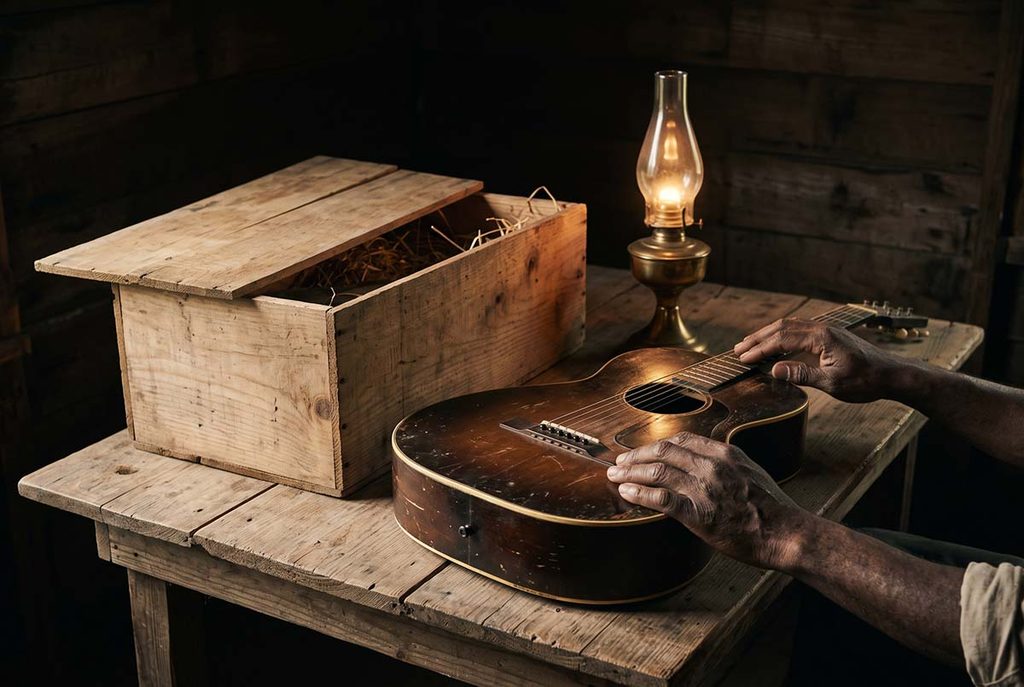
Sears, Roebuck and Company attacked that barrier through distribution. By the early twentieth century, its mail-order network could carry mass-produced goods into communities far beyond the normal reach of specialist urban retailers. Buying a guitar no longer required living near a music shop or entering an institution built around formal musical culture.
The production record for this episode places a steel-string flat-top in a 1908 Sears catalog at $1.89. Historical price claims deserve precision, but the larger mechanism is more important than the romance of a single figure. Mail order separated possession of the instrument from geography.
That distinction mattered profoundly in the rural South. Black musicians living amid poverty, segregation, and restricted institutional access could encounter guitars through a commercial network that operated differently from conservatories, formal instruction, and many local cultural institutions. A catalog required an order and a destination. It did not require a judgment about whether the customer belonged in a music school.
Sears did not create the blues. The social history that produced blues was much larger than one company, one instrument, or one distribution network. Cheap mail-order guitars nevertheless became one enabling condition within that world because communities could take an inexpensive commercial object and use it far beyond the cultural intentions of the people selling it.
Blues, country, gospel, and folk traditions could circulate through relatives, neighbors, churches, records, traveling musicians, workplaces, repetition, and observation. Formal credentials were unnecessary when people possessed the instrument and shared a social environment in which knowledge could move from person to person.
A mail-order catalog consequently did more cultural work than its mundane appearance suggests. The decisive innovation was logistical. Participation became possible for people who had never received institutional permission to participate.
The Pickup and the Stage
Acoustic projection eventually reached its limit. The magnetic pickup altered the scale of what a guitarist could do inside an ensemble, and players such as Charlie Christian demonstrated the change by the late 1930s. Amplification allowed the guitar to step beyond a supporting rhythmic role, sustain lines, and become a focal voice.
That change involved position as much as volume. A musician who once struggled to remain audible could now organize attention around the sound of the instrument. Amplification moved the guitar physically and culturally toward the front.
The 1951 recording of “Rocket 88” offers another glimpse of the technology changing under pressure. Ike Turner’s Kings of Rhythm recorded the session that was released under Jackie Brenston and His Delta Cats, with Willie Kizart playing guitar through a damaged amplifier. Accounts differ on exactly how the damage occurred, so the episode does not need the accident turned into a creation myth. The important fact is that a compromised speaker produced distortion and that the sound was worth keeping.
Technological imperfection had become expressive material. Stress and saturation no longer had to be corrected before the guitar could be culturally effective.
Manufacturers increasingly recognized a younger market for amplified music in the postwar years. Sears again appeared at the meeting point between technology and price through Silvertone packages that paired guitars with amplifiers, including designs integrated into carrying cases. A young player could move much closer to amplified music through a single purchase instead of assembling professional equipment piece by piece.
The effect was practical before it became symbolic. Bedrooms and garages became plausible musical spaces. Amplified identity was becoming available at the point of purchase.
Austerity, Scarcity, and Three Chords
Postwar Britain encountered the American electric guitar through scarcity. Austerity, currency restrictions, import controls, and the continuing economic effects of the war made American consumer goods difficult to obtain. Instruments visible on American records could acquire an almost mythical quality precisely because ordinary British teenagers could not easily buy them.
Hank Marvin’s Fiesta Red Fender Stratocaster became one famous sign of that distance narrowing. In 1959, a Fiesta Red Stratocaster obtained by Cliff Richard arrived for Marvin and became one of early British rock’s defining guitar images. It represented American modernity inside a country still living with the consequences of postwar constraint.
Most teenagers needed another route. European makers such as Hofner, Futurama, Hagstrom, and Framus supplied instruments that existed within economic and geographic reach. Prestige mattered less when availability itself was the scarce resource. A generation learned on what it could obtain.
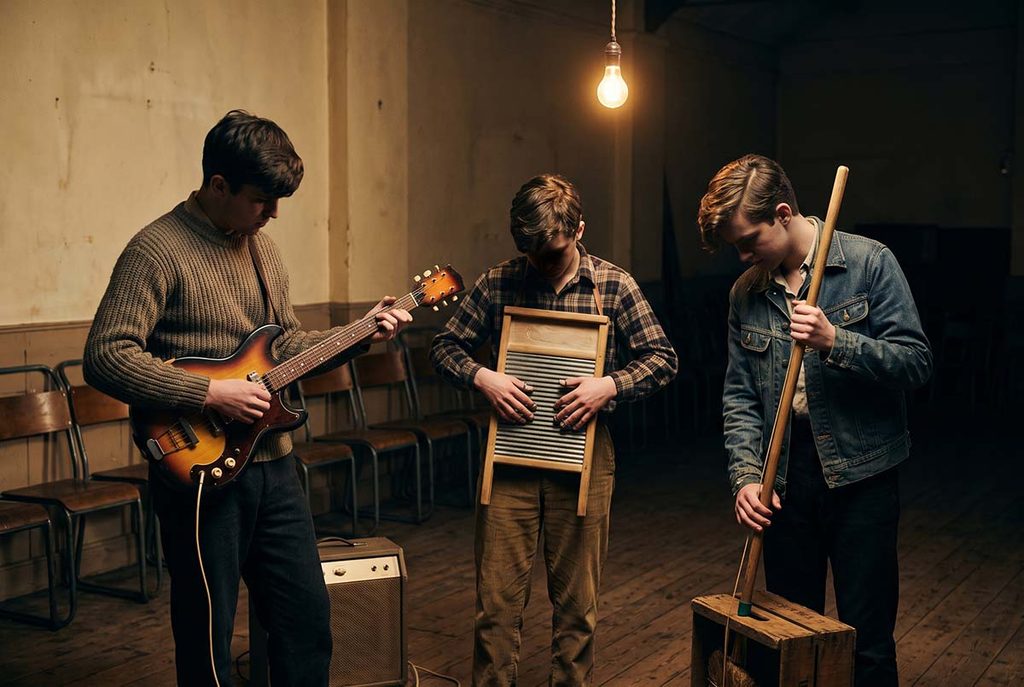
Skiffle pushed the principle further. Cheap guitars shared rooms with washboards and tea-chest basses, creating a musical culture in which equipment announced the argument before anyone needed to articulate it. Participation could begin with a small number of chords and whatever objects were available.
That made skiffle particularly compatible with young people emerging from austerity. The distance between consuming music and producing it could be crossed cheaply, and formal training no longer determined who could form a group. The Quarrymen emerged from this environment, placing a culture of improvisation and substitution directly on the path toward the Beatles and the wider British rock explosion.
British art schools created another route into cultural production. Grants and relatively accessible educational structures brought some working-class and lower-middle-class students into contact with visual art, performance, design, and experimental ideas outside the oldest elite institutions. Music became entangled with fashion and self-invention.
Mod culture transformed disposable wages into public identity through clothes, scooters, imported records, soul, ska, R&B, and guitars. British youth were consuming American culture, but they were also reshaping it within their own experience of class and postwar life. The attitude later associated with British rock developed inside material conditions that had already taught musicians to work around scarcity.
Volume as Occupation
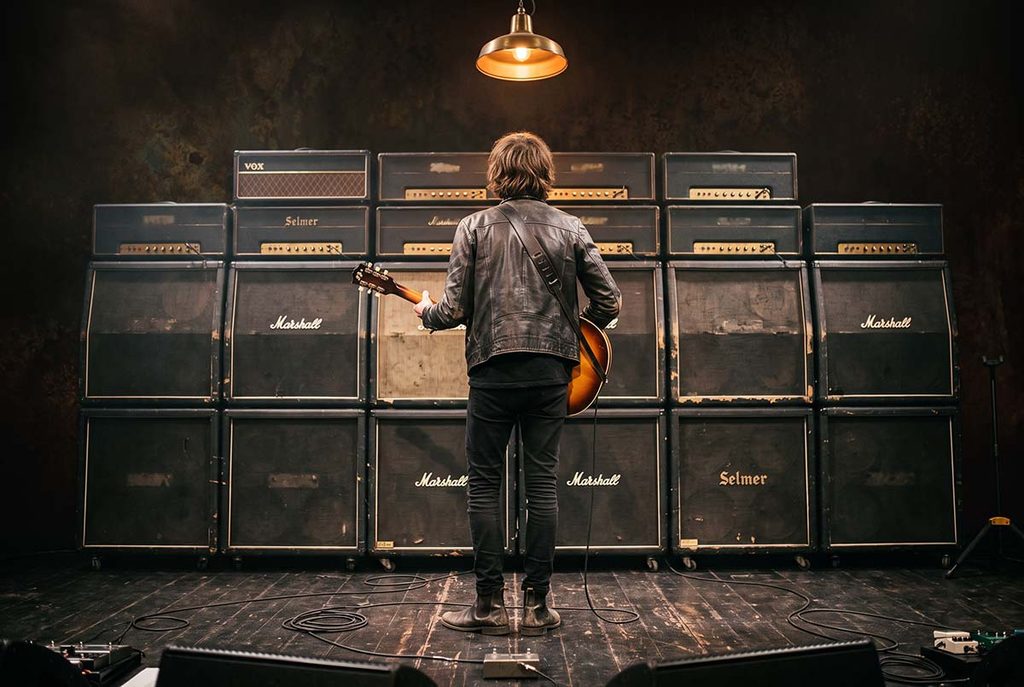
Pete Townshend and John Entwistle faced a practical problem on increasingly loud stages. Keith Moon was loud, audiences were louder, and existing amplification had limits. Jim Marshall’s company responded to musicians asking for greater power, helping develop the large cabinet configurations that became inseparable from the visual language of British rock.
Marshall’s history includes a 1965 8×12 prototype that proved cumbersome enough to expose the limits of sheer size. More manageable cabinet arrangements followed. One of rock culture’s great theatrical objects grew from ordinary problems of output, transportation, weight, and stage use.
Townshend needed to be heard over his drummer. The symbolism came afterward.
Once walls of amplifier cabinets existed, their cultural meaning exceeded the engineering problem they solved. They reorganized a room before the first note sounded. Cabinets occupied visual space, and once the circuit opened they occupied acoustic space as well.
At that scale, volume and power become difficult to separate. The parlor guitar had been suited to a room that contained it. The amplified guitar could force the room to accommodate the player instead. What began as increased projection had become control over space.
The guitar’s association with public declaration extended beyond electricity. Woody Guthrie carried an anti-fascist inscription on his acoustic guitar in the 1940s, using a portable instrument as a surface for political speech. Joe Strummer later carried related ideas through amplified music, while Billy Bragg continued another branch of the relationship between guitar, voice, and political language.
The technologies and styles changed, but the recurring possibility remained. A portable instrument could give one person enough presence to make a public claim. Amplification magnified that possibility until it became architectural.
A Way to Be Heard
The Victorian parlor guitar and the amplifier wall appear to belong to different universes when measured by sound pressure. Culturally, the route between them was built from a series of practical changes. Steel improved projection. Mail order widened ownership. Pickups altered the guitarist’s place in an ensemble. Budget electric packages reduced the infrastructure required for amplification. British scarcity turned substitutes and improvised instruments into gateways. Large amplifiers eventually gave individual players control over rooms that earlier guitars had been designed not to disturb.
No single development created the working-class guitar. Together they changed both the number of people who could participate and the amount of cultural space their participation could occupy.
The rebellion associated with the instrument was real. British teenagers spent wages on guitars and clothes as declarations of identity. Black musicians built traditions beyond institutions that excluded them. Skiffle players assembled bands from what they could afford. Guthrie put politics onto the instrument, and Strummer drove political frustration through amplification.
Rebellion describes what people eventually did with access. The deeper history lies in how that access became possible.
The guitar crossed boundaries of class, gender, geography, and political temperament because its physical and economic form kept changing. Someone obtained an instrument, discovered that it could carry something they had struggled to express elsewhere, and made the object their own. That human moment links the rural mail-order customer, the British teenager holding an affordable substitute, and the modern player remembering the first guitar that truly felt like theirs.
The mechanism underneath the mythology was access.
It was never about rebellion. It was about who finally had a way to be heard.
Frequently Asked Questions
How did the guitar become a working-class instrument?
The guitar acquired its working-class identity as barriers to participation fell. Steel strings increased projection, mail-order distribution lowered geographic barriers, inexpensive instruments reduced the cost of entry, and amplification eventually allowed players without institutional authority to occupy public cultural space.
What role did Sears play in the history of the guitar?
Sears helped separate guitar ownership from local music stores and formal institutions by distributing inexpensive instruments through its mail-order network. That logistical change gave rural communities, including Black musicians in the American South, another route to guitars despite geographic and economic exclusion.
What did the guitar mean to Black musicians in the rural South?
In this history, the guitar offered access to musical expression outside institutions that were often unavailable to Black rural communities. Cheap instruments supported oral traditions that didn’t depend on conservatories, written notation, or formal pedagogy. Sears was one enabling condition within that history rather than its sole cause.
Why were Victorian parlor guitars associated with women?
In nineteenth-century Britain and America, the guitar was strongly associated with respectable domestic performance. Its small body, relatively low projection, and portability suited the parlor environment. Women such as Caroline Maud Berkeley could also carry the instrument into charities and penny readings, expanding where respectable performance could occur.
Why was skiffle important to British guitar culture?
Skiffle reduced the practical barriers to making music during postwar austerity. British teenagers could form groups with inexpensive guitars, washboards, tea-chest basses, and a small number of chords instead of relying on costly American instruments or formal training. That make-do culture turned scarcity into widespread participation.
How did amplification change the social meaning of the guitar?
Amplification changed the guitarist’s position as well as the instrument’s loudness. Charlie Christian demonstrated how an amplified guitar could move toward the front of an ensemble. Later amplifier walls converted volume into physical presence, giving individual players control over acoustic space even when they lacked conventional cultural authority.
Was the guitar always a rebellious instrument?
No. The guitar moved from restrained Victorian domestic settings through successive changes in strings, price, distribution, scarcity, informal learning, and amplification. Those material changes produced the conditions from which its rebellious identity emerged. Access came first.
What does this history say about who the guitar belongs to?
Guitar culture also belongs to ordinary people who gained entry as barriers fell. Price, portability, distribution, informal learning, scarcity, and volume repeatedly widened participation. The instrument became culturally powerful because more people could acquire it and make themselves heard.