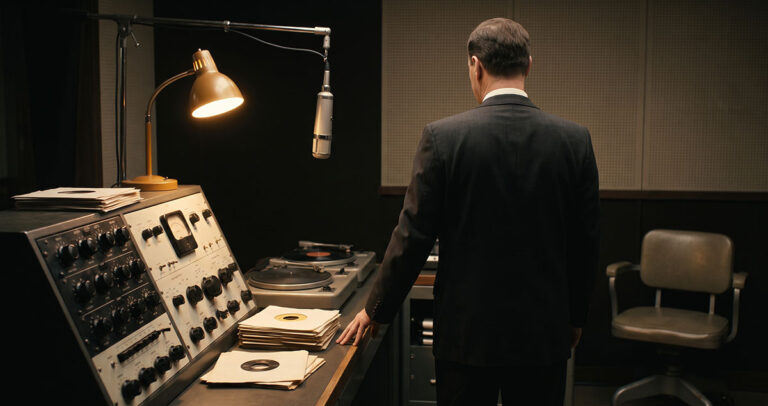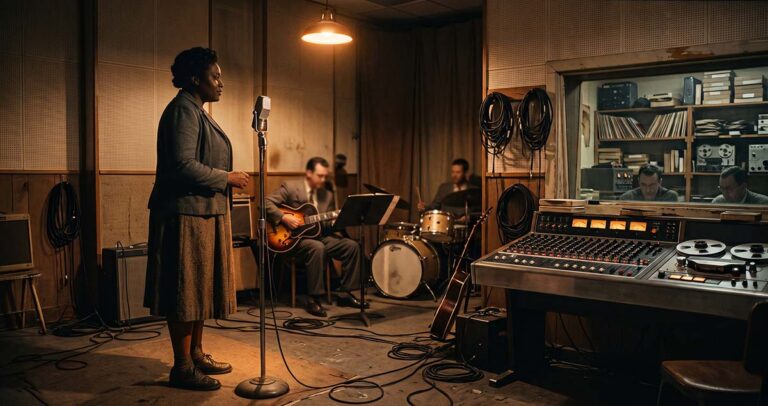
Episode 2: The Migration and the Magnet (1947–1954)
Episode 2 of the History of Rock examines how rock and roll before Elvis emerged from a convergence already transforming American music before July 1954. Black migration carried Southern musical traditions into Chicago and Detroit, urban conditions pushed blues toward amplification, independent labels built regional distribution networks, radio exposed Black R&B to widening audiences, and Memphis connected Delta music to modern recording and broadcasting infrastructure. The turning point came on July 5, 1954, when Elvis Presley, Scotty Moore, and Bill Black transformed Arthur Crudup’s “That’s All Right” at Sam Phillips’s Memphis Recording Service, producing a form of that existing convergence capable of crossing the industry’s racialized market categories. The session revealed how far the culture, audience, and independent music economy had already moved beyond the institutions attempting to classify them.
Between 1940 and 1970, roughly five million African Americans left the South during the second wave of the Great Migration. Many traveled toward industrial centers such as Chicago and Detroit, carrying musical traditions developed across Mississippi, Arkansas, Tennessee, Louisiana, and the wider South into neighborhoods built around factories, rail lines, apartment blocks, clubs, and storefronts. The people moved, and the music moved with them.
That migration did more than relocate musicians. It changed the physical environment in which their music had to work. A guitar that could command a porch, house party, or rural juke faced a different problem beneath elevated trains, near automobile plants, or inside crowded city clubs. The industrial North didn’t ask the blues to become modern. It simply became too loud for the old delivery system.
The Cities That Changed the Sound
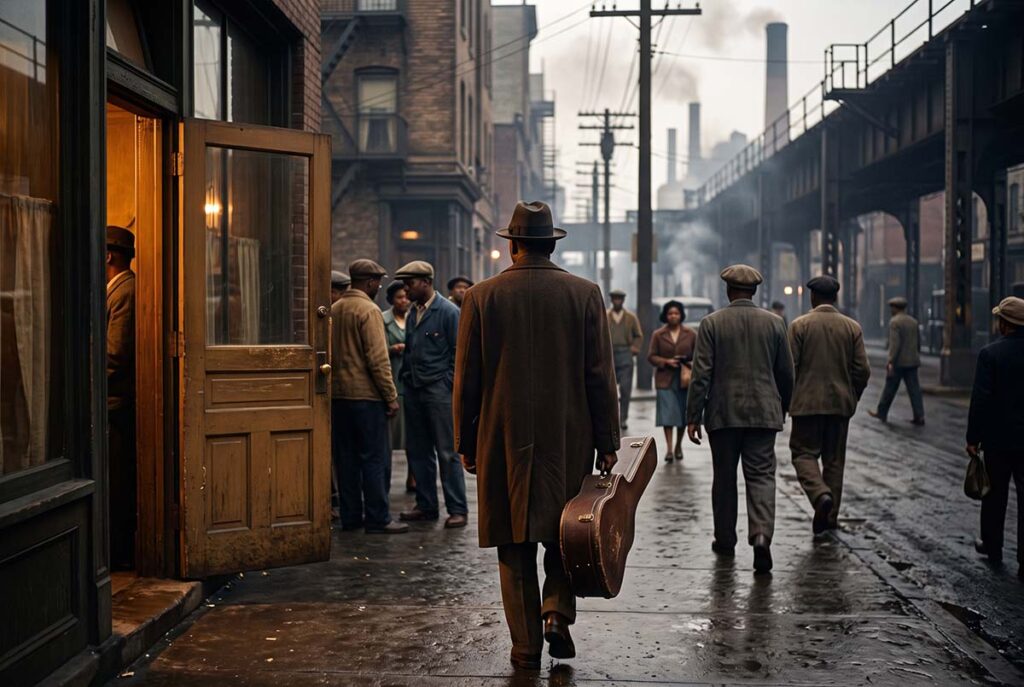
Muddy Waters reached Chicago in May 1943 after leaving Mississippi. John Lee Hooker arrived in Detroit that same year and entered an economy dominated by industrial labor. Their histories weren’t interchangeable, but both men encountered cities whose noise, density, working hours, and nightlife altered the practical conditions of performance.
Amplification solved an immediate problem. Electric guitars and small amplifiers allowed musicians to compete with crowded rooms and urban noise, and the resulting volume changed more than audibility. Stronger attack, sustained notes, amplifier breakup, and the physical force of the electric guitar gradually became part of the language itself.
The electrification of the blues was an engineering solution to an acoustic problem the city imposed.
That doesn’t mean technology created the emotional substance of the music. The traditions arriving from the South remained recognizable, but migration changed how those traditions occupied physical space. Industrial America didn’t erase a folk language. It amplified one.
Chicago became a major center of urban electric blues. Detroit produced a parallel transformation through musicians such as Hooker, whose 1948 “Boogie Chillen” carried Southern musical memory into an industrial record market. Cleveland would matter differently, less as a center of blues production than as a place where Black R&B reached a widening broadcast audience.
No committee coordinated these changes. No record executive assembled them into a genre plan. Compatible developments were taking place in different cities because musicians, audiences, technologies, and local economies were responding to conditions already in motion.
Rock and roll wouldn’t need a single inventor. Too many people were already building its conditions at the same time.
Memphis as Gravity Well
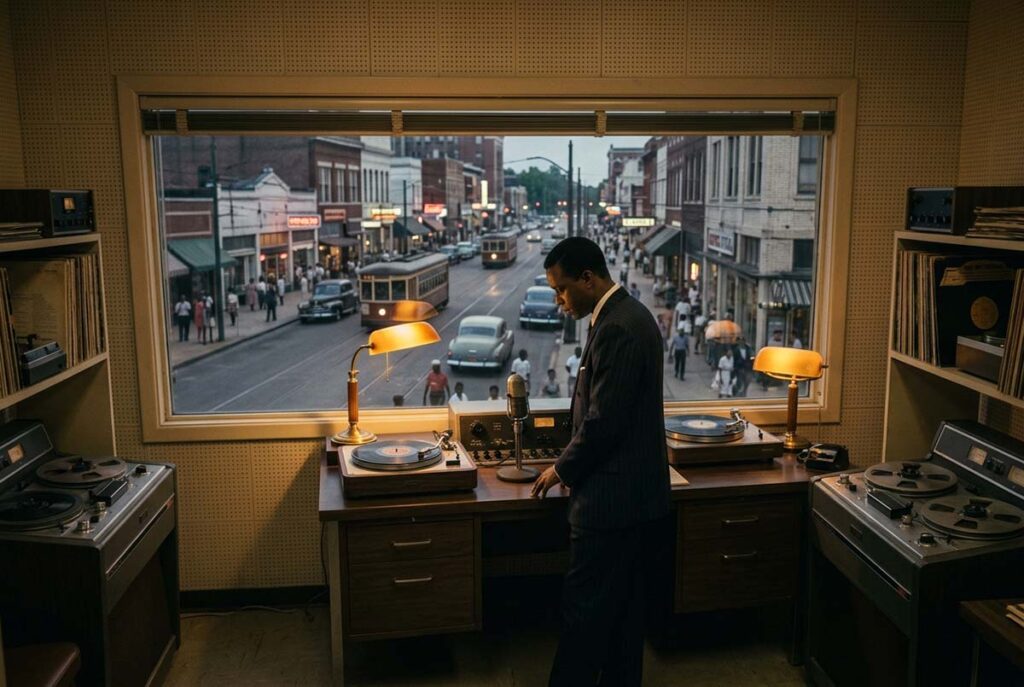
Memphis occupied a different position in this geography. Chicago and Detroit absorbed large numbers of Black Southerners into northern industrial economies, while Memphis remained a Southern commercial crossroads tied directly to the Mississippi Delta. Rural Black and white musical traditions didn’t have to complete a migration north before encountering radio, recording equipment, transportation networks, retail markets, and an urban audience.
That distinction matters because Memphis complicates the usual picture of modernization. The agricultural Delta and modern broadcasting weren’t opposite ends of a historical timeline. They existed within the same regional economy, close enough for rural musical traditions to remain immediate and commercial enough for those traditions to enter a technological system.
Radio made the market harder to ignore. WDIA went on the air in Memphis in 1947, and Nat D. Williams began broadcasting there in 1948 as the station moved toward programming aimed at Black listeners. The audience existed before broadcasters decided to serve it. Once the ratings and commercial response became visible, neglect became harder to defend as simple economics.
The major labels had treated much of the Black South as a marginal market. Memphis radio demonstrated that money had been sitting inside that supposed margin.
Broadcasting also changed the scale of musical circulation. A performance no longer ended when the audience left the room. Records could travel through radio, retail, and jukebox networks, giving regional music an economic reach that exceeded the club, neighborhood, or city where it originated.
Memphis therefore became a kind of gravity well. Southern traditions, modern recording technology, radio, transportation, and an underserved consumer market occupied the same commercial geography. None of those forces was moving toward a predetermined invention called rock and roll. American life was simply forcing them into contact.
The convergence was already underway.
The Collapse That Opened the Door
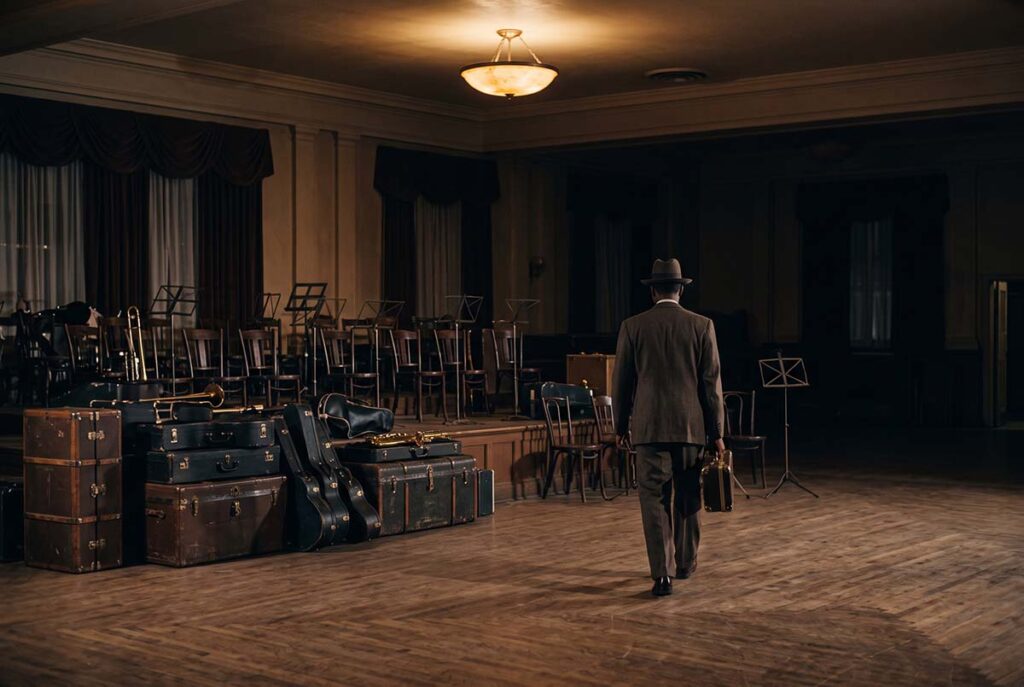
The established recording economy entered the 1940s carrying an expensive business model. Large swing orchestras might require fifteen or twenty musicians, arrangements, rehearsals, payroll, transportation, hotel rooms, ballrooms, and a national touring structure. Their scale helped make swing spectacular. It also made the system vulnerable when wartime conditions attacked nearly every major cost at once.
Gasoline and rubber rationing complicated travel. Personnel shortages affected bands. Federal entertainment taxes increased pressure on venues. Transportation became more expensive, payroll remained substantial, and consumer tastes continued to change. No single force ended the swing era, but several forces made its economics increasingly difficult to sustain.
The American Federation of Musicians recording bans added another disruption. Beginning in 1942, union musicians stopped making commercial recordings during a dispute over compensation and the displacement of live work by recorded music. Another ban followed in 1948. The bans didn’t single-handedly destroy the large-band economy, but they landed on a system already carrying wartime costs, taxation, labor problems, and changing demand.
For rock history, the important question is what entered the space created by that instability.
Large record companies needed scale. A regional Black R&B record that looked commercially small beside a national pop release could be dismissed as unworthy of major investment. An independent operator with lower overhead didn’t need the same return. Regional sales, direct relationships with retailers, jukebox operators, local radio, and modest pressing runs could make a supposedly marginal market economically useful.
The weakness of one system therefore gave smaller businesses room to operate. They didn’t require permission from the established industry because they had learned to survive beneath its threshold of interest.
The opening didn’t remain empty.
The Independent Network

Aristocrat Records operated in Chicago before becoming Chess Records in 1950. King Records worked from Cincinnati. Sensation operated in Detroit. Their catalogs, business models, and histories differed, but together they demonstrated that music overlooked by larger companies could circulate through another system.
The physical infrastructure was modest. Records might leave a small recording room, move to an independent pressing plant, pass through regional salesmen, and reach listeners through record shops, jukeboxes, and local radio. Compared with the major-label machinery, it looked fragmented. Fragmentation was precisely what allowed it to reach markets the centralized companies had decided weren’t worth serving.
Muddy Waters entered that system before Chess Records carried the name history remembers. He recorded for Aristocrat beginning in 1947 and broke through the following year. By the time Chess emerged in 1950, the commercial logic behind urban electric blues had already been demonstrated.
Sam Phillips entered the same independent economy from Memphis. He opened Memphis Recording Service at 706 Union Avenue in 1950, then launched Sun Records in 1952. That chronology matters because the later fame of Sun can make the operation seem inevitable in retrospect. It wasn’t. Phillips began with a small recording business operating inside a regional music economy whose commercial possibilities were still being discovered.
His work with Black artists came before Elvis Presley. Phillips recorded blues and R&B musicians and licensed masters to independent labels with distribution beyond Memphis. The white breakthrough that later transformed Sun’s fortunes didn’t introduce Phillips to Black music, small-label economics, or regional distribution. He was already working inside all three.
The 1951 “Rocket 88” session makes the network visible. Ike Turner’s Kings of Rhythm, with Jackie Brenston on vocals, recorded the song with Phillips in Memphis, and the master went north to Chess Records in Chicago. Arguments about whether “Rocket 88” deserves the title of the first rock and roll record can obscure the more useful fact: the record physically traveled through an independent system connecting Southern musicians, a Memphis recording room, a Chicago label, radio, jukeboxes, retailers, and listeners.
Sam Phillips was sending music into that network years before July 1954.
The route is more important than the mythology. A performance could begin in the South, be recorded by a small operator in Memphis, travel to an independent company in Chicago, and return to audiences through radio and jukebox distribution without a national major label authorizing the process. The economic structure rock would eventually exploit already existed.
The major companies hadn’t designed it. Smaller operators built it in markets the majors had undervalued.
The Audience Crosses the Line
Alan Freed began broadcasting rhythm and blues from Cleveland in 1951, giving Black records access to an expanding audience that included white teenagers. His importance in this story lies partly in what the response revealed. The racial categories imposed by record companies, radio programmers, and retailers didn’t describe listening behavior as neatly as the industry assumed.
The 1952 Moondog Coronation Ball made that problem physically visible. Demand overwhelmed the venue, demonstrating that the audience for Black R&B had already expanded beyond the commercial classifications designed to contain it. The market was becoming interracial before the record business had a stable language for acknowledging what was happening.
Radio therefore acted as another magnet. Migration had moved people. Cities had changed the sound. Independent labels had moved records. Broadcasting could now move those records across social and geographic boundaries at a speed the older industry structure hadn’t anticipated.
By 1954, the infrastructure didn’t need to be invented. It needed a breakthrough large enough to force recognition.
The Room Reveals the System

On the evening of July 5, 1954, Sam Phillips was running a session at Memphis Recording Service with nineteen-year-old Elvis Presley. The formal work hadn’t produced what Phillips wanted. During a break, Presley, guitarist Scotty Moore, and bassist Bill Black began playing a fast, loose version of Arthur “Big Boy” Crudup’s 1946 blues recording “That’s All Right.”
Phillips heard the change and recorded it.
The room was remarkably small for the amount of history later placed inside it. Presley played acoustic rhythm guitar. Moore played hollow-body electric guitar. Black drove the performance on upright bass. There was no drummer, no new recording technology, and no technical device that suddenly made an unknown musical language possible.
The machinery around them was part of the same recording infrastructure Phillips had already used for Black blues and R&B. The song itself came from a Black blues artist. The rhythmic energy sat inside traditions that had been circulating for years, while the country background of the musicians added another existing language to the performance.
What happened in that room was historically consequential. Recognizing what preceded it doesn’t require pretending otherwise. Presley brought ability, charisma, timing, and a racial identity that allowed the performance to move through commercial spaces many Black musicians could not enter on equal terms. Phillips recognized a record capable of crossing categories whose instability had already been demonstrated by audiences elsewhere.
The categories had been constructed by institutions. The music had already outrun them.
That is what makes July 5 a turning point without making it a creation myth. Muddy Waters had already electrified Mississippi-derived blues in Chicago. John Lee Hooker had already made an urban Detroit market respond. Independent companies had already built distribution outside the major-label structure. Alan Freed had already put Black R&B before a widening audience, and the Moondog Coronation Ball had already shown that racial market boundaries were losing their descriptive power.
The wall didn’t fall in Memphis that evening. It had been deteriorating from street level for years.
What Phillips captured was a particularly powerful form of the convergence, one capable of moving through the racial and stylistic categories used by broadcasters, retailers, and record companies. The performance didn’t become important because nothing like rock had existed before it. It became important because the mainstream could finally hear a version of what had been developing outside its control.
That changes Elvis Presley’s place in the story without requiring either sainthood or erasure. He wasn’t the inventor imposed by simplified mythology, and he wasn’t historically irrelevant. He became part of a mechanism in which Black musical practice, Southern country music, independent recording, racial privilege, audience demand, and commercial instinct converged at an unusually consequential moment.
The following year made the acceleration unmistakable. Chuck Berry’s “Maybellene” broke through on Chess in 1955. Little Richard’s “Tutti Frutti” followed on Specialty. They belong after the July 1954 threshold, but their rapid arrival confirms how much infrastructure and demand were already waiting.
The room matters because so much had already happened outside it.
Verdict
A room in Memphis didn’t invent rock and roll. By July 1954, the route to that room already ran through Black migration, Chicago clubs, Detroit factories, Memphis radio, independent record companies, regional distributors, jukebox routes, record shops, and audiences whose listening habits were refusing the industry’s racial categories.
Muddy Waters had adapted Southern blues to Chicago. John Lee Hooker had carried Southern musical memory into industrial Detroit. Phillips had spent years recording Black musicians and feeding masters into independent distribution. Broadcasters had already discovered that listeners didn’t remain inside the boundaries record companies had assigned to them.
The Presley session gave those forces a form with unusual commercial power. Race was inseparable from that power. Presley could cross mainstream commercial boundaries that many of the Black musicians who helped establish rock’s vocabulary could not cross on equal terms, and the industry could market him into spaces where Black performers still encountered structural limits.
Seen from inside the mainstream music industry, July 1954 can look like a beginning. Seen from the streets, clubs, radio booths, factories, recording rooms, and independent businesses that produced the conditions around it, the date arrives much later in the story.
Institutions didn’t lead this convergence. They observed it after musicians, audiences, broadcasters, and smaller businesses had already demonstrated its value, then moved toward the market that emerged. That pattern will recur throughout rock history because cultural change rarely waits for the organizations that eventually package it.
The room did not invent the sound. It simply provided the first microphone that the mainstream could not pretend it hadn’t heard.
The next transformation will move from the market into the machinery itself. Leo Fender’s solid-body instruments, magnetic tape, Les Paul’s overdubbing experiments, regional distribution alliances, and the economics of airplay will make records louder, easier to construct, easier to circulate, and harder for established institutions to ignore. Episode 3, The Workshop and the Cartel, begins when the infrastructure stops merely carrying the new music and starts changing what musicians can physically make.
Frequently Asked Questions
Did Elvis Presley invent rock and roll in 1954?
No. The July 5, 1954 Presley session was historically consequential, but the musical and commercial forces behind rock and roll were already operating. Electric blues, Black R&B, migration, independent labels, radio, jukebox distribution, country music, and interracial youth demand had been converging for years before Presley entered Memphis Recording Service.
How did the Great Migration change blues music?
The postwar Great Migration carried Southern Black musicians and musical traditions into industrial cities such as Chicago and Detroit. Crowded clubs and dense urban noise made amplification increasingly practical, helping electric guitar, stronger attack, sustain, and amplifier distortion become central features of urban blues.
Why is Memphis different from Chicago and Detroit in this story?
Memphis wasn’t simply another northern Great Migration destination. It remained a Southern crossroads closely tied to the Mississippi Delta while possessing urban broadcasting, transportation, retail, and recording infrastructure. That combination allowed rural Black and white traditions to encounter radio, recording technology, and commercial markets without first completing a migration into the industrial North.
What role did independent record labels play in early rock and roll?
Independent labels served regional markets that major record companies often undervalued. Aristocrat and later Chess in Chicago, King in Cincinnati, and other small operators could record and distribute blues and R&B with lower overhead. Their networks connected musicians to record shops, jukeboxes, radio stations, and audiences outside the major-label system.
What were the AFM recording bans, and why do they matter here?
The American Federation of Musicians imposed recording bans beginning in 1942 and again in 1948 during disputes over compensation and recorded music’s effect on live employment. The bans didn’t single-handedly destroy swing orchestras, but they added pressure to a large-band economy already affected by wartime costs, taxation, transportation problems, labor shortages, and changing demand.
Why is July 5, 1954 still a turning point if rock already existed?
The Presley, Scotty Moore, and Bill Black session matters because it gave an existing musical convergence a form capable of crossing segregated commercial categories. Sam Phillips recognized the potential. Its historical significance lies in institutional recognition of cultural and market changes that had already developed beyond mainstream control.
What does this episode establish about how rock history gets told?
It separates cultural creation from institutional recognition. When history begins with the moment mainstream institutions notice a movement, earlier musicians, audiences, broadcasters, and independent businesses disappear from view. Rock’s emergence shows culture developing across distributed networks first, with larger institutions responding after the economic and social evidence becomes difficult to ignore.
What changes next when recording technology and instrument design accelerate?
The next stage shifts toward the infrastructure itself. Leo Fender’s solid-body instruments, magnetic tape, Les Paul’s overdubbing experiments, increasingly organized independent distribution, and payola expand what musicians can record and how efficiently those records can reach an audience.