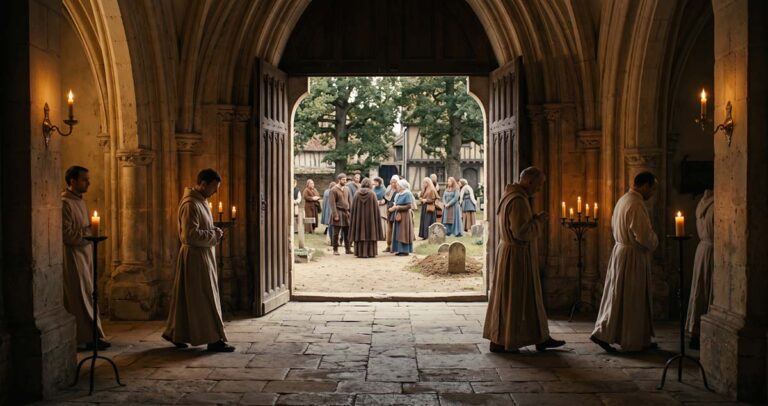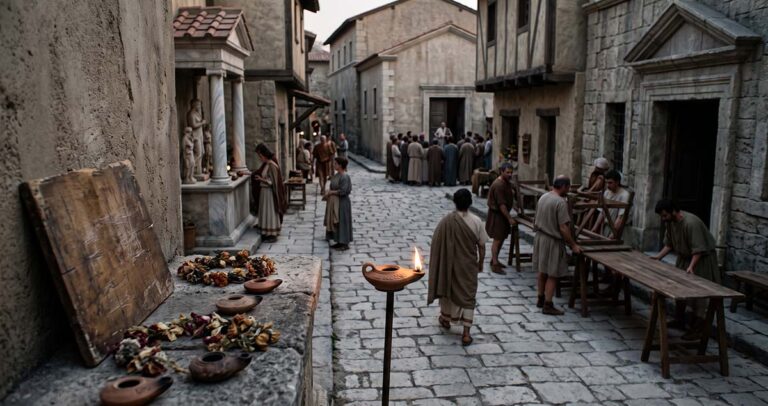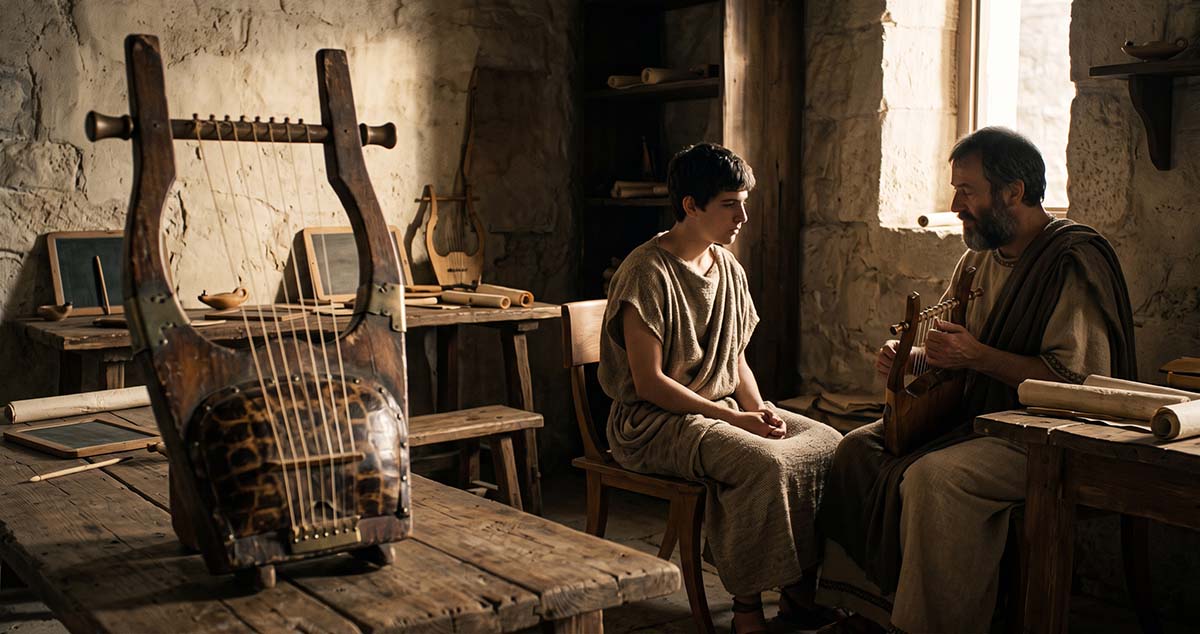
Episode 1: Before the Panic: Plato, the Modes, and the State’s First Claim on Sound (c. 380 BCE – 4th century CE)
This is Episode 1 of Music and the Moral Panic, examining how Plato music censorship emerged as political theory rather than an enacted Athenian ban. Ancient mousikē joined song, poetry, rhythm, movement, education, and performance within the formation of the citizen. Plato placed Dorian and Phrygian harmoniai inside the guardian curriculum while rejecting several lamenting or relaxed forms, and Republic 424c supplied the decisive political turn by connecting changes in musical practice with changes in civic law. Plato didn’t establish the world’s first music-censorship law. He supplied one of the earliest surviving systematic arguments for why political authority might claim jurisdiction over sounds believed to shape character.
An ancient Greek learning music entered a world much larger than the modern category suggests. Mousikē joined song, poetry, rhythm, movement, education, and performance. It accompanied ritual, helped structure civic education, and participated in the formation of people who were expected to occupy particular places within the community. Music belonged inside the machinery by which a culture reproduced itself.
That difference is essential to understanding Plato. He wasn’t deciding what records citizens should buy, what songs a radio station could broadcast, or which performers belonged on a prohibited list. None of that apparatus existed. His question concerned formation itself: what repeated exposure to rhythm, poetry, melody, and movement might cultivate in a human being.
The political logic of music regulation therefore appears before the modern machinery of censorship. No celebrity had to be denounced and no recording had to be confiscated. The series begins earlier, with an argument that would eventually make those actions intelligible.
Music as Civic Discipline
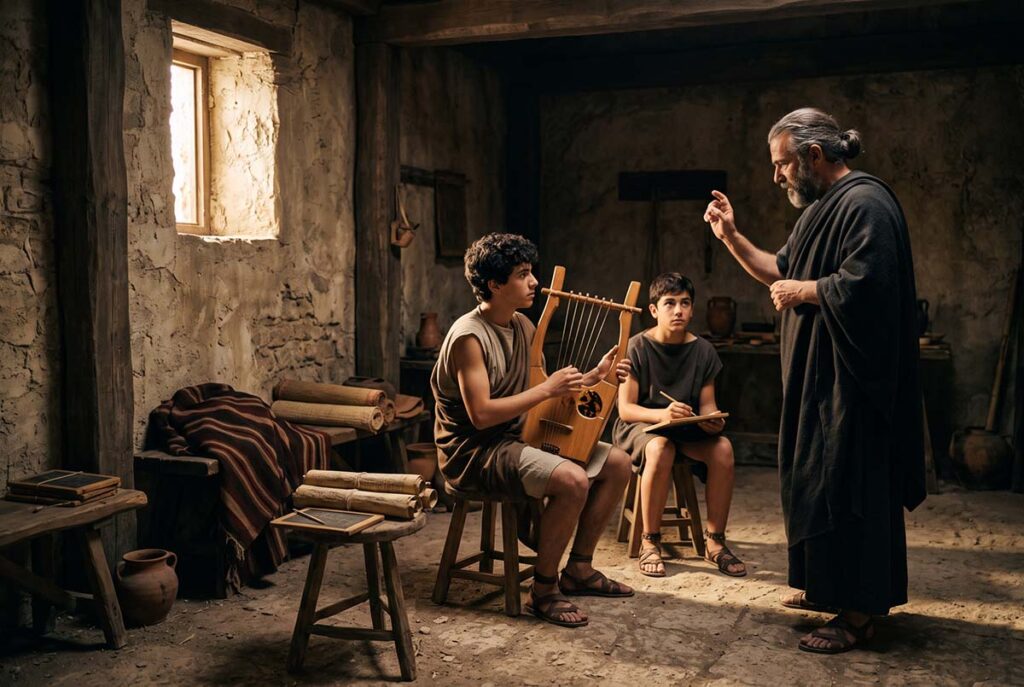
Greek musical education placed sound within a system of social formation. A young person learning song, poetry, rhythm, and movement wasn’t simply acquiring an accomplishment. These practices could help teach memory, coordination, inherited values, and forms of participation in communal life. The significance of music came partly from the fact that people believed it could become habitual.
Plato enters an intellectual culture in which the connection between education and character was already politically consequential. Once a society treats musical experience as formative, arguments about music can become arguments about the kind of people education ought to produce. A musical curriculum can then carry moral and civic expectations without requiring anything resembling a modern censorship bureau.
That distinction matters throughout this episode. The object being designed wasn’t a playlist. It was the citizen.
The Spartan Mirage and the Athenian Signal
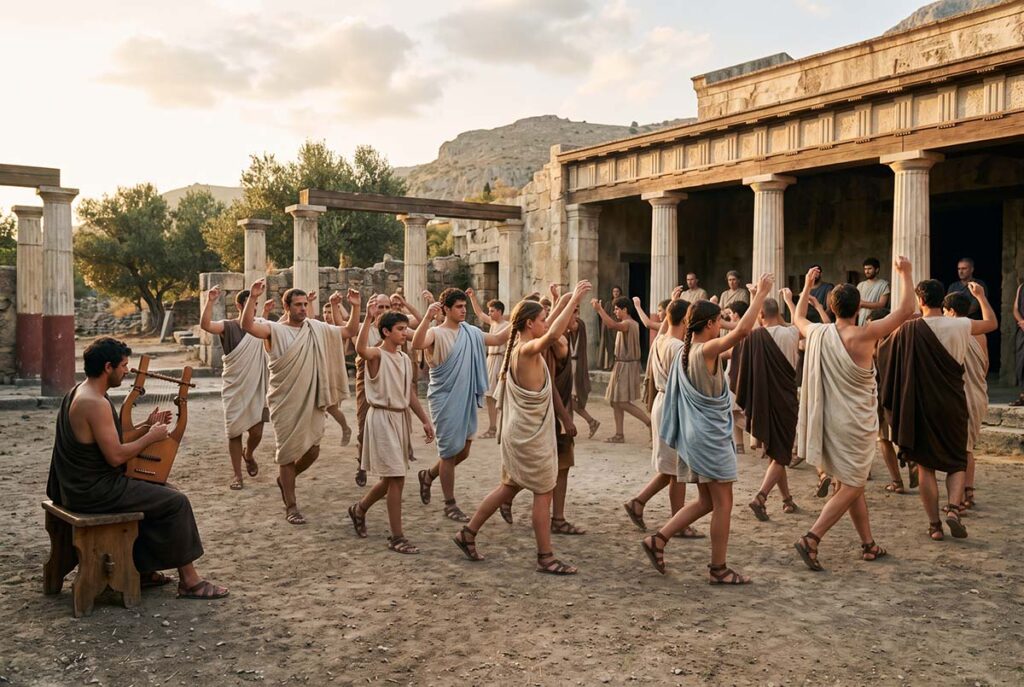
Sparta immediately complicates the popular image of Greek civic discipline. Later memory often reduces Spartan culture to warfare and austerity, yet poetry, choral performance, dance, musical competition, civic education, and military culture could occupy the same social world. Artistic sophistication didn’t sit outside discipline. It could participate in it.
That relationship makes music more politically interesting, not less. Choral practices coordinated bodies. Poetry carried shared ideals. Performance created habits of participation. The surviving evidence shouldn’t be forced into a picture of centralized musical conditioning, and much of what later writers tell us about Sparta arrives through outside perspectives. Even with those cautions, Spartan life demonstrates that civic discipline and substantial musical culture weren’t mutually exclusive.
Athens presents a different environment. Song and instrumental proficiency could belong to elite education and symposium culture, carrying social meaning beyond private pleasure. Ability with the lyre could mark participation in a cultivated social world.
The two cities shouldn’t be collapsed into a common political system. Their institutions and cultural practices differed. What they reveal together is more basic: musical education could belong inside civic formation rather than standing apart from it.
The Science of the Soul

By the fifth century BCE, Greek thinkers were developing arguments about the relationship between rhythm, musical organization, character, and emotional disposition. Modern scholarship often gathers these positions under the convenient label of musical ethos. That shorthand can make a complicated intellectual tradition look more uniform than it was, but the recurring concern is clear. Music was repeatedly discussed as something capable of participating in the cultivation of character.
Damon of Oa belongs close to the center of that tradition. Much of his thought survives indirectly, which makes reconstruction hazardous, but Plato treats him as an authority on rhythm and invokes him again when musical change becomes politically consequential. Damon matters precisely because his presence prevents Plato from looking like the solitary inventor of the connection between musical form and civic character.
The political implications follow from the premise. If musical experience cultivates disposition, musical education does more than communicate ideas. It participates in forming the person who receives them.
Sound constructs feeling within this ancient philosophical model, which turns a theory of music into a technology of governance. That sentence compresses the political implication of the Greek argument; it shouldn’t be mistaken for a claim about modern neuroscience. These writers weren’t conducting experimental psychology. They were reasoning from philosophical beliefs about imitation, habit, education, rhythm, emotion, and character.
The ancient harmoniai become especially important here, and their familiar names can mislead modern musicians. Dorian, Phrygian, Lydian, and Ionian in Greek theory shouldn’t simply be heard as the church or jazz modes that later inherited those names. The terminology survived while the underlying theoretical systems changed. For Plato, their importance lay in the dispositions he believed different forms encouraged.
Once musical classification becomes classification of character, the stakes change.
Plato Writes the Security Policy
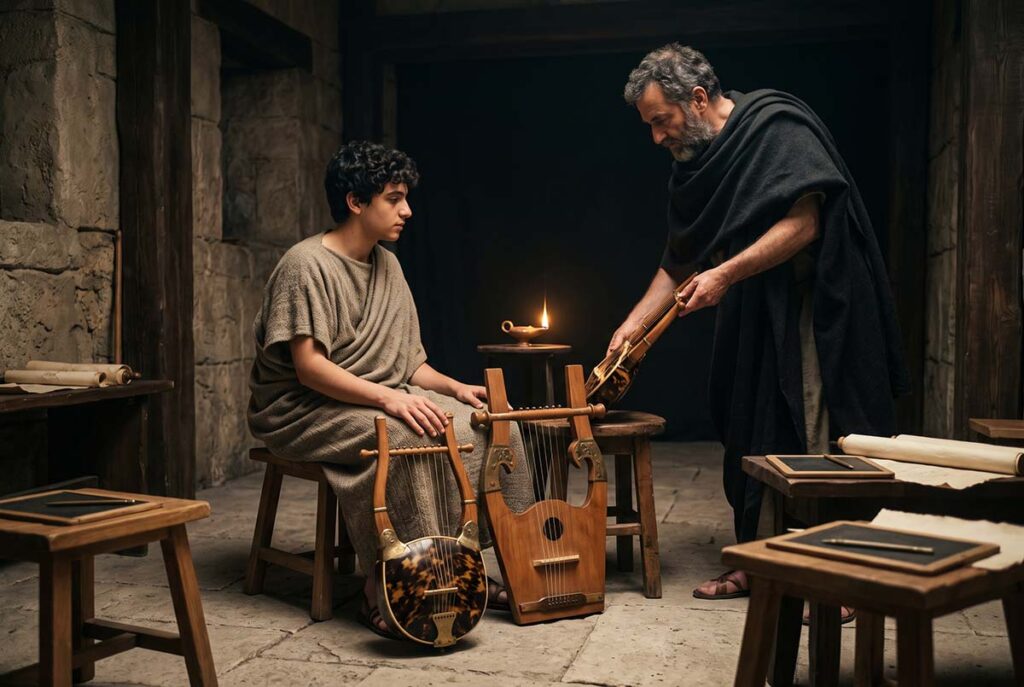
Book Three of The Republic places music inside Plato’s program for educating the guardians of his ideal city. The guardians can’t simply be exposed to whatever forms happen to circulate because their character, in Plato’s political design, is too important to leave to chance. Musical education becomes selective because human formation is selective.
Plato rejects several harmoniai he regards as lamenting or relaxed while retaining Dorian and Phrygian. The detail matters. Popular summaries sometimes reduce his position to a simple preference for stern Dorian discipline, but Phrygian survives his selection as well. Plato is constructing a curriculum, and the distinctions reflect what he believes different musical practices will cultivate in the people charged with defending the city.
Courage, restraint, grief, softness, excitation, and discipline acquire political importance because Plato treats them as elements of character rather than momentary reactions. Music enters the argument as one of the means through which those qualities can be cultivated.
He is writing a security policy.
The phrase identifies the political logic without converting Plato’s imaginary city into actual Athenian law. The surviving evidence doesn’t show Athens enforcing the guardian curriculum as a censorship code. Control appears here first as philosophy, inside a theory of legitimate education.
That makes the argument more consequential. A censor can disappear when a government changes. A justification for cultural jurisdiction can survive wherever an institution accepts the premise behind it: formation is politically important, and culture participates in formation.
Aristotle Objects and Agrees
Aristotle challenges Plato’s musical choices in Book Eight of the Politics. He accepts music’s importance to education but objects to Plato’s treatment of Phrygian, which Aristotle associates with a more emotional and exciting character. Dorian receives a stronger educational position in Aristotle’s account.
Their disagreement matters because it prevents Greek thinking about musical ethos from becoming a single doctrine with one approved list. Aristotle evaluates Plato’s categories, disputes part of the curriculum, and constructs a different hierarchy.
Yet the dispute leaves a larger assumption intact. Both philosophers allow political and educational thought to reach into the musical formation of citizens. They disagree over the contents of the curriculum while retaining the curriculum as a legitimate object of political philosophy.
The argument has already crossed an important boundary. Questions about what citizens hear, what dispositions education should cultivate, and how music participates in that cultivation have entered the sphere of public authority. The private interior is becoming public business.
Republic 424c and the Turning Point
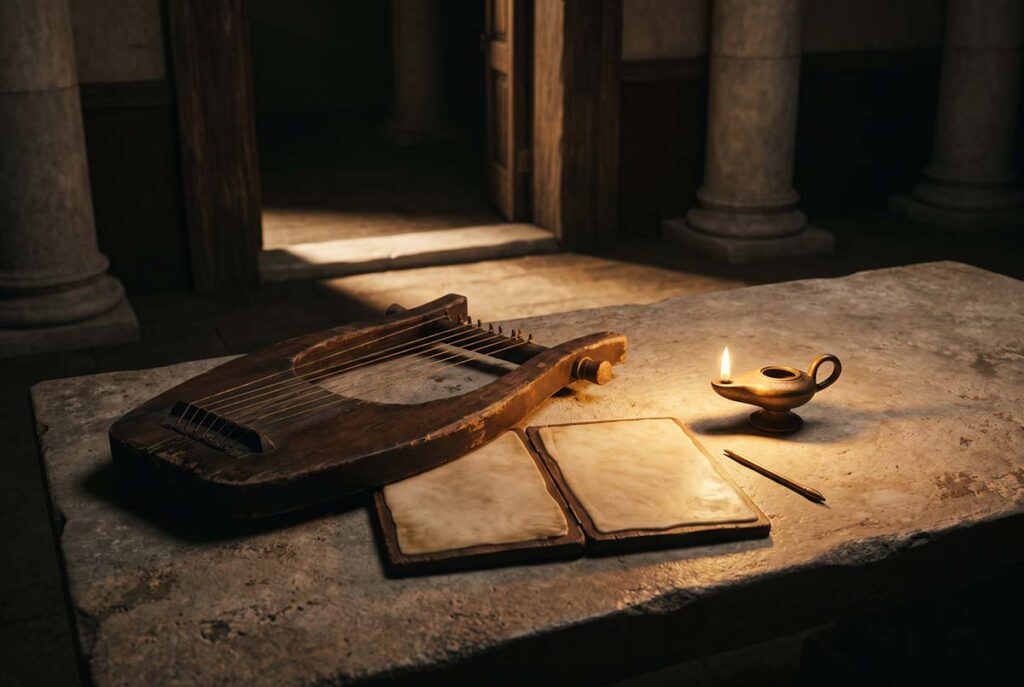
Republic 424c changes the scale of Plato’s argument. Earlier passages deal with music through character and education. Here Plato accepts a proposition attributed to Damon that changes in musical practice don’t stay inside music. They can eventually reach the city’s most important laws.
The danger works gradually. Musical practice shapes habits; habits help form conduct; conduct belongs to the social order; the social order supports political institutions. The larger argument can be compressed into a sequence: sound, soul, habit, social order, law. That sequence isn’t a single quotation from Plato, but it captures the political chain constructed across the argument.
Republic 424c is the hinge because musical innovation can now be understood as an early stage in constitutional instability. A change in sound has acquired political consequences far beyond the performance itself.
Musical innovation becomes legible as subversion.
The claimed interior is now visible. A government that believes disorder begins in habit has a reason to intervene before disorder appears publicly. Political control moves upstream toward education and character formation because waiting for conduct means waiting until the formative work has already occurred.
The crucial step doesn’t require proving that music actually causes constitutional collapse. It requires a political authority to believe that musical formation shapes the people from whom political order is made. Once that premise enters government, sound becomes a security problem.
The Logic That Survived

Plato’s program remained philosophical prescription rather than an enacted Athenian music law. That boundary can’t be surrendered without turning a strong historical argument into a false one. The Republic constructs an ideal city, and its musical curriculum belongs to that imagined political order.
The ancient world also resists any simple origin story. Greek music was more varied than Plato’s preferences. Sparta complicates the relationship between discipline and artistic culture. Aristotle complicates Plato. Later writers inherit, revise, and preserve different portions of the intellectual tradition. History doesn’t run in a straight line from Republic 424c to every censored song that follows.
A structure of reasoning survives more easily than a statute.
If culture forms character, institutions responsible for character can claim an interest in culture. Regulation can then be described as education, protection, moral formation, or political necessity. Suppression acquires a respectable vocabulary because the intervention is presented as care for the person or preservation of the community.
Centuries after Plato, Aristides Quintilianus was still discussing music within a broad intellectual framework that joined musical theory with education and ethical life. His work doesn’t prove an uninterrupted chain of censorship. It shows that arguments connecting music with the formation of human beings survived well beyond the political world in which Plato wrote.
That distinction will matter throughout this series. Later institutions don’t need to have read Republic 424c before arriving at similar conclusions. Structural inheritance can appear whenever authority identifies culture as formative and then claims jurisdiction over the formation.
The Claim on Feeling
Plato’s importance lies in the political architecture of the argument. Once musical experience is treated as a means of forming character, political authority gains a rationale for supervising the conditions under which that formation occurs. In The Republic, the laboratory is an ideal city rather than historical Athens.
Plato therefore didn’t establish the world’s first music-censorship law. Traditions joining music, ritual, civic authority, and collective life are older than his writing, and no single philosopher can be made the origin of cultural regulation.
What Plato gives us is one of the earliest surviving systematic explanations of why political authority might consider musical formation a legitimate concern of government. The argument begins with education, reaches inward toward disposition and character, then returns outward through Republic 424c to the stability of civic law. Once character has political consequences, whatever is believed to form character acquires political consequences too.
The next institution in this story will inhabit a different world. Early Christianity encounters Roman spectacle, pagan festivals, theater, dance, and ritual systems that organize communal life outside the emerging Church’s authority. The struggle will concern allegiance, calendars, bodies, pleasure, and communal time.
The mechanism changes. The claim over formation remains.
The argument was never merely about music. It was about who possessed the authority to decide what kind of person sound should help produce.
Frequently Asked Questions
Did Plato actually ban music in ancient Athens?
No. Plato’s musical curriculum belongs to the ideal political community constructed in The Republic. No surviving evidence establishes it as a censorship law enacted by fourth-century Athens. Its historical importance lies in the political argument that musical formation shapes character and can therefore become a legitimate concern of authority.
What did mousikē mean in ancient Greece?
Mousikē was broader than the modern category of music. It joined song, poetry, rhythm, movement, education, and performance within a larger system of cultural formation. Plato was theorizing practices through which young people acquired habits, dispositions, and forms of participation in civic life.
Who was Damon of Oa, and why does he matter to Plato’s argument?
Damon of Oa was an Athenian thinker associated with arguments connecting rhythm and musical practice with character and education. Much of his thought survives indirectly, so reconstruction requires care. His importance to this episode is explicit because Plato invokes Damon when connecting changes in musical practice with changes in civic law at Republic 424c.
What were the Dorian, Phrygian, Lydian, and Ionian harmoniai?
They were ancient Greek musical categories discussed in relation to ethical and emotional qualities. They shouldn’t be equated directly with modern church or jazz modes carrying the same names. Plato’s political argument depended on the dispositions he believed different musical forms cultivated.
Why does Aristotle matter if this episode is mainly about Plato?
Aristotle reveals both disagreement and consensus within Greek thinking about musical education. In Politics VIII, he criticizes Plato’s treatment of Phrygian and gives Dorian a stronger educational position. He still preserves the larger premise that music affects character and therefore belongs within political and educational thinking about the formation of citizens.
Why is Republic 424c the turning point of the episode?
Republic 424c expands the argument from character formation to political stability. Plato accepts Damon’s proposition connecting changes in musical manners with changes in civic law. Musical innovation can therefore become politically significant long before its supposed consequences appear in public institutions.
What did this era actually establish about music and political authority?
It produced a durable political rationale rather than a documented censorship regime. Once culture is treated as formative, institutions responsible for education and character can claim an interest in culture. Plato provides an early systematic version of that reasoning while the historical evidence requires a firm distinction between philosophical prescription and enforcement.
How does Plato’s argument lead into early Christianity and the next episode?
The institutional setting moves from Plato’s ideal state to the early Christian Church, while the conflict over formation continues. Episode 2 examines Christianity confronting Roman spectacle, pagan festivals, dance, theater, and ritual practices that organize bodies, calendars, pleasure, and communal allegiance through systems the emerging Church doesn’t control.