A Machine That Kills Fascists: The Guitar as a Political Decoy
Across labor movements, Cold War blacklists, Latin American resistance networks, and apartheid South Africa, the acoustic guitar carried testimony and collective memory when newspapers, broadcasters, institutions, and public speech were controlled. Woody Guthrie’s “This Machine Kills Fascists” inscription named this function, but the method had already been used by the Industrial Workers of the World, Joe Hill, and Ella Mae Wiggins before appearing in the work of Pete Seeger, Víctor Jara, Roger Lucey, and others. The historical record does not show that guitars defeated governments. It shows that songs placed forbidden narratives inside communities, where removing the original performer could no longer guarantee the destruction of what people had already learned.
Political resistance often begins before anyone gives it a formal name. It begins in a union hall, kitchen, church basement, public square, or crowded back room where something privately understood is about to be spoken aloud. Someone has to carry the idea through the door, make it intelligible to the people gathered there, and give them a form in which they can remember it after the room clears.
The object carrying that idea determines how far it can travel. A pamphlet requires paper, printing, distribution, and enough literacy to read it. A newspaper depends on a press and a network that can be monitored, purchased, or shut down. A broadcast requires electricity, equipment, access to the airwaves, and an institution willing to tolerate the risk.
An acoustic guitar requires one person, one instrument, and a room containing people capable of learning a tune. It can enter ordinary spaces without announcing itself as communications infrastructure. Its familiarity conceals the seriousness of its function.
The guitar takes grief, fury, solidarity, or fear and gives a group of people something they can hold together. When the other channels are closed, that is not a decorative achievement. It is a form of transmission.
From Factory Floor to Guitar Body
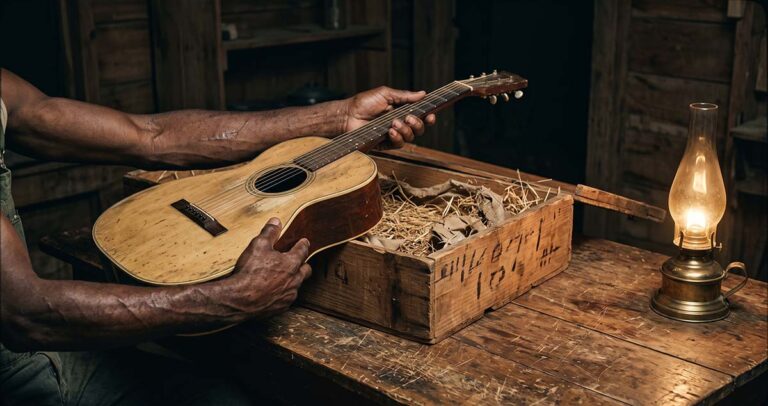
In 1943, Woody Guthrie painted the words “This Machine Kills Fascists” across the body of his acoustic guitar. The inscription became one of the defining images of American political folk music, but its language did not originate in the folk movement. Similar slogans had appeared on American factory machinery and equipment during the Second World War.
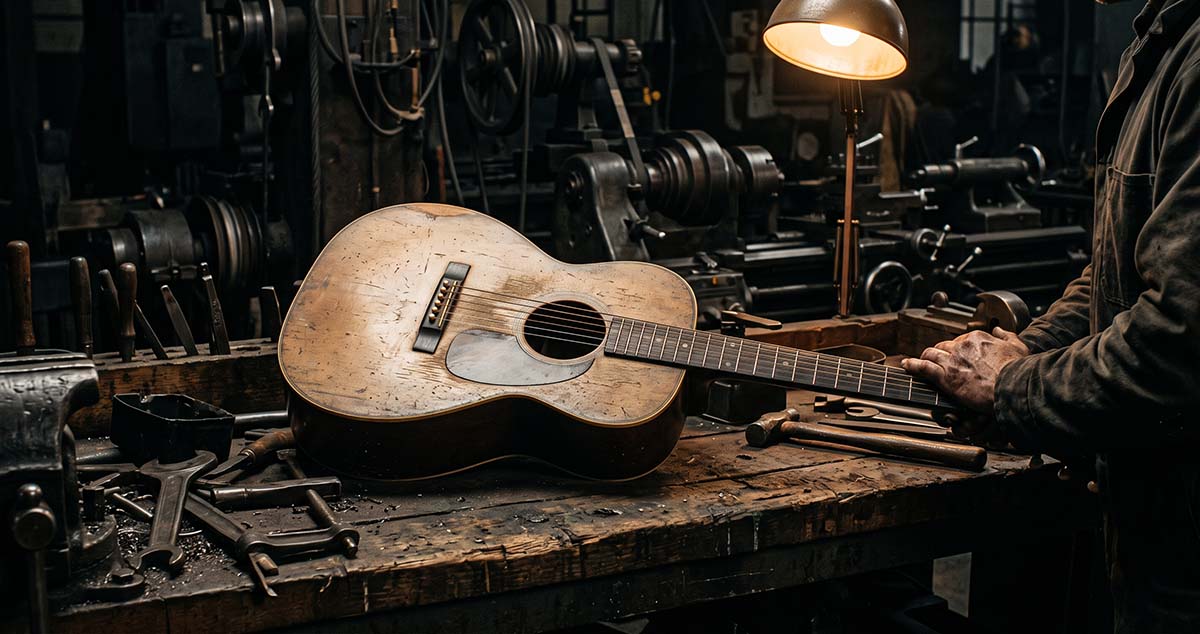
Factory language is blunt because it describes machines according to the work they perform. A lathe, drill press, or piece of aerospace equipment contributed materially to the production of weapons and vehicles used against fascist governments. The slogan compressed that relationship into a sentence workers could place directly on metal.
Guthrie transferred that industrial language onto a hollow wooden box.
The act has often been remembered as political decoration, yet the transfer contained a more serious proposition. Guthrie was classifying the guitar as a machine and asking that it be judged by its function. It could not manufacture an aircraft or physically destroy an army, but it could carry accounts of displacement, poverty, labor violence, and political belief from one gathering to another without a publisher, power source, license, or institutional intermediary.
The slogan was memorable. The method behind it was older.
The Distribution Problem
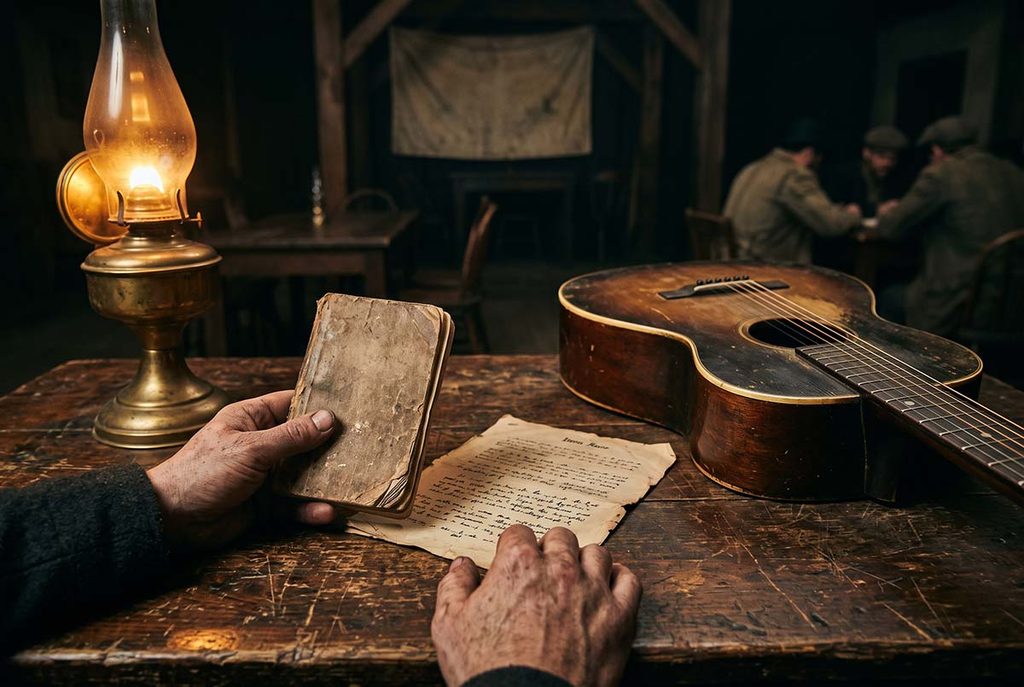
The Industrial Workers of the World confronted a practical organizing problem during the early twentieth century. The Wobblies were attempting to reach a workforce that moved constantly, spoke several languages, and was often excluded from formal education. A written political argument could be completely accurate and almost useless when the intended reader could not read it or had left town before it arrived.
Joe Hill solved a distribution problem by taking familiar hymn melodies and supplying them with new words. The tune had already been stored in the bodies and memories of workers. That recognition removed much of the instructional burden, allowing people who had never met to learn an altered lyric quickly and sing it together.
Hill was building a distribution network that required no paper, printing press, or literacy to operate. A pamphlet remains an object that someone must carry, preserve, and place in the next person’s hands. A song becomes part of the person carrying it.
Once the song has been learned, the distinction between audience and distributor begins to disappear. The political message is no longer merely being received by a crowd. It is being reproduced inside them.
Ella Mae Wiggins and the Cost of the Signal
Ella Mae Wiggins carried that method into the 1929 Loray Mill strike in Gastonia, North Carolina. A textile worker, single mother, union organizer, and songwriter, she used guitar, banjo, and radio to describe the poverty endured by workers and their families. Her songs were records created from inside the conditions they described.
Radio extended the reach of those records. Someone who had never entered a Gastonia mill could hear the language of the people who worked there. The guitar converted private suffering into public testimony, while broadcasting moved that testimony beyond the physical boundary of the picket line.
Wiggins was shot and killed while riding in the back of a truck on her way to a union rally. The men accused of killing her were acquitted. Her songs survived.
The evidence does not establish that the state ordered the murder of a songwriter. It reveals a political and economic system prepared to deploy armed force against organized workers, followed by a judicial outcome that imposed no meaningful accountability for her death.
Her story establishes a sequence that will recur across the following decades. Conditions are documented. The record moves outward. Authorities respond to the network forming around it. The body of the transmitter becomes vulnerable, but the transmitted material may already have passed beyond reach.
Woody Guthrie Inherits the Method
Woody Guthrie inherited a method that Hill, Wiggins, and generations of labor singers had already tested. He widened its field of operation.
The Dust Bowl gave Guthrie a population in motion. Families displaced by environmental collapse and economic failure carried little institutional power with them, and the official record rarely described their experience from inside the migration. Guthrie’s songs moved with those families and created an archive that did not depend on remaining in one place.
He used the same portable system to record coal-mining violence, labor struggles in Ludlow and Harlan County, and the international fight against fascism. Wherever Guthrie could travel, the account could be delivered without waiting for an editor, broadcaster, or publishing company to decide that the story deserved distribution.
In the early 1940s, Guthrie joined Pete Seeger and other musicians in the Almanac Singers. The group initially produced material opposing American involvement in the European war. After Nazi Germany invaded the Soviet Union, the Almanacs rapidly adopted a pro-enlistment and anti-Hitler position.
The reversal attracted federal attention. Intelligence agencies noted the earlier anti-war work and interpreted the speed of the change as possible evidence of organized political coordination. Whether that conclusion accurately represented the musicians’ motives mattered less than the institutional response it produced.
Acoustic folk performers were increasingly assessed as political transmitters capable of moving ideological language through culturally familiar American forms.
What the FBI Actually Understood
Cold War authorities developed a specific suspicion of folk music. Its rural imagery, hymn-derived melodies, acoustic instrumentation, and associations with an older America could give politically radical content a reassuring cultural surface.
The folk revival was carrying political ideas through a medium whose apparently apolitical register had been strategically useful since the Wobbly songbooks. Federal authorities understood the mechanism. Their larger mistake was believing that controlling the performer would produce control over everything the performer had already distributed.
J. Edgar Hoover’s FBI, congressional committees, and commercial publications assembled overlapping systems of surveillance and exclusion. Musicians were indexed, monitored, subpoenaed, professionally isolated, and removed from mainstream broadcasting. The publication Red Channels gave commercial institutions a reference guide for deciding which artists had become politically unsafe.
Pete Seeger appeared before the House Un-American Activities Committee in 1955. Rather than invoke the Fifth Amendment’s protection against self-incrimination, he relied on the First Amendment and rejected the committee’s authority to force testimony about his political beliefs and associations. He was cited for contempt of Congress, later cleared on appeal, and excluded from much mainstream broadcasting for more than a decade.
The scale of the response deserves attention. A government with enormous legal, military, intelligence, and economic power devoted serious resources to people carrying banjos and acoustic guitars.
That response makes sense once the musician is understood as one visible point in a larger distribution system. Removing Seeger from television could restrict his access to a national audience. It could not remove the songs from every union member, student, folk-club performer, or family that had already learned them.
The government could close a channel. The tradition kept producing new ones.
The British Complication
The British folk revival reveals what can happen when a form built to carry marginal voices begins constructing an institution of its own. Beginning in the late 1950s, Ewan MacColl, Peggy Seeger, Charles Parker, and their collaborators created the BBC Radio Ballads, documentary works that combined testimony from miners, railway workers, fishermen, and traveling communities with newly composed songs.
Working-class speech was not treated as local color. It became the organizing center of the work. People whose lives were usually interpreted by journalists, broadcasters, and middle-class authorities were allowed to speak in their own voices, while the surrounding ballads treated their experience as material worthy of serious documentary art.
The movement preserving working-class expression also developed restrictive ideas about authenticity. MacColl advocated strong connections between singers and the national or regional traditions from which their repertoire originated. American influences were resisted, while boundaries involving gender, instrumentation, and cultural legitimacy hardened.
The contradiction does not erase the achievement of the Radio Ballads. It demonstrates that folk music can resist authority, serve authority, or reproduce smaller systems of control within its own community.
The guitar possesses no automatic political virtue. It travels in the direction chosen by the people holding it.
Nueva Canción and the Southern Cone
Nueva Canción developed an acoustic transmission system across Latin America from the late 1950s through the 1970s. Musicians such as Violeta Parra in Chile and Mercedes Sosa in Argentina joined the guitar with indigenous instruments, including the charango and Andean pan pipes, creating a musical language rooted in communities that national institutions had often pushed to the margins.
The songs addressed poverty, indigenous land rights, repression, and human dignity through specific names, places, and lived conditions. Their regional instruments did not serve as picturesque decoration. They carried an argument about whose experience belonged inside the national record.
In Chile, Nueva Canción became cultural infrastructure. La Peña de los Parra in Santiago gave musicians, workers, students, and political organizers a physical place to share a cultural vocabulary. Víctor Jara, Inti-Illimani, Quilapayún, and other artists worked inside a network whose musical and political functions could no longer be separated cleanly.
When Salvador Allende’s Popular Unity coalition campaigned for the presidency in 1970, musicians within that network became part of its cultural apparatus. Songs moved through rallies, cultural venues, records, informal gatherings, and international performances.
Official channels controlled by political opponents required the construction of unofficial ones. In Chile, many of those channels ran through acoustic strings.
Chile Stadium

A military coup overthrew the Allende government on September 11, 1973, with support from the United States. Thousands of political prisoners were detained inside Chile Stadium in Santiago during the days that followed.
Víctor Jara was among them. Soldiers recognized the songwriter, and witness accounts consistently describe his hands as being deliberately targeted, although descriptions of the exact injuries vary. Some witnesses said they were broken. Others described severe beating and damage.
The historical distinction matters, but the consistent fact carries the argument. Inside a stadium holding organizers, journalists, workers, students, teachers, and political officials, the hands of a songwriter became a specific site of punishment.
The soldiers attacked the point where Jara’s body met the instrument. They could prevent those hands from forming another chord. They could humiliate a recognizable performer in front of other prisoners and turn his damaged body into an example.
They could not return the songs to him.
Once a song has been learned, it no longer requires the person who wrote it. The archive was no longer stored in one body. The soldiers were destroying the body that had become its most visible transmitter.
Jara continued singing with other detainees after his hands had been injured. He was killed by gunfire soon afterward. His songs have since been performed around the world by people who never entered Chile Stadium and never heard him sing in person.
Nothing about that survival redeems his death. His family, community, and country endured a dictatorship whose violence cannot be converted into an uplifting lesson about the endurance of art.
The survival matters because it exposes a limit within the violence. A government can kill the person who created a record. It cannot automatically retrieve the memory that record has placed inside other people.
What Suppression Looked Like Elsewhere
Military governments across Argentina, Uruguay, Brazil, and the wider Southern Cone used censorship, imprisonment, exile, broadcast restrictions, and record bans to break cultural networks connected to political opposition.
In Francoist Spain, Nova Cançó used the Catalan language as both cultural material and political fact. A song performed in Catalan preserved a public identity the regime had attempted to subordinate. Language and melody became one transmission system.
Cuba prevents any simple claim that acoustic folk music is inherently oppositional. Revolutionary music there could receive state support and operate in service of official narratives. The same instrument that carries a forbidden account under one political order may distribute an approved account under another.
The guitar contains no politics by itself. Its political meaning emerges from the relationship among the singer, the listeners, the institutions controlling public speech, and the narrative being carried.
Apartheid South Africa produced another extensive system of cultural control. The South African Broadcasting Corporation regulated access to the airwaves, while censorship, passport restrictions, surveillance, and commercial pressure narrowed the spaces available to politically dangerous musicians.
Miriam Makeba’s passport was revoked after her work and international visibility made her unacceptable to the apartheid government. Musicians such as Vusi Mahlasela used songs to preserve accounts of segregation and police violence in forms capable of surviving censorship, at least temporarily.
The guitar performed documentation work where official documentation was controlled by the state. A song could retain a victim’s name after a government report had erased it, distorted it, or prevented the report from appearing.
Roger Lucey and the Structural Proof
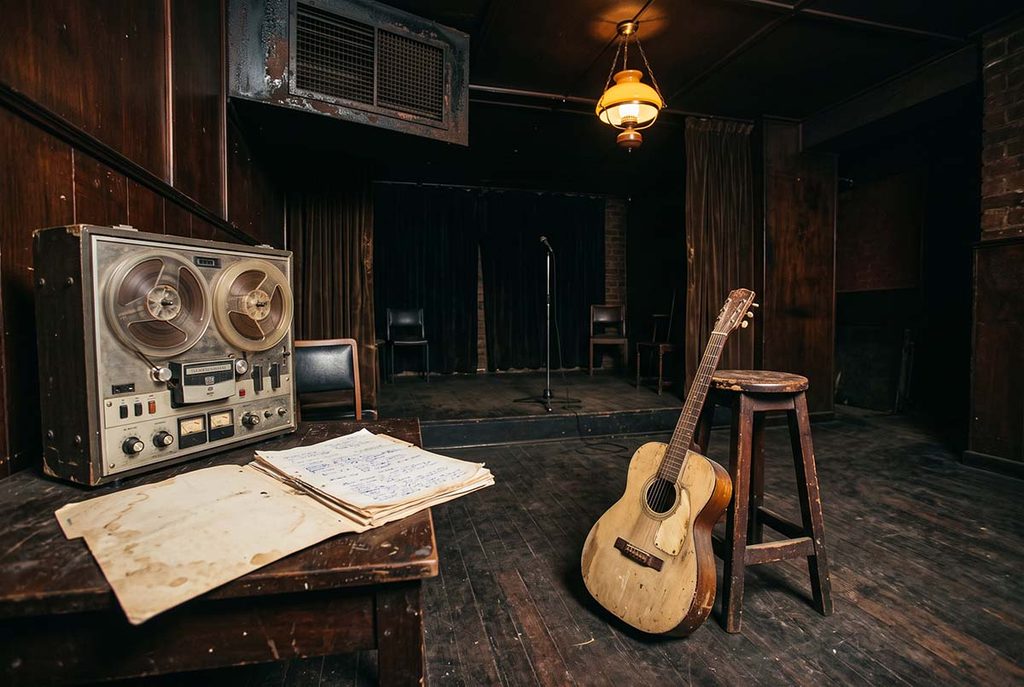
Víctor Jara provides the episode’s emotional center. Roger Lucey provides its structural proof.
Lucey was a young South African songwriter whose lyrics named people killed in police custody and addressed conditions the apartheid government was determined to control. He was not an internationally dominant cultural figure capable of commanding enormous crowds. His audiences could fit inside an ordinary club.
The South African Security Branch still recorded his performances, transcribed his lyrics, pressured record-company executives, intimidated venue owners, and obstructed his access to commercial distribution. Clubs where he appeared were disrupted, including through teargas introduced through ventilation systems. The pressure steadily dismantled his ability to earn a living as a performer.
The disproportion is the argument.
When a state security apparatus records one folk singer, pressures businesses to deny him employment, and disrupts a nightclub to prevent a few dozen people from hearing his songs, it has made an assessment. The size of the audience is not its only measure of danger.
Listeners could carry the material elsewhere. One performance might become several conversations, another performance, a copied recording, or a song learned by someone who would never appear in a security file.
Lucey’s guitar was not physically powerful. It was operationally inconvenient. It allowed a narrative naming police violence to move through small human networks that were difficult to map completely and expensive to suppress one room at a time.
From Washington’s blacklists to Santiago’s stadiums and Pretoria’s intelligence files, governments of radically different political compositions expended legal, military, and institutional power against people with wooden instruments. Their motives and methods differed. Each confronted the same logistical problem.
The Machine and What It Actually Does
Guthrie’s inscription was a cultural diagnosis rather than magic or prophecy. “This Machine Kills Fascists” expressed something political authorities on several continents encountered through experience. A song that has entered a community possesses properties that are difficult to confiscate.
A publishing house can be closed. A broadcast license can be revoked. A record can be banned, a performer blacklisted, and a cultural venue raided. Each action can inflict lasting damage, but none automatically removes a melody and its associated memory from every person who already knows it.
The guitar is unusually suited to this form of transmission because it is portable, relatively inexpensive, intimate, and independent of large infrastructure. One player can carry it. One room can hear it. Anyone who learns the song can reopen the channel somewhere else.
Songs do not substitute for political organization, material resistance, law, diplomacy, or the people who accept the physical risk of confronting power. The histories of Wiggins, Jara, Seeger, Makeba, and Lucey offer no basis for romanticizing the cost.
The inscription matters because it named a function that political authorities repeatedly recognized. The guitar could carry testimony after the official record had been seized. It could preserve the name of someone a government wanted forgotten. It could transform listeners into custodians of a narrative.
A political pamphlet can be burned. A memory that has entered a voice and a community of listeners is already past the checkpoint.
Frequently Asked Questions
What did Woody Guthrie mean by “This Machine Kills Fascists”?
Guthrie transferred industrial wartime language from American factory machinery onto an acoustic guitar. He was not claiming that the instrument could physically destroy fascism. The inscription identified the guitar as a working machine capable of carrying political testimony, labor history, and anti-fascist ideas without requiring a publisher, license, or power source.
How did the acoustic guitar function as political transmission?
The acoustic guitar allowed political memory to move through human gatherings without depending on centralized infrastructure. A player could carry a song into a union hall, kitchen, church basement, public square, or small club. Once listeners learned it, they could become new transmitters, making the narrative harder to isolate or confiscate.
Who were the Industrial Workers of the World and the Wobblies?
The Industrial Workers of the World, commonly called the Wobblies, was a radical labor organization founded in 1905. It organized workers across industries, languages, and ethnic groups. Songwriters such as Joe Hill adapted familiar hymn melodies so workers could learn political lyrics quickly, even without literacy, printed pamphlets, or stable access to newspapers.
Who was Ella Mae Wiggins and why is she important to this history?
Ella Mae Wiggins was a textile worker, union organizer, and songwriter involved in the 1929 Loray Mill strike in Gastonia, North Carolina. She used guitar, banjo, and radio to document workers’ poverty from inside the community. She was killed while traveling to a union rally, but the songs carrying that testimony survived.
What was Nueva Canción?
Nueva Canción, or New Song, was a Latin American musical movement that joined acoustic guitar with indigenous instruments and regional traditions. Artists including Violeta Parra, Mercedes Sosa, Víctor Jara, Inti-Illimani, and Quilapayún addressed poverty, land rights, repression, and cultural identity while building networks that joined musical performance with political organization.
Why were Víctor Jara’s hands targeted in Chile Stadium?
Witness accounts consistently describe soldiers deliberately injuring Jara’s hands after the September 1973 military coup, although descriptions of the exact injuries vary. The act targeted the physical point where the songwriter met his instrument. It could stop him from playing, but it could not retrieve songs already held in other people’s memories.
How did apartheid authorities suppress Roger Lucey?
South Africa’s Security Branch recorded Lucey’s performances, transcribed his lyrics, pressured venues and record companies, and obstructed his commercial career. Clubs where he appeared were disrupted, including through teargas introduced through ventilation systems. The scale of that response revealed how seriously authorities treated one songwriter’s ability to circulate accounts of police violence.
What does this history reveal about who the guitar belongs to?
The record shows that the guitar belongs neither exclusively to famous performers nor to commercial institutions and recognized political movements. Its political force came from ordinary human networks in which listeners became custodians and carriers. The instrument itself has no fixed ideology, but it can place memory beyond the control of whoever governs the official archive.