Painted Sound: What Picasso’s Cardboard Guitar Did to the 20th Century
Pablo Picasso’s 1912 cardboard Guitar transformed commercial packaging, thread, twine, and wire into a constructed sculpture that helped move Cubism from fractured representation into physical space. Its disposable material, its connection to the perceptual logic of a Grebo mask, and its identity as the instrument of Spanish, bohemian, and working-class Paris formed a calculated cultural provocation. Picasso brought both commercial society’s discarded matter and the social world excluded by elite institutions into modern art. He used the guitar to challenge the hierarchy that claimed the authority to decide what deserved elevation.
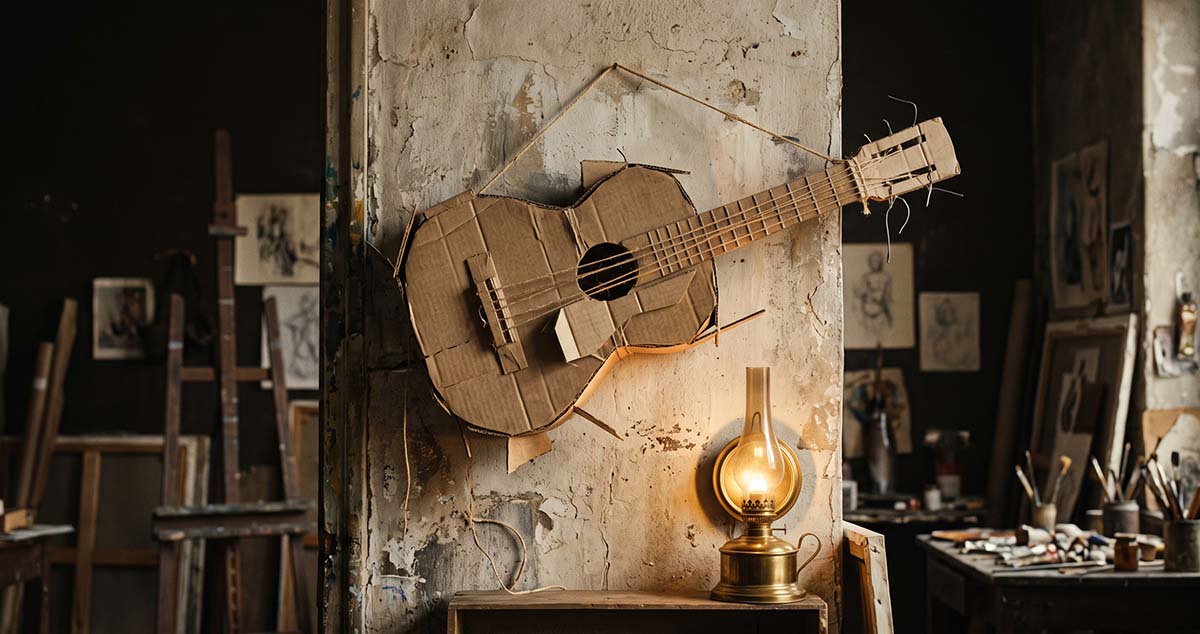
In late 1912, Pablo Picasso assembled a guitar from paperboard, coarse thread, twine, and wire in his studio on the Boulevard Raspail in Paris. The paperboard was the heavy laminated stock used for commercial hat boxes and shoe boxes. It bent, creased, and retained the pressure of the hands that worked it. Nothing about the material suggested that anyone expected it to survive.
The finished construction has become one of modern art’s fixed historical points. It stands near the division between Analytic and Synthetic Cubism and is regularly described as a decisive step toward constructed sculpture. Picasso didn’t carve material away or model a form that could later be cast. He folded, cut, joined, and stitched ordinary matter into three-dimensional space.
That account is accurate, but it leaves out the cultural decision that came before the construction. Picasso chose to build a guitar at a moment when the instrument carried associations far removed from the academy, concert hall, and museum. In the Paris of 1912, the guitar belonged to cafés, popular entertainers, migrants, Spanish identity, itinerant musicians, and working people. It carried the sound of streets and rooms that serious cultural institutions weren’t designed to hear.
Before Picasso cut the cardboard, he had already made the defining decision. He had chosen the instrument.
The Logic of Permanence Picasso Abandoned
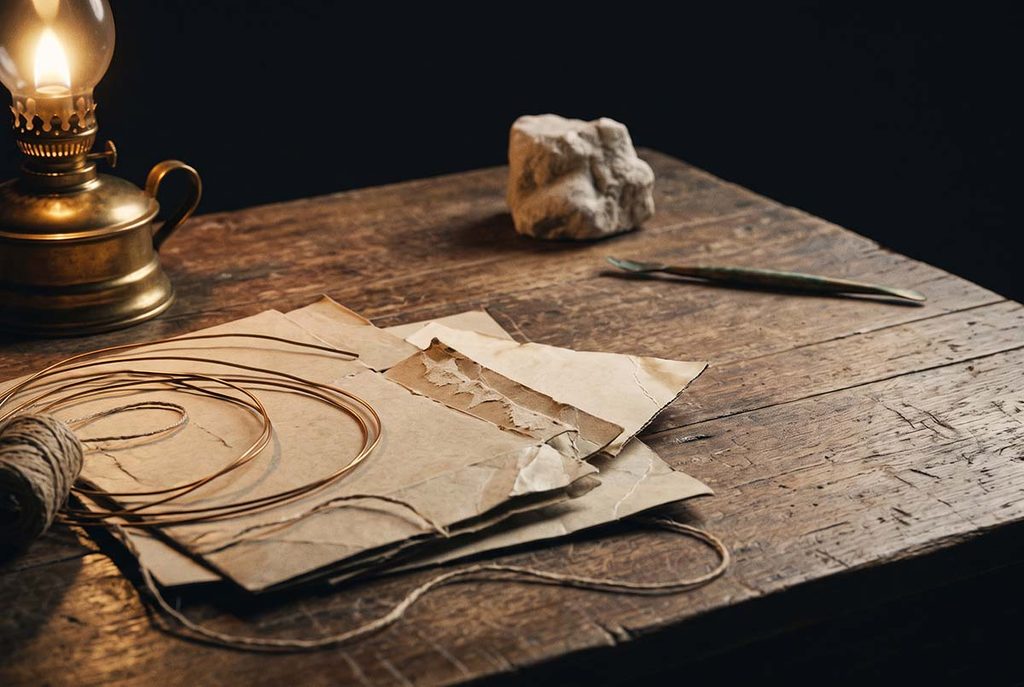
European sculpture had operated for centuries within a logic of permanence. Marble was quarried because it resisted time. Bronze was cast because it could survive the person who commissioned it. The material announced a cultural verdict before the finished form had spoken: this object deserved endurance.
Picasso brought the packaging of commercial industry into that tradition. Hat boxes and shoe boxes belonged to circulation rather than preservation. They protected commodities until a purchase was complete, then became unnecessary. Their expected destination was the rubbish heap, not the pedestal or archive.
He didn’t disguise the paperboard as something more respectable. Its layered edges remained visible. Coarse thread crossed its surfaces, while twine and industrial wire held parts of the construction together. The object revealed how it had been made because the method carried part of its meaning.
The material was the argument. Commercial waste entered a cultural form historically associated with wealth, authority, and permanence. The cardboard had already been declared disposable by one system of value before Picasso placed it inside another.
That decision raised a question larger than sculptural technique. Who possessed the authority to determine what deserved preservation? Picasso’s answer began with material that commercial society had already judged unworthy of keeping.
The Corner Analytic Cubism Built
The cardboard construction emerged from a problem Picasso and Georges Braque had created together. Between 1908 and 1911, the two artists dismantled the conventions of Western perspective and fractured represented objects into overlapping planes. Analytic Cubism asked viewers to reconstruct a subject from simultaneous angles, partial signs, and geometric interruptions.
The paintings were rigorous, but the method produced its own limit. As objects were divided into increasingly dense networks of facets, recognizability began to disappear. Viewers often needed prior knowledge of a composition to identify what the picture claimed to contain.
Cubism had successfully broken the authority of conventional sight, yet it risked severing its remaining connection to the visible world. The represented object had been analyzed until it could barely survive the analysis. Picasso found himself caught inside a problem created by his own achievement.
Restoring traditional perspective would have surrendered the argument. He needed another way to let the physical world enter the work without returning to illusion.
The Braque Forcing Function
In 1912, Braque began pasting commercially produced paper directly onto his canvases. Wallpaper, newspaper fragments, and simulated wood grain entered a medium that had previously represented such surfaces through paint. He called the method papier collé.
The rupture was straightforward but profound. A painted imitation of wood remained an image. A fragment of patterned paper was a physical object carried into the composition from the world outside it. The material no longer needed to be represented because it was present.
When Picasso encountered what Braque had done, the limitations of the canvas became harder to ignore. Braque had moved literal material onto the painted surface. Picasso responded by leaving that surface and constructing an object in the physical space of the room.
The move altered the terms of their collaboration. Analytic Cubism had depended on two painters contesting the same picture plane. Three-dimensional construction opened territory their previous method couldn’t contain. Picasso made Braque’s innovation look like a half-measure by extending its logic beyond the canvas.
The Guitar was therefore both a solution and an escalation. It gave recognizability back to the object while refusing to retreat into conventional representation. It also moved Picasso into a field where his partnership with Braque could no longer continue on equal terms.
What the Grebo Mask Actually Taught Him
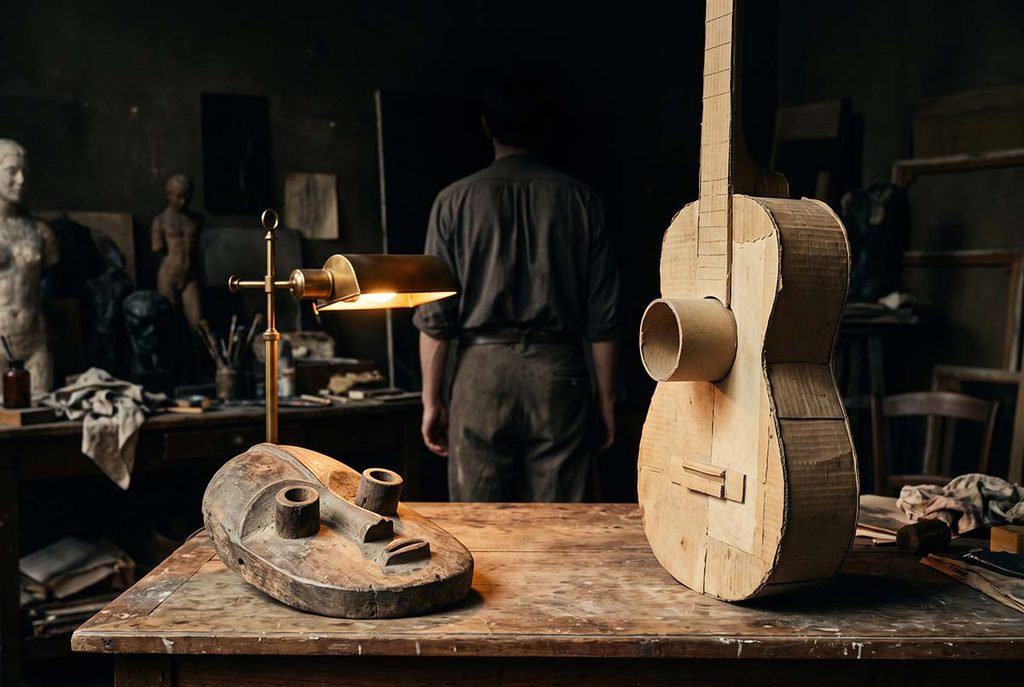
A traditional acoustic guitar conceals the space that gives it resonance. The wooden top covers a hollow chamber, and the enclosed air volume helps the instrument produce sound. Its front plane hides its functional interior.
Picasso reversed that relationship. He opened the guitar’s body and exposed the space normally concealed behind the wooden surface. The hollow chamber became part of the visible structure. He then gave physical mass to the sound hole, ordinarily an absence cut into the top. In the cardboard Guitar, the sound hole projects outward as a cylinder.
Art historians have connected this reversal to a mask made by the Grebo people of Liberia and Côte d’Ivoire, part of the wider African material culture Picasso encountered through the collections and markets of colonial Europe. The mask presents a relatively flat frontal plane from which cylindrical wooden eyes project outward. Anatomically, an eye socket would recede. The mask produces the idea of recessed space through projecting mass.
The connection remains a supported art-historical inference rather than a documented account of one decisive moment in Picasso’s studio. Its significance reaches beyond surface resemblance. The mask demonstrates that the mind can understand depth even when the expected recessed form is missing. A projecting cylinder can make viewers imagine the absent space behind it.
Picasso encountered a perceptual principle: the brain completes what the object projects. Mass and void can exchange functions without destroying legibility.
That principle helps explain the Guitar’s formal structure, but its cultural consequences reach further. Picasso projected discarded material and a socially marginal instrument into the space of elite art. The cardboard carried the commercial system that had disposed of it. The guitar carried Montmartre, popular song, Spanish identity, and the lives of people who existed beyond approved cultural boundaries.
The viewer completed both absences. The projecting cylinder implied the space hidden behind the mask. The projecting instrument brought an excluded social world into the gallery.
The Instrument of Everyone Not Supposed to Be There
Musical instruments carried recognizable social positions in early twentieth-century Paris. The violin belonged to the conservatory, the concert hall, and the cultivated inheritance of the educated bourgeoisie. Braque played the violin and returned to it repeatedly within the shared visual vocabulary of Cubism.
The guitar occupied another cultural world. In Montmartre, it belonged to cafés, cabarets, popular entertainers, working people, and itinerant musicians. It could accompany a voice in a crowded room without the ceremony that separated performer from audience. Its sound was intimate, portable, and ordinary.
Picasso knew that environment. Before his success placed him near the center of the Parisian avant-garde, he had spent years around the Lapin Agile on the Butte Montmartre. Frédéric Gérard, known as Frédé, presided over a room that gathered artists, poets, laborers, and outsiders whose lives didn’t conform to the cultural dignity of the concert hall. The guitar belonged to the room’s atmosphere rather than its formal program.
Picasso was also a Spaniard operating inside French modernism, and the guitar carried Spanish and Andalusian associations for Parisian audiences. Those associations can’t serve as simple proof of his private intentions, but they formed part of the instrument’s public meaning. The object arrived already marked by geography, class, and cultural identity.
Picasso chose the guitar because it belonged to people who weren’t expected to occupy the institutions surrounding him. When he moved it into modern art, he imported more than a convenient arrangement of curves, strings, and openings. He imported a social position, with the café and street still attached.
The Guitar Wins the Argument
The competition between Picasso and Braque unfolded partly through their choice of subjects. The violin occupied a central position in their shared Cubist vocabulary. During the later months of 1912, Picasso increasingly substituted the Spanish guitar for an instrument culturally associated with Braque and the French academic tradition.
Historians have interpreted this sequence as more than a change of motif. In Guitar, Sheet Music, and Glass, Picasso included a newspaper fragment carrying the phrase “La Bataille s’est engagée,” meaning that the battle had begun. Art historian Tyler Green has connected the clipping to the rivalry, although the interpretation can’t be treated as a confirmed statement of Picasso’s intentions.
The reading carries weight because it fits the documented chronology. Braque introduced papier collé. Picasso answered by moving construction into the room. The guitar then displaced the violin within the visual language they had developed together.
The instrument was Spanish in association and working-class in its Parisian cultural position. It claimed the iconographic center of a movement Picasso had built beside a French collaborator whose instrument was the violin. Their partnership ended, and the avant-garde continued into territory Picasso’s construction had opened.
The guitar won the argument.
Neither Painting Nor Sculpture
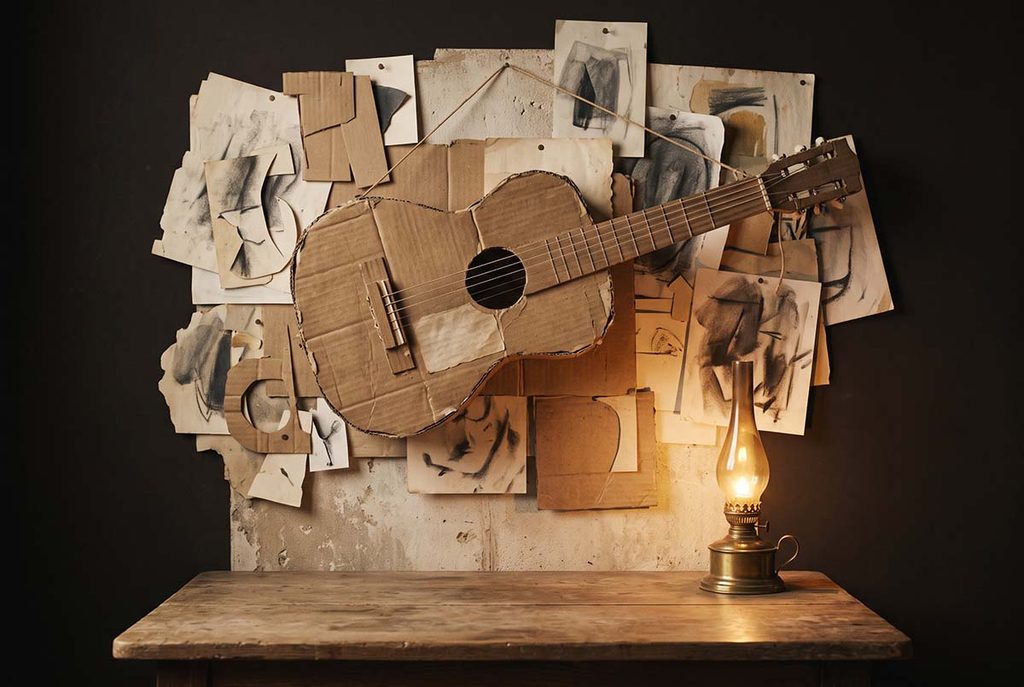
Picasso didn’t present the cardboard Guitar on a sculptural pedestal. He hung it on a wall among drawings, clippings, and other Cubist works, placing a three-dimensional construction inside territory conventionally assigned to painting. It projected into the room while remaining attached to a flat architectural surface.
The poet and critic André Salmon recognized the categorical problem. The inherited distinction between painting and sculpture couldn’t adequately account for the object. It occupied the wall, possessed physical depth, and refused to settle within either established medium.
For decades, the work was understood primarily as a hanging construction. Early photographs of Picasso’s studio eventually led researchers to a curved paperboard element preserved among his stored materials. When recognized as a tabletop and reconnected conceptually to the Guitar, it changed the scale of the work’s ambition.
The guitar ceased to appear as an isolated object suspended against a wall. It became part of a projected still life extending into the viewer’s physical space. The wall served as picture plane and architectural support, while the tabletop crossed the boundary between represented space and occupied space.
The Guitar was designed to inhabit the territories of painting and sculpture without accepting a final verdict on which one contained it. The recovered tabletop didn’t impose a new interpretation on the work. It revealed how completely the original construction had resisted classification from the beginning.
The Metal Version and the Museum
In 1914, Picasso produced another Guitar from sheet metal and wire. The material was harder, colder, and more durable, but its structural logic remained tied to the fragile paperboard original. Folded planes and projecting forms were translated into an industrial medium capable of surviving the handling that threatened the first construction.
Picasso kept both versions for the rest of his life. He gave the metal Guitar to the Museum of Modern Art in 1971. After his death in 1973, the cardboard construction entered the museum through his estate.
By then, the works no longer required institutional acceptance to establish their influence. Constructed sculpture had become part of twentieth-century practice. Assemblage, mixed-media work, and spatial installation had expanded the materials and environments art could occupy.
The museum arrived after the argument had been won.
MoMA’s later research and exhibition of the cardboard construction restored the tabletop to the object’s interpretation and presented the Guitar as a system rather than an isolated sculpture. The archive clarified what Picasso’s early studio had already contained: an image, object, still life, wall construction, and spatial environment that refused to accept any single description as final.
Recognition: What the Hierarchy Decided
Picasso lived until 1973, long enough to see the cardboard construction become part of the established history it had once disturbed. The paperboard survived despite having been designed for temporary commercial use. The guitar entered the museum despite carrying the cultural associations of streets and rooms that museums had rarely been built to preserve.
The object established that the disposable materials of mass culture could carry a serious artistic and cultural argument. It also established that the working-class guitar could carry that argument without being cleansed of its social origins. Its marginal position supplied the force of the provocation.
Picasso didn’t elevate the guitar. He used it to dismantle the hierarchy that decided what was worth elevating.
That distinction preserves the people and places the instrument carried into modern art. The guitar didn’t acquire meaning when a museum accepted it. Its meaning had accumulated through the café, the street, migration, labor, popular entertainment, and the private act of making sound without institutional permission.
Picasso’s cardboard Guitar remains silent. It can’t resonate, accompany a voice, or fill a room with music. Yet the human tradition embodied by its shape remains recognizable. It belongs to every player who has discovered that a guitar can create a place for someone before the wider culture decides whether that person belongs.
The instrument was never waiting to be elevated. The hierarchy was waiting to be confronted.
Frequently Asked Questions
Why did Picasso make a guitar out of cardboard?
Picasso used paperboard, thread, twine, and wire because those materials challenged the European sculptural tradition of marble and bronze. Commercial packaging had already been classified as disposable. By building a serious cultural object from it, Picasso questioned who possessed the authority to decide which materials and lives deserved preservation.
Why is Picasso’s cardboard Guitar important to modern art?
The 1912 Guitar helped establish constructed sculpture by replacing carving and modeling with cutting, folding, joining, and stitching. It also moved Cubist thinking beyond the flat canvas and into physical space. Its importance lies in both its unusual construction and the cultural argument carried by its discarded material and marginal instrument form.
What did the Grebo mask teach Picasso?
Scholarship connects the Guitar’s projecting sound-hole cylinder to the cylindrical eyes of a Grebo mask from Liberia and Côte d’Ivoire. The crucial principle was perceptual. A projecting form could cause the viewer’s mind to imagine absent depth, allowing physical mass and empty space to exchange functions while remaining legible.
What did the guitar represent in Paris in 1912?
In prewar Paris, the guitar carried associations with Montmartre cafés, popular song, Spanish identity, informal performance, working-class life, and the wandering outsider. Unlike the violin of the conservatory and concert hall, it belonged culturally to rooms and communities beyond institutional permission. Picasso brought that social position into modernist art.
How did Georges Braque influence Picasso’s Guitar?
Braque’s papier collé works introduced actual wallpaper, newspaper, and commercial surfaces into Cubist painting. Picasso answered by moving beyond pasted material on a flat canvas and constructing an object in the room itself. The evidence supports reading the Guitar as an artistic response and competitive escalation, although Picasso’s precise intention remains interpretive.
Was Picasso’s Guitar a painting or a sculpture?
It resisted either classification. Picasso hung the object on a wall among drawings, clippings, and Cubist works, placing sculpture inside painting’s traditional territory. Early studio photographs also revealed a tabletop element that extended the construction toward the viewer. The Guitar functioned as object, image, still life, wall construction, and spatial environment.
What did Picasso’s cardboard Guitar establish culturally?
It established that commercial waste and a working-class instrument could carry one of modern art’s most serious arguments without being purified of their origins. The Guitar’s marginal associations supplied the force that allowed Picasso to challenge inherited ideas about permanence, respectability, and value.
Who does the guitar belong to in Picasso’s cultural argument?
The Guitar belongs to the broad tradition of café musicians, migrants, amateurs, workers, and players who create a place for themselves without institutional permission. Picasso’s object didn’t grant that tradition legitimacy. It exposed how slowly museums and cultural authorities recognized meaning that already existed outside their walls.