Episode 5: Burn Their Songs, Then Teach Them Yours – Savonarola, the Reformation, and Music as Political Technology (1490s–1560s)
This is Episode 5 of Music and the Moral Panic, examining how Savonarola and the Reformation turned familiar music into infrastructure for religious participation and institutional authority. In Florence, Girolamo Savonarola’s movement attacked Carnival culture and destroyed instruments and secular-song materials at the Bonfire of the Vanities on 7 February 1497, while also redirecting familiar musical habits through contrafactum, devotional laude, youth processions, and organized public ritual. Martin Luther and other reformers later expanded vernacular sacred song through congregational participation and print, while Catholic authorities at the Council of Trent confronted questions of sacred decorum, intelligibility, and secular musical associations. The decisive mechanism was the capture of an existing musical delivery system: the melody could survive while its words, social meaning, and institutional purpose changed.
Carnival Before the Seizure
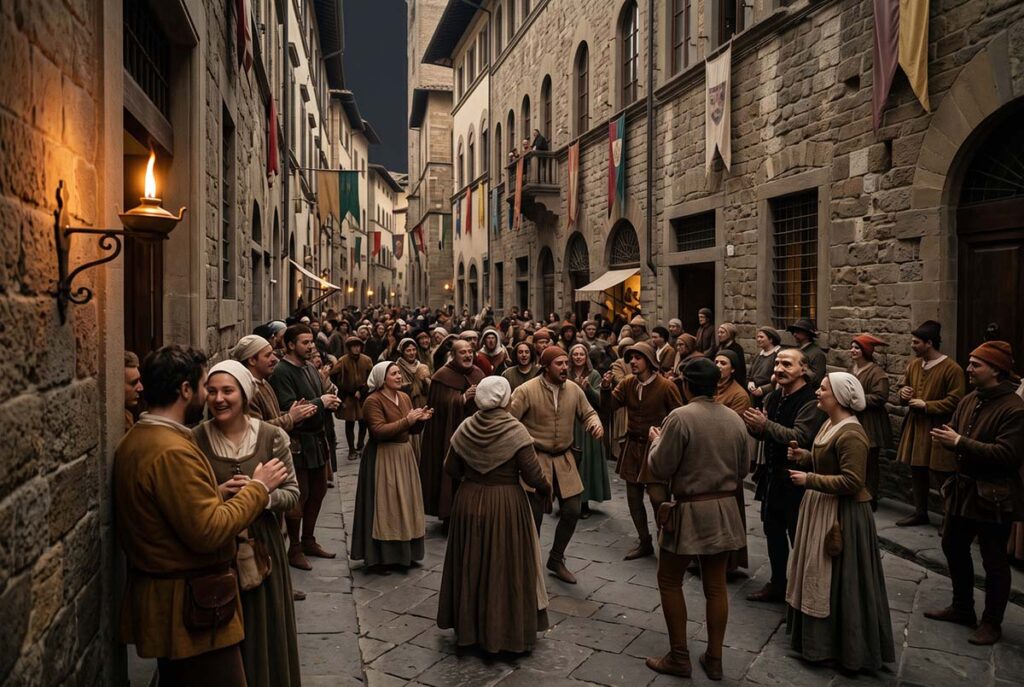
In fifteenth-century Florence, Carnival occupied the city physically. Songs moved through streets and public squares while masks loosened ordinary identities and seasonal excess temporarily rearranged the social order. The Medici tolerated and sponsored a civic culture in which spectacle and government were closely entangled. Carnival gave Florence a sanctioned place to make noise, gather in public, and inhabit forms of disorder that remained contained by the calendar.
The previous episode followed a similar bargain. Medieval institutions could permit transgression when they retained the power to decide where it happened, what it meant, and when it ended. Florence carried that logic into a civic world where festivity, politics, and public ritual shared the same streets. Savonarola’s movement would reveal what happened when a reformer stopped managing that arrangement and tried to seize it.
By February 1497, Florence sounded different. Girolamo Savonarola had acquired enormous religious and political influence, and young Florentines now moved through streets once associated with Carnival singing devotional laude. Processions, repentance, and disciplined participation occupied the public spaces where secular festivity had flourished.
Savonarola understood that removing a ritual left behind more than silence. It left streets, habits, memories, gatherings, and an audience accustomed to participating together. His movement attacked spectacles associated with the older civic order while constructing spectacles of its own. Florentine youth, devotional song, procession, and collective ritual kept the city’s acoustic life populated under new direction.
Silence is a vacuum. Vacuums get filled by whoever arrives second. Savonarola intended to arrive first, and to bring music.
The Contrafactum Weapon

Contrafactum gave Savonarola’s movement an unusually efficient way to occupy familiar musical territory. The technique retained an existing melody while replacing its text. People didn’t have to learn an entirely new musical language because the tune, rhythm, repetitions, and expectations were already stored in memory.
That existing knowledge mattered. A familiar melody arrives with infrastructure already built into the listener. People know where phrases turn, how repetitions work, when to breathe, and how to join the group. Replace the words and much of the labor required to make the new material participatory has already been done.
Savonarola did not need composers. He needed editors.
Devotional culture could therefore inhabit musical territory that secular Carnival had already prepared. A melody associated with one kind of collective life could carry another set of words into the same population. The tune could survive even as its social function changed.
The melody was the infrastructure. New words traveled through it.
That makes capture a more useful description than disappearance. The older cultural material wasn’t rendered useless simply because reformers rejected the world associated with it. Its familiarity made it valuable. Memory itself could be requisitioned.
The Bonfire and the Singing
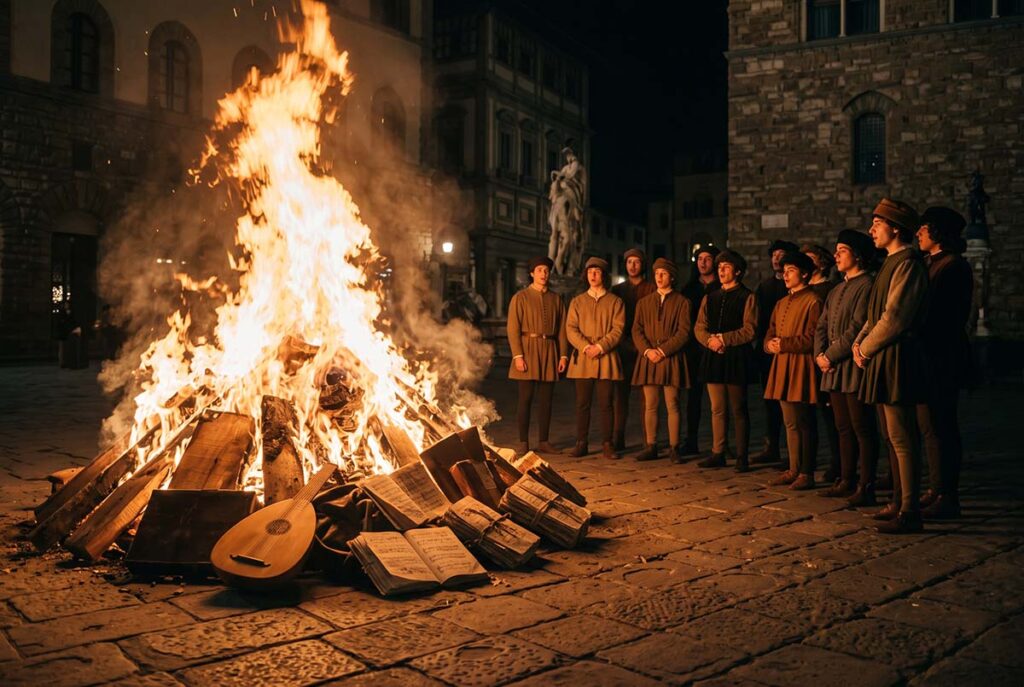
On 7 February 1497, the Bonfire of the Vanities gave Savonarola’s Florence the image history would remember. Objects associated with luxury and worldly temptation were collected and destroyed in the Piazza della Signoria. Musical instruments and secular-song materials appear among the documented categories associated with the campaign.
The fire easily dominates later retellings because destruction photographs well in the historical imagination. It reduces the episode to austerity confronting pleasure, with religious authority burning the objects of a corrupt culture. Yet the singing around the bonfire reveals a more consequential operation.
Savonarola’s movement was simultaneously filling Florence with organized devotional participation. The older culture faced destruction at the level of objects while its mechanisms of gathering, repetition, and collective voice were redirected toward reform. The city wasn’t being emptied of ritual. It was being supplied with another ritual.
One operation created a vacancy while the other occupied it. The movement didn’t destroy an undesirable repertoire and then trust silence to finish the work. It cultivated a replacement culture capable of occupying the same streets, the same season, the same communal attention, and many of the same musical memories.
The famous fire tells only half the story. The deeper political act can be heard in the singing beside it.
Luther’s Delivery System
Martin Luther confronted the transmission problem on a much larger scale. Reformation arguments about scripture, authority, salvation, clerical power, and Christian life had to travel beyond universities and learned theological circles if reform was going to become a mass movement. Printing transformed the possibilities of distribution, but written argument alone still encountered the limits of literacy.
Music gave doctrine another route.
Luther didn’t invent vernacular religious song or lay musical participation. Both had precedents. His historical importance lies in how extensively vernacular hymnody became organized, printed, and incorporated into the communicative life of the Reformation.
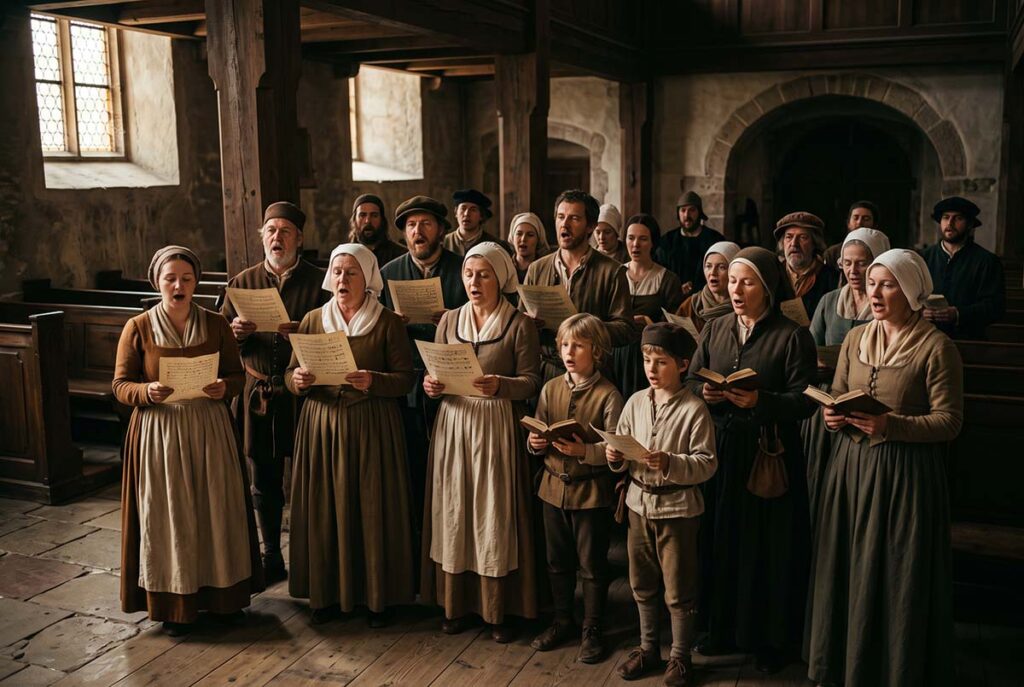
German-language sacred song made doctrine memorable and repeatable while turning religious communication into physical participation. A worshipper who sings performs a different act from a worshipper who only listens. Breath, voice, memory, repetition, and the surrounding congregation all become part of the transmission.
This changed where authority could operate. Religious ideas didn’t have to remain abstract propositions delivered by specialists. They could become words ordinary people carried in their own bodies and reproduced with one another.
Luther spread the Reformation through argument, preaching, print, and institutional organization. Song gave all of them a form people could repeat after the preacher had stopped speaking.
The Printed Song Goes Everywhere

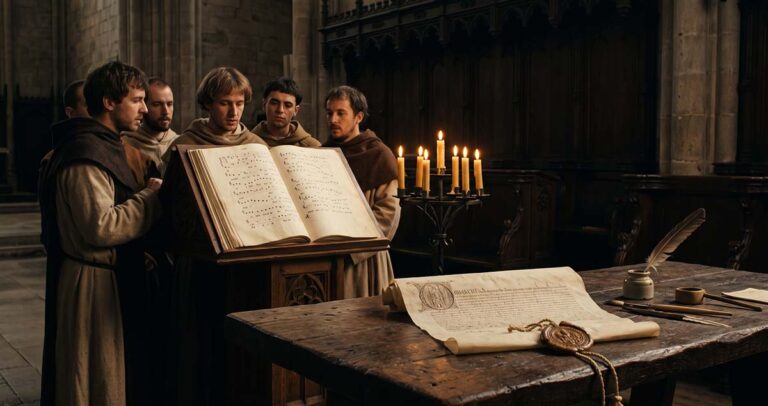
The year 1524 made that system tangible. The first major burst of Lutheran hymn publication included the Achtliederbuch and other important collections, linking vernacular sacred music to the expanding communications ecology of print.
A printed song could move differently from a sermon delivered in one place. Sheets and collections could enter households, workshops, gatherings, and communities far beyond the original point of instruction. The physical object traveled, and people could reproduce its contents after the authorized teacher was gone.
Printing therefore changed more than the speed of communication. It distributed the point of transmission. A congregation could learn material locally and carry it elsewhere. A family could repeat it at home. Communities separated by geography could participate in related confessional repertoires without hearing the same cleric or standing in the same church.
Familiar musical material reduced the barrier further. Contrafactum and related practices allowed new words to move through tunes a population could already reproduce. Old cultural knowledge carried new ideological weight.
The press made religious communication portable. Congregational singing made it reproducible.
Together they weakened forms of gatekeeping that depended on controlling the location of instruction.
Trent Draws the Acoustic Boundary
The musical politics of reform quickly exceeded Luther’s immediate world. Reformed communities developed vernacular psalmody and other forms of collective religious song, while English Protestant traditions created their own practices. Confessional identity increasingly became something ordinary worshippers could voice together rather than something they only received from above.
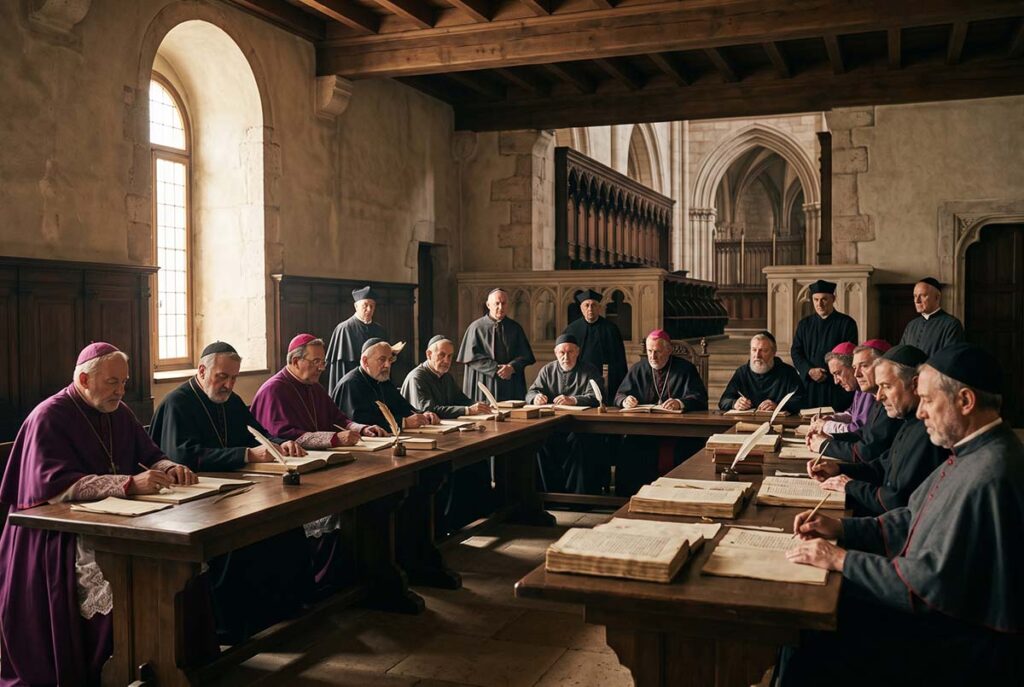
Catholic authorities at the Council of Trent therefore confronted sacred music within a transformed communicative environment. Music plainly belonged in worship. The difficult question concerned what sacred music should be allowed to do.
Popular retellings sometimes reduce Trent to an attempted prohibition of polyphony. The historical record is more complicated. Concerns included whether sacred words could be understood, whether secular musical associations belonged inside worship, how decorum should be maintained, and which musical practices were appropriate to sacred space.
Those questions were institutional as well as aesthetic. The Reformation had demonstrated that religious meaning could become singable, portable, and reproducible. Once people could carry confessional language in collective song, the message no longer depended entirely on the physical institution where it originated.
Catholic reform therefore had to define relationships among text, music, worshipper, and sacred space. Musical effectiveness could reinforce authority, but the same acoustic channel could also carry a rival confession.
The boundary around sacred music was also a boundary around transmission.
Verdict
Savonarola, Luther, English and Reformed Protestants, and the Catholic authorities gathered at Trent didn’t share a theology or a single conscious political theory. Their projects emerged from different conflicts and produced different institutional arrangements. Flattening those differences into one universal strategy would make the history tidier and less accurate.
Their practices nevertheless expose a common structural fact. Collective music can carry doctrine, organize participation, strengthen communal identity, and move ideas beyond the place where an institution first releases them. Once authorities recognize those capacities, music becomes more consequential than decoration.
Savonarola’s Florence demonstrates capture through substitution. Familiar melodies acquired devotional words while the movement reorganized public ritual around religious participation. Luther’s Reformation demonstrates scale. Vernacular song and print allowed religious ideas to become reproducible across distance. Trent reveals the defensive problem that follows when competing institutions understand that sound can preserve authority or erode it.
The historical shift is from controlling repertoire to controlling participation through repertoire. Burning an instrument can remove an object. Prohibiting a song can remove a performance. Neither settles the larger question of what people will sing, repeat, remember, and do together afterward.
That question leads directly into the next struggle. In England, institutions that had tolerated and sometimes sponsored popular festivity would increasingly turn against Morris dancing, Sunday recreation, alehouses, and other forms of communal pleasure. Once authorities had learned to worry about what a population sang together, they would also have to confront what happened when people simply gathered without institutional supervision.
Institutional authority rarely survives simply by silencing a defiant crowd. It endures by teaching the masses exactly what to sing together.
Frequently Asked Questions
What did Savonarola actually do with music in Renaissance Florence?
Savonarola’s movement organized Florentine youth into devotional processions, promoted laude, attacked objects associated with worldly entertainment, and redirected existing traditions of collective participation toward religious reform. Florence remained full of ritual and song, but the movement increasingly supplied the repertoire and disciplined public form through which participation occurred.
What is contrafactum, and why does it matter to Savonarola’s story?
Contrafactum is the practice of retaining an existing melody while replacing its text. Familiar musical material could therefore carry devotional words without requiring people to learn an entirely new musical language. Memory, repetition, and participation remained available even when the ideological content changed.
What happened at the Bonfire of the Vanities in 1497?
On 7 February 1497, objects associated with luxury and worldly temptation were gathered and destroyed in Florence’s Piazza della Signoria. Musical instruments and secular-song materials appear among the documented categories. The fire becomes more revealing when considered beside the devotional processions and organized singing already occupying Florence’s public spaces.
Did Martin Luther invent congregational singing?
No. Vernacular religious song and forms of lay musical participation existed before Luther. His importance lies in the scale, organization, printing, and institutional force with which German-language hymnody became part of the Reformation. Congregational song helped make doctrine memorable, repeatable, portable, and physically participatory.
Why was 1524 important for Reformation music?
The year 1524 saw a major burst of Lutheran hymn publication, including the Achtliederbuch and other influential collections. Printing allowed religious songs to travel beyond a single church or authorized teacher into homes, gatherings, and other communities. Song became part of the Reformation’s expanding communications ecology.
Did the Council of Trent ban polyphony?
No. The popular story that the Council of Trent simply prohibited polyphonic sacred music is misleading. Its concerns were more complex and included textual intelligibility, sacred decorum, secular musical associations, and elements considered inappropriate to worship. Catholic authorities were defining what music could legitimately do inside sacred space.
What does this episode establish about music and institutional power?
Suppression is only one form of cultural authority. Institutions can redirect participation by supplying replacement songs, distributing them through new technologies, and regulating where collective singing occurs. Savonarola, Protestant reformers, and Catholic reformers pursued different objectives, but each confronted music as a mechanism of participation and transmission.
Why did Puritans later turn against Morris dancing and popular festivity?
The next episode follows the problem from musical transmission into social assembly. In England, institutions that had tolerated or sponsored popular festivity increasingly confronted Morris dancing, Sunday recreation, alehouses, and seasonal celebrations as their religious and political meanings changed. The emerging question concerns what kinds of communities form when people gather for pleasure.